
Squash referees keep matches fair and moving at every level, and the route to the badge is more structured than most players expect. Here is how certification works in the United States, the United Kingdom, and Australia, plus the international pathway run through the World Squash Federation (WSF).
For each region, it covers the certification levels, prerequisites, training, examinations, practical experience, and recertification rules. Officiating structures are being standardised worldwide, so some regional schemes are gradually aligning with the global World Squash Officiating system described at the end.
US Squash (United States): Referee Certification Pathway
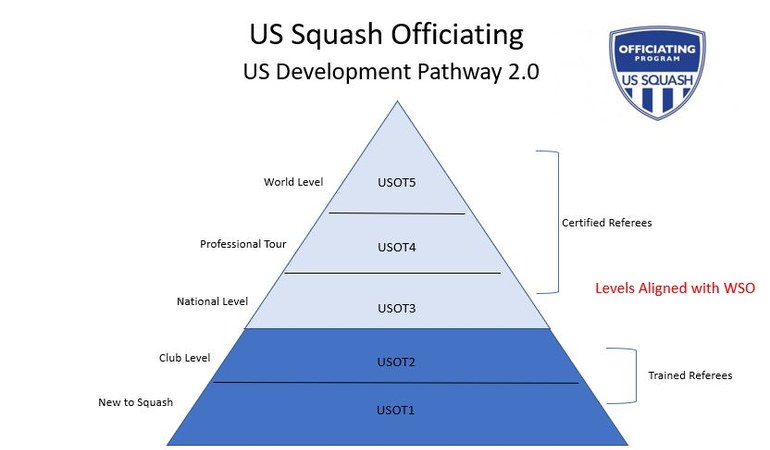
Levels of certification. US Squash runs a five-tier pathway, from USOT1 (entry level) up to USOT5 (the highest, elite level). Beginners start at USOT1 and can progress upward through the tiers:
- USOT1: basic club referee.
- USOT2: club and advanced amateur level.
- USOT3: regional and national level.
- USOT4: elite national and professional events.
- USOT5: the top tier for officiating professional and international events.
USOT5 referees are invited to officiate at the most prestigious tournaments, including WSF and PSA championships around the world.
Prerequisites and eligibility. To begin at USOT1, candidates take age-appropriate rules exams that combine test questions and video clips. Junior players complete these exams as they progress through age groups, with the U13 group taking the Level 1 exam and the U19 group taking the Level 4 exam.
At USOT2 and above, additional requirements apply. Officials must be US Squash members in good standing, hold a current SafeSport certification (athlete safety training), and pass the Level 4 referee exam.
Training and courses. US Squash provides online training resources and clinics. New officials are encouraged to review beginner officiating material to learn basic rules and duties. Advancing referees must complete Continuing Professional Development (CPD) clinics:
- At least one clinic for USOT2.
- Two clinics each for USOT4 and USOT5.
US Squash also runs an Online Match Assessment Program in which referees review and analyse match video clips, required from USOT3 upward. In May 2026, US Squash announced a partnership with World Squash Officiating to adopt its methodology and framework for referee development in North America, which over time will align US training, certification, and appraisals with the global system.
Examination and assessment procedures. Progression requires passing the written rules exam and, at higher levels, on-court assessments. The standard written test from USOT2 onward is the Level 4 referee exam, which officials must pass and keep current.
Beyond the written test, certified assessors observe candidates officiating real matches:
- USOT3: two passing assessments per season from different assessors, covering at least 25 decisions.
- USOT4 and USOT5: four assessments per season each, covering at least 40 decisions.
These evaluations judge accuracy, consistency, demeanour, and the ability to apply the rules under pressure.
Practical experience requirements. Match experience is central to the U.S. pathway, with the volume and calibre of matches rising at each tier:
| Level | Minimum matches per season | Required events |
|---|---|---|
| USOT3 | 15 | At least one U.S. National Championship |
| USOT4 | 30 | At least one National Championship, plus at least 10 matches involving players ranked outside the world top 100 |
| USOT5 | 30 | At least one National Championship, plus at least 15 matches involving players ranked inside the world top 75 |
Referees gain experience across junior events, local leagues, professional PSA tour events, and national finals as they move up. Higher-level officials are also expected to mentor others: USOT4 referees assess 5 officials and USOT5 referees assess 10, and both submit broadcast self-evaluations (at least 3 for USOT4, at least 5 for USOT5).
Continuing education and recertification. US Squash requires referees to stay current. At USOT2, officials recertify after 2 years by re-taking and passing the current exam.
From USOT3 upward, there is an annual review. The season runs from June 1 to May 31, and all requirements (activity logs, assessments, CPD, and self-evaluations) must be fulfilled within that window. Officials who do not submit the required evidence by the end of the season lose their certification for the following year. SafeSport training must be kept current for any referee working with juniors.
England Squash (United Kingdom): Referee Qualification Pathway
Levels of certification. England Squash uses the WSF's World Squash Officiating (WSO) program for its referee education, which is built around a five-level pathway (Levels 1 to 5) above a free introductory rules course. In broad terms:
- Level 1: club or entry-level referee.
- Level 2: tournament-grade referee handling county and regional events.
- Level 3: national-grade referee for top domestic events.
- Levels 4 and 5: the continental and world grades for major international competition.
Prerequisites and eligibility. To be invited to apply to referee at England Squash events, a referee needs to:
- Be a member of England Squash (renewed annually).
- Hold an England Squash enhanced DBS check.
- Complete the online Safeguarding in Squash course.
The DBS check is free for volunteers aside from an administration fee of around 16 pounds. The enhanced DBS check and the Safeguarding course both must be renewed every 3 years. People under 16 can complete the WSO Player Certificate (Introductory Level) and be appointed as a junior referee; they can progress through the full referee pathway from age 16, and still require the DBS check and Safeguarding certificate.
Training and courses. New referees begin with the WSO Level 1 (Club) online course, which builds a foundation in the rules and the role of a referee. The WSO courses are modular online programs with reading, video, and scenario exercises, and each level concludes with an online theory exam that candidates must pass to earn that level.
The WSO Level 1 annual membership fee is about 12 pounds, and England Squash members with a paid membership receive a 20% discount on all WSO courses. England Squash also runs in-person workshops and rules sessions to give newer referees practical advice on running a match, calling the score, and applying lets and strokes correctly.
Examination and assessment procedures. To achieve each level, a referee passes the corresponding WSO theory exam, which includes rules questions and video decision scenarios, and then demonstrates practical ability. From Level 2 upward, passing the theory exam is not enough on its own; the referee must also complete practical requirements.
England Squash has a network of senior referees and assessors who mentor and appraise developing officials. An appointed assessor observes the official refereeing matches and judges rule application, consistency, positioning, communication, and the handling of difficult calls. Formal appraisals happen at England Squash events such as Silver and Gold tournaments and the National Championships, where the appointed Tournament Referee assigns matches and coordinates debriefs.
Practical experience requirements. Building experience by refereeing matches is essential before moving up. After passing the Level 1 exam, a new referee officiates at club leagues and county events to build confidence, then progresses to junior opens, county championships, and lower-tier national events.
To reach the national grade, a referee needs substantial experience refereeing full matches in top domestic divisions and at national championships. Progression to the continental and world grades involves officiating at international events and professional tour matches under supervision, reached by only a small number of referees.
England Squash does not publish a fixed number of matches for each level. Instead it relies on the appraisal system, so referees must show they have handled enough matches at their current level to be ready for the next.
Continuing education and recertification. Once certified, referees keep their qualifications active through ongoing compliance and learning. The DBS check and Safeguarding course are renewed every 3 years. England Squash works in partnership with WSO, which requires referees to renew their WSO membership annually so they have access to current rule updates, exams, and resources.
Referees are expected to keep officiating regularly; an inactive referee may not be selected for events. They attend refresher sessions and rules updates, particularly when the WSF issues new interpretations, and developing officials are typically assigned a mentor to discuss calls and share knowledge at events.
Squash Australia: Officiating Accreditation Pathway
Levels of certification. Squash Australia recognises five levels of referee accreditation, plus a separate Junior Referee program for those under 16. Responsibility for each level is split across local, national, and global bodies:
- Levels 1 and 2: handled by local associations.
- Level 3: handled by Squash Australia.
- Levels 4 and 5: handled by World Squash Officiating.
A Level 1 referee officiates at local and state competitions, such as state junior championships, local pennant (league) matches, and lower-tier events on the junior tour. A Level 2 referee is more experienced and handles higher-level state events and many national tournaments.
A Level 3 referee is the highest nationally accredited official, eligible to referee at the Australian National Championships and Australian Open, in Oceania regional championships, and at professional (PSA) and WSF-sanctioned events. Levels 4 (Continental) and 5 (World) are pursued through the WSO system by those who excel at Level 3 and are selected for international duties.
Prerequisites and eligibility. To become an accredited referee, candidates must complete integrity and safeguarding education and hold a valid Working with Children Check (WWCC). The WWCC is a background screening required for anyone in regular contact with minors, and is compulsory since referees often officiate junior matches.
The Junior Referee program for those under 16 requires:
- The Sport Integrity Australia Safeguarding Children and Young People in Sport course.
- The WSO Level 0 Rules course.
- Acknowledgement of the Junior Referee Code of Behaviour.
Referees are also expected to be affiliated with their state body or Squash Australia, and to register through the official accreditation program.
Training and courses. Squash Australia's curriculum is aligned with the World Squash Officiating online courses for theory instruction. An entry-level referee usually starts with the WSO Level 0 and Level 1 material covering the rules and basic officiating principles.
State associations may add a face-to-face component, such as a Level 1 seminar where experienced referees go over rules, demonstrate calling a match, and discuss common scenarios, followed by an exam. As referees move to Level 2 and Level 3, training goes deeper into rule application, match control, elite player movement, and handling high-pressure matches, often through the corresponding WSO course plus mentorship at tournaments.
Referees are expected to keep up with rule changes published by the WSF, and Squash Australia compiles WSF directives and case-study videos on its officiating resource pages.
Examination and assessment procedures. Each level requires passing an examination and, at the higher levels, practical assessments:
- Level 1: candidates take a rules theory test, which may be the WSO Level 1 exam, and may then be observed during a few matches to confirm basic competency.
- Level 2: passing the WSO Level 2 exam plus a practical appraisal, where experienced assessors watch candidates officiate at a state or national tournament and use a standardised assessment form to judge whether calls (lets, no-lets, strokes, conduct warnings) are correct and whether the referee manages the match firmly and fairly.
- Level 3: the most rigorous tier. Candidates pass the WSO Level 3 (National) exam and are then assessed across several high-level matches, often at events such as the Australian Open or Junior Nationals, by senior Australian or regional assessors.
The Level 3 criteria include composure under pressure, accurate rule application in fast pro matches, and clear communication of decisions. The Squash Australia Officiating Committee endorses successful candidates and coordinates recognition with the WSF where relevant.
Practical experience requirements. Referees gain experience at progressively higher levels of competition as they advance:
- Level 1: club night matches, junior tournaments, and state junior championships, often starting by refereeing junior matches or club tournaments.
- Level 2: more advanced state and national events, such as State Open or State Masters championships and early rounds of national junior events, with comfort handling stronger adult matches and more challenging interference calls.
- Level 3: significant experience at top national tournaments and minor international events, often including the Australian Open, the National Championships, and regional events such as the Oceania Squash Championships.
The requirement is less about a fixed number of matches and more about demonstrating the ability to handle the pressure and complexity of high-level play before promotion.
Continuing education and recertification. Referee accreditations in Australia are time-limited credentials. Squash Australia accreditations are generally valid for two years, with some variation across the framework (for example, club-level accreditation can run longer while national-level status is reviewed annually).
To maintain status, referees stay active and complete refresher requirements, which can include rules-update clinics, an online rules refresher test, or a log of matches officiated. The integrity requirements, including the Working with Children Check, must be kept current, and these checks expire on a cycle that varies by state.
Referees are encouraged to follow the latest WSF rule interpretations and to take part in WSO webinars and updates, so that any major rule changes are quickly absorbed. The recertification process is managed by the Squash Australia Officiating Committee or the relevant state referee coordinators, who remind officials when an update is due and outline what is needed.
World Squash Federation (WSF): International Referee Certification

Levels of certification. The WSF runs its global referee certification through the World Squash Officiating (WSO) program, established jointly with the Professional Squash Association (PSA) to standardise officiating worldwide. The structure has five levels above a free introductory course:
- Level 0 (Rules): a free introduction to the rules for beginners.
- Level 1 (Club): the entry-level certification for club and local referees.
- Level 2 (Tournament): the equivalent of a county or provincial referee handling larger area tournaments.
- Level 3 (National): qualifies a referee for national championships and certain international events, equivalent in practical terms to what was previously a regional referee.
- Levels 4 (Continental) and 5 (World): the two highest grades, for referees officiating at major regional events and at world championships and the highest-profile matches.
Levels 4 and 5 correspond to the old WSF International Referee and World Referee designations, now split into two tiers.
Prerequisites and eligibility. The pathway is open to all, but progression is sequential, so each level must be completed before the next becomes available. To start, a referee registers on the WSO online portal and enrols in the free Level 0 course. There are no strict prerequisites for Level 0 or Level 1 beyond an interest in refereeing and a working understanding of the language the materials are presented in.
Higher levels add criteria:
- Level 2: requires Level 1 plus some local officiating experience.
- Level 3: requires Level 2 plus certification from the referee's National Governing Body or Region confirming they are operating at the appropriate standard.
- Levels 4 and 5: more selective, typically reached through nomination based on demonstrated excellence at Level 3.
From Level 1 upward there is an annual subscription fee (Level 0 is free). When a referee progresses to the next level they pay that level's fee and receive a pro-rata refund of the previous level if they upgrade mid-year.
Training and courses. WSO provides online courses for each level:
- Level 0: a short, free module introducing the basic rules, suitable for players and newcomers.
- Level 1 (Club): covers the rules in depth and the role of a referee, largely theory-focused to build confidence in making calls.
- Level 2 (Tournament): goes deeper into applying the rules, presenting and controlling a match, and working with a marker, with modular coursework, periodic testing, and appraisals.
- Level 3 (National): addresses elite player movement, match management, and applying the rules under pressure; completing it qualifies a referee to officiate at National, PSA, and WSF events.
- Levels 4 and 5 (Continental and World): delivered as a single advanced course, currently offered free, focused on the highest level of officiating, including coping with pressure on showcourts, refining judgement in complex situations, and the consistency expected at elite finals.
All WSO courses are delivered through an interactive e-learning platform with reading, video, and quizzes, alongside a library of rulebooks, guidelines, and webinars. Because WSO is a joint WSF and PSA initiative, the training covers both amateur and professional scenarios.
Examination and assessment procedures. Each WSO level requires a theory exam, and the higher levels add practical assessment. For Level 0 and Level 1, the candidate completes the online lessons and takes an online exam that mixes rules questions with video clips where they choose the correct decision (no let, let, or stroke); a passing score earns the certificate.
From Level 2 upward, passing the theory exam alone is not enough: the referee's status remains Pending until they upload the required practical evidence, such as referee logs and appraisals. The practical side is generally coordinated by the national federation, which arranges for the referee to officiate matches and for a local assessor to verify competence.
For Level 3, the referee passes the advanced theory exam and is then assessed across actual national-standard matches, with logs and appraisal forms submitted to WSO and certification confirmed by the National Governing Body or Region. Levels 4 and 5 are handled by WSF and WSO leadership and are highly selective, drawing on appraisals, portfolios, and video evidence of decision-making.
When existing WSF and International Referees were transitioned into the new WSO levels, their performance was reviewed against the new standards, and every referee, at any level, completes the theory tests for Levels 0 through 5 so that knowledge is uniform.
Practical experience requirements. The WSO pathway requires accumulating officiating experience to advance. Level 0 and Level 1 need no prior experience, as they are aimed at newcomers. Beyond that, referees must actively officiate matches and document their experience:
- Level 2: should reflect county or provincial level practice.
- Level 3: requires substantial experience at national competitions.
- Levels 4 and 5: require years of high-level experience, often including international events and finals of major professional tournaments.
Some national federations set their own benchmarks (for example, a minimum number of matches at national championships before a Level 3 appraisal). Referees upload match logs and assessor reports to the WSO platform, and a level is only granted once both the theory and the documented practical criteria are met, so a WSO qualification reflects real on-court experience.
Continuing education and recertification. WSO treats referee education as continuous. It charges an annual membership renewal fee from Level 1 upward, which keeps referees engaged with the platform and its updated resources; if a referee does not renew, their access and active listing can lapse.
WSO does not currently require fixed-interval re-examination for all referees, but it enforces ongoing activity in practice: a referee who stops officiating or fails to upload new assessments can see their higher-level status become inactive or revert to Pending. When a significant rule change occurs, WSO can release new modules or short courses so referees can update their knowledge, and it provides refresher material and a resources library.
National federations adopting WSO often add their own recertification cycles, such as a seminar or short rules test every couple of years. Referees at Levels 4 and 5 are also subject to periodic review to confirm they are still performing at the required standard. The underlying principle is that consistent practice and ongoing learning produce the best referees.