
Most squash you watch is one player against another on the PSA tour. This is about the other format: professional team leagues, the ones running now or just getting off the ground, rather than the PSA tour, national championships, or club ladders.
The PSA World Tour remains the main global individual professional circuit, but it is not a league in the team-sport sense.
Squash does not have one central global league directory, so this list draws on official league and federation sources along with squash media. Some countries have strong elite club systems but limited public English-language information, and those cases are described carefully rather than overstated.
Quick Comparison
| League | Country | Status | Format |
|---|---|---|---|
| Optasia Squash Super League | England | Active | Club and franchise-style team league hosted by England Squash |
| National Squash League | United States | Active | Franchise-style professional league |
| Deutsche Squash Liga / Bundesliga | Germany | Active | National inter-club professional league |
| Squash Eredivisie | Netherlands | Active | National premier club league |
| Championnat de France Interclubs (Nationale 1) | France | Active | National inter-club top division |
| Swiss Interclub Nationalliga A | Switzerland | Active | National inter-club top division |
| Egyptian club league | Egypt | Active or periodically active depending on season | Elite professional club league |
| World Premier Squash | International | Announced for an August 2026 launch | International franchise and team league |
The Main Professional Squash Leagues
1. Optasia Squash Super League (England)
Status: Active. Model: club and franchise-style team league hosted by England Squash.
The Optasia Squash Super League is England's current flagship professional team competition. It replaced the older Premier Squash League with a compact, broadcast-friendly format and a small group of elite teams.
Hosted by England Squash, it brings together six teams: Bexley Ballers, Bristol Buccaneers, Chichester Centurions, Coolhurst Cavaliers, Leamington Royals and St George's Hill Knights. The competition is designed as a short, high-impact league rather than a traditional long club season.
England has one of the deepest squash ecosystems in the world, with strong clubs, established junior pathways, PSA-ranked professionals and a long history of televised team squash. The Super League uses that infrastructure but presents it in a more compact way for fans, venues and online audiences.
The league features leading professionals, young players and local club figures. Match nights are built around team identity rather than individual tournament draws, which makes it closer to a franchise-style sport than to a standard PSA event. This gives clubs a visible product to promote and gives fans a simpler reason to follow a team through a season.
Typical format and features
- Six teams
- A short regular season followed by a Grand Final
- A fast-paced match format
- Coverage through official league channels and squash broadcast partners
It is currently the most visible professional team league in Britain and one of the main examples of how squash is trying to package itself for spectators.
2. National Squash League (United States)

Status: Active. Model: franchise-style professional league.
The National Squash League is the main professional team league in the United States, run in partnership with US Squash. Unlike older European inter-club systems, it uses a recognisable American sports model: named teams, local markets, regular fixtures, team branding and ticketed match nights, all built around three-on-three team matches.
The league's goal is to build a premier professional squash league in North America. This matters because squash in the United States has often grown through private clubs, colleges and urban junior programmes rather than as a mass spectator sport. A city-based league gives professional players another platform and gives clubs a clearer event product to sell to members and local fans.
The women's expansion is notable. The SoNo Sharks, based at MSquash in Norwalk, were launched as the league's first women's expansion team, and the women's division has since grown to include teams in markets such as Washington, Philadelphia and the Cleveland area. This makes the NSL one of the more ambitious attempts to create a balanced professional team structure for squash in North America.
Typical format and features
- City and team identity
- Men's and women's competitions
- Draft and roster-style team building in some markets
- Home fixtures designed as spectator events
It is the strongest current attempt to turn professional squash into a franchise-led spectator product in the United States.
3. Deutsche Squash Liga / Bundesliga (Germany)

Status: Active. Model: national inter-club professional league.
The Deutsche Squash Liga, organised through its Bundesliga structure, is Germany's highest-level club team competition. It is built around clubs rather than city franchises, with teams competing through the season before a final stage known as the Endrunde decides the national team champion.
Germany's league shows the traditional European model of professional squash: clubs develop local players, then strengthen their top squads with experienced national and international professionals. This creates meaningful match nights for club members while giving PSA players paid competitive opportunities outside the individual tour calendar.
The Bundesliga Endrunde runs as a multi-team final event. The 2026 Endrunde is scheduled in Saarbrücken, at the Güdingen facility, and brings together the leading teams from the regular-season North and South divisions plus the host club. This gives the league a clear championship climax and makes it easier to follow than a fully decentralised club league.
Typical format and features
- A Bundesliga club system
- A regional, divisional regular-season structure across North and South
- An Endrunde final stage
- A men's team championship, with a women's team championship held in the same competition environment
Germany's league is one of the strongest examples of the European club-based professional model.
4. Squash Eredivisie (Netherlands)

Status: Active. Model: national premier club league.
The Squash Eredivisie is the Netherlands' premier squash league, run by the Dutch squash federation. It functions as a national top division, sometimes described as the Dutch Premier Squash League, and sits above the broader Dutch club structure to give elite clubs a professional stage.
Player lists and match previews show that the Eredivisie attracts players from outside the Netherlands, including PSA-ranked professionals. This is a key sign of professional status in squash leagues, where clubs recruit international players to strengthen squads for specific fixtures or seasons.
The Eredivisie also matters because the Netherlands has a compact but active squash market. A national league can improve domestic player standards, give fans and clubs regular elite fixtures, and provide PSA players with competitive match practice between individual tournaments.
Typical format and features
- Men's and women's elite club competition
- Dutch club teams
- International player registration
- League rounds with playoffs or title-deciding stages depending on the season structure
It is one of mainland Europe's most relevant professional club leagues and a useful bridge between local squash and PSA-level competition.
5. Championnat de France Interclubs, Nationale 1 (France)
Status: Active. Model: national inter-club top division.
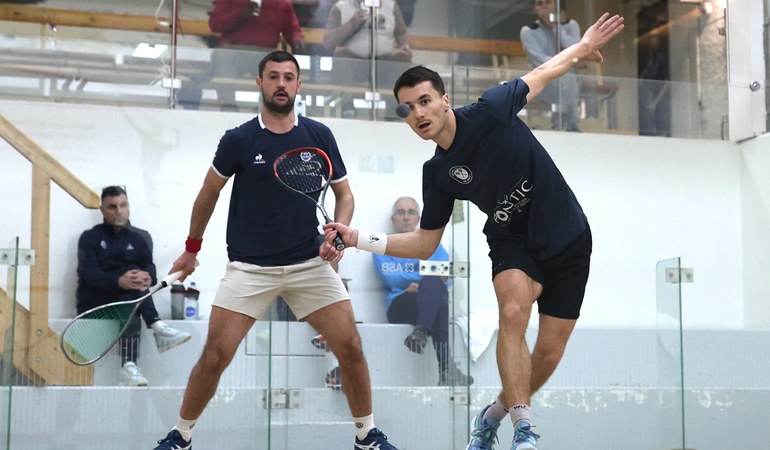
France has one of Europe's strongest squash systems, with a history of producing world-class professionals such as Thierry Lincou, Camille Serme, Gregory Gaultier and Victor Crouin. The Championnat de France Interclubs provides the elite team competition that connects clubs to that professional pathway, with Nationale 1 (N1) as the top tier above Nationale 2 and Nationale 3.
The competition runs in two phases: qualifying rounds in pools, followed by play-offs. In Nationale 1 the play-offs bring together the leading teams, and the winner is crowned French champion. SquashInfo's event records list French League Play-Offs under the Championnat de France Interclubs name, which shows how the competition is treated as a recognised elite team event.
Like other continental European leagues, the French model is club-based. Teams may include established professionals, emerging French players and strong international signings, which makes it a useful environment for high-level competitive matches outside the individual PSA World Tour.
Typical format and features
- Elite inter-club divisions, with Nationale 1 at the top
- Men's and women's team competition
- A regular season with title-deciding play-offs
- A federation-linked competition structure
France combines strong domestic elite players with a formal club competition structure, making its interclubs one of the more important European professional leagues.
6. Swiss Interclub Nationalliga A (Switzerland)

Status: Active. Model: national inter-club top division.
Swiss squash is smaller than the major markets in England, Egypt, France or Germany, but the country has a structured interclub system with Nationalliga A at the top. Swiss Squash organises and publishes the interclub competition, with promotion and relegation between Nationalliga A and Nationalliga B.
The NLA model follows the typical European club approach, with regular team fixtures, national rankings, player eligibility rules and a hierarchy of divisions. It is not a mass commercial league, but it is professional-adjacent because top teams can involve elite domestic and foreign players. League rules require a minimum number of Swiss-qualified players in each match.
For players, the value of the Swiss league is competitive opportunity and club support. For clubs, the league gives a visible benchmark for sporting strength. For the broader squash ecosystem, it helps maintain elite match play in a country with a comparatively small player base.
Typical format and features
- The top Swiss interclub division
- Men's and women's club teams across the broader interclub system
- Team orders based on ranking and eligibility rules
- Regular fixtures during the winter season
It is a smaller but credible professional-level European league, especially relevant for club squash and elite domestic development.
7. Egyptian club league (Egypt)

Status: Active or periodically active depending on season. Model: elite professional club league.
Egypt is the strongest nation in modern professional squash. Its elite clubs and academies have helped produce repeated world number ones, world champions and dominant junior champions. A club league in Egypt therefore has a different character from most other countries, because the domestic player base alone can produce world-class match nights.
Public information on the Egyptian league is less centralised than for England's Super League or Germany's Bundesliga, but Egyptian club squash has a clear professional environment. Reports on the Egyptian League describe a Pro division of around six teams, with Wadi Degla a repeat title winner.
Wadi Degla, one of the most important clubs in the country, describes its squash academy as the world's biggest, with a large athlete base, 74 courts and 106 coaches. That infrastructure helps explain why Egyptian club competition can operate at a professional standard.
The league has involved major clubs in past reports, with Wadi Degla among the leading names. The most useful way to understand it is as an elite club league in the world's deepest squash market, rather than a franchise product aimed at international broadcast audiences.
Typical format and features
- Elite club teams
- A strong concentration of PSA-ranked Egyptian players
- Clubs and academies as the main organisational base
- Seasonal activity that can be harder to track publicly than European leagues
Egypt's club system is central to global squash performance, even when the league itself receives less international media coverage.
8. World Premier Squash (International)

Status: Announced, with a planned launch in August 2026. Model: international franchise and team league.
World Premier Squash is not yet an established season-by-season league, but it is worth including as an emerging professional property. World Squash announced it as a new team-based league created by League Sports Co and endorsed by both World Squash and the Professional Squash Association.
The planned launch is significant because it aims to create a global rather than purely national team product, which is rare in squash. Most professional leagues are either national club competitions or local franchise leagues. World Premier Squash is positioned as a more international product with teams, player rosters, technology-driven engagement and new presentation ideas.
In March 2026, World Squash reported that Saurav Ghosal had been appointed Sports Commissioner of World Premier Squash, a sign that the league is moving from announcement into organisational build-out. It should still be treated as planned rather than proven until it completes its first season.
Typical format and features
- International team-based competition
- An expected launch in August 2026
- Endorsement by World Squash and the PSA
- A design focused on fan engagement and new scoring formats
If launched successfully, it could become the first genuinely global professional team league in squash.
Historical and Predecessor League
Premier Squash League (England)

Status: Historical predecessor competition.
The Premier Squash League was the best-known British professional team league before the current Optasia Squash Super League. It traces back to 1983, under earlier names, and was rebranded as the PSL in 2005.
Its later seasons in 2019/20 and 2020/21 were cancelled because of the COVID-19 pandemic, with a PSL Cup held afterwards. It remains important historically because many leading players competed in it, and because it helped show that club-based professional team squash could attract audiences in Britain.
What This List Excludes
- PSA World Tour and PSA Challenger Tour: these are professional individual tournament circuits, not team leagues. They are the main professional ranking pathway, but they do not operate as team leagues.
- World Team Championships and European Team Championships: these are national-team competitions, not professional leagues with regular club or franchise seasons.
- Regional amateur premier divisions: many countries have premier or first-division club competitions. They were excluded unless there was clear evidence of professional-level recruitment, PSA-level player participation or formal elite league positioning.
- One-off PSA events: open tournaments, national opens and invitational events can be professional, but they are tournaments, not leagues.
Key Observations
- Professional squash leagues are mostly team-based rather than ranking-based. The individual PSA tour provides rankings and prize money, while leagues create club or franchise identity.
- Europe still relies heavily on the club model. Germany, France, the Netherlands and Switzerland use inter-club systems that can include PSA-level players.
- The United States is pushing a more American franchise model through the National Squash League.
- England has modernised its professional team product through the Optasia Squash Super League, which is more compact and broadcast-friendly than older club league formats.
- Egypt has the strongest playing base, but its club-league information is less centralised internationally than the European and US examples.
- World Premier Squash is the major emerging project to watch, because it is framed as an international team league endorsed by World Squash and the PSA.
Summary
Professional squash leagues remain fragmented compared with football, basketball or cricket. The sport's main professional structure is still the PSA World Tour, while team leagues exist as national, club-based or franchise-style products. That fragmentation makes the landscape harder to research, but it also shows where squash is experimenting with new formats.
At the established end, Germany, France, the Netherlands and Switzerland show the European inter-club model. England and the United States show a more media-led direction through the Optasia Squash Super League and the National Squash League.
Egypt remains a special case because its clubs operate inside the world's deepest elite talent environment. World Premier Squash could become the most important new entrant if it launches successfully and creates a sustainable international team calendar.