
Squash keeps better records than its modest profile suggests, across both the men's and women's tours. What follows pulls together the numbers that actually tell a story: the longest winning streaks, the biggest earnings, the longest matches, and the longest reigns at number one, from recent seasons and from the history books, men's and women's alike.
Win-Loss Records and Dominance
Top squash players carry formidable win-loss records, with some going nearly unbeaten over long stretches of their careers. In the modern era, dominant players regularly post season win rates above 85-90%.
Ali Farag (EGY) won over 90% of his matches in the 2023-24 season, lifting 8 titles and losing only 6 times in 65 matches. On the women's side, Nouran Gohar (EGY) ended the same season on a 25-match winning streak, capturing five consecutive titles. That consistency at the elite level reflects the high standard of play on tour.
Historically, squash has seen even longer streaks of dominance. Jahangir Khan (PAK) went unbeaten from 1981 to 1986, winning 555 consecutive matches, the longest winning streak in any professional sport. In women's squash, Heather McKay (AUS) set an almost untouchable benchmark: she remained unbeaten for 19 years (1962-1981), losing only two matches in her entire career.
These runs show the gap these players created between themselves and their peers. Even outside such streaks, all-time greats built strong career win-loss tallies. When he retired in 2025, Ali Farag had won 445 of his 553 PSA matches (about 80.5%), and many other top players past and present similarly keep win rates well above 70%.
Whether in one dominant season or over an entire career, the best in squash turn the majority of their matches into wins.
Longest and Shortest Matches on Record
Matches in professional squash vary widely in length, from marathon contests to quick finishes. The longest matches push the limits of endurance and have set records that stand for decades.
The longest recorded men's match lasted 2 hours 50 minutes: a 2015 PSA tournament semifinal where Hong Kong's Leo Au defeated Canada's Shawn Delierre 11-6, 4-11, 11-6, 7-11, 16-14, a five-game match totaling 170 minutes. The fifth game alone in that match ran 78 minutes. The previous long-standing record was a 166-minute match in 1983, when Jahangir Khan outlasted Gamal Awad in the Chichester final.
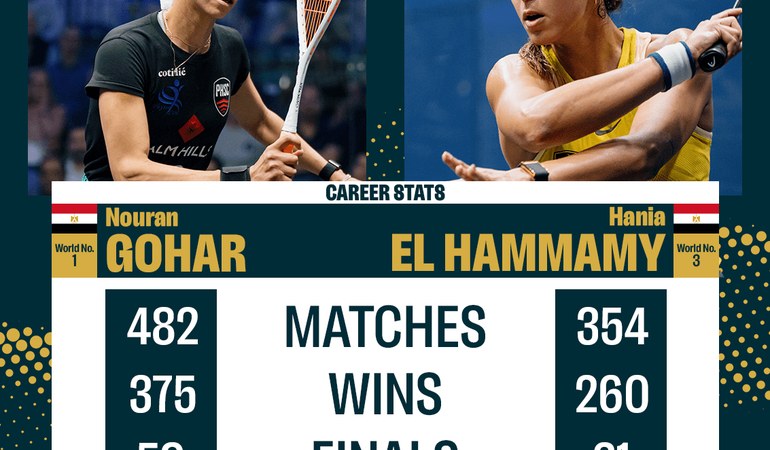
On the women's tour, the longest match on record is 130 minutes, the 2023 PSA World Tour Finals championship in which Nouran Gohar edged Hania El Hammamy in five games. That figure surpassed a 127-minute women's match from 1981 (Rhonda Thorne d. Vicki Cardwell). These contests show the fitness and mental endurance squash can demand at the highest level.
By contrast, some squash finals have been very short. The shortest championship match on record was over quickly: in a British Open match, England's Phil Kenyon defeated Egypt's Salah Nadi in only 6 minutes 37 seconds (9-0, 9-0, 9-0).
Such brevity usually comes from a player retirement or complete domination. Routine matches rarely sit at either extreme, but these outliers show the range of match duration, from a few minutes to several hours.
Prize Money and Career Earnings
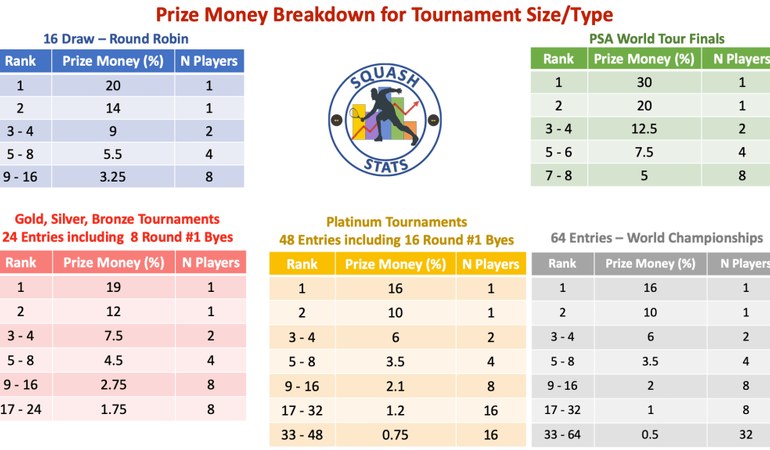
Professional squash prize money has reached all-time highs in recent seasons, reflecting the sport's growth and increased parity for women. In the 2024-25 season, the Professional Squash Association (PSA) offered a record total of 12.53 million US dollars across all events.
Prize funds are now split equally between men's and women's draws at major tournaments, and both tours have seen significant increases in compensation. The top players today earn several hundred thousand dollars per year in prize money alone.
In 2024-25, Mostafa Asal (EGY) was the highest-earning male player with 400,686 US dollars in prize money, and Nouran Gohar (EGY) led the women with 400,045 US dollars, both first-time peaks for these young stars. It was the first time a woman's annual earnings virtually matched the men's top earner, as Gohar's total was less than 1,000 US dollars short of Asal's.
These sums are a large jump from a decade earlier, when the men's top annual earnings sat around 165,000 US dollars and career totals above 1 million US dollars were rare. Now, average annual earnings of the top 10 men and women are about 184,000 US dollars, and a growing number of players have career earnings well over 1 million US dollars.
The increase in prize money has come alongside more tournaments and broader global reach, including season-ending finals, which makes the current generation the best-compensated in squash history. Despite this growth, squash remains less lucrative than sports like tennis, so elite players often compete more for titles than for money.
Age and Physical Attributes of Top Players
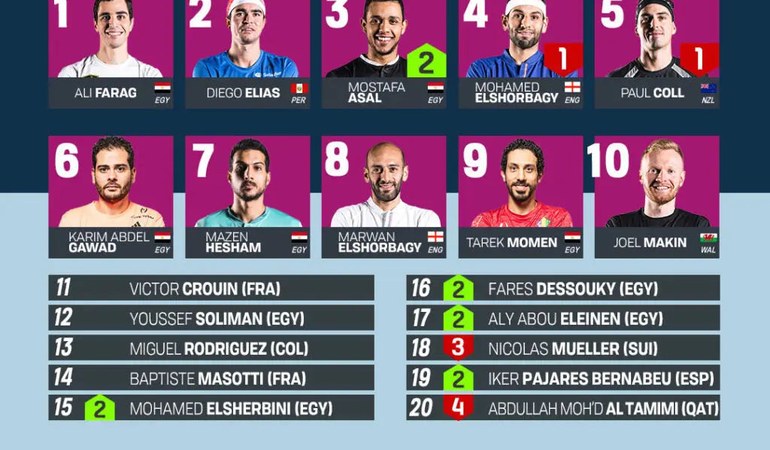
Player age in professional squash ranges from teenage prodigies to veteran campaigners, and recent trends differ between the men's and women's games.
On the men's tour, the average age of the top 10 has shifted over time, rising from about 26 years in 2000 to around 31 by 2014, then settling around 29 years in the late 2010s. It became more common to see players in their mid-30s still in the upper ranks. Three-time world champion Nick Matthew, for example, stayed in the men's top 10 until age 37.
In contrast, the women's top 10 has skewed younger in recent years. The 2000s saw several veterans in their 30s, but the 2020s are dominated by twentysomethings from Egypt. It is now routine for teenagers to reach the elite: Nour El Sherbini entered the women's top 10 at just 16 and a half years old (ranked #7 in 2012), and she went on to become world #1 by age 18. The oldest woman to ever hold a top-10 ranking was nearly 39 (England's Suzanne Horner in 2001), a sign that strong fitness can extend careers, though such cases are now rare for women.
In physical terms, top squash players come in various builds, but they are generally lean, agile, and strong. Elite male players typically stand around 1.8 m (5'10" to 6'1") and weigh between 70-80 kg (155-175 lb). Among the women, top players are often in the 160-170 cm range (5'4" to 5'7") and around 55-65 kg, again with notable exceptions.
A few illustrative examples across both tours:
| Player | Height | Weight |
|---|---|---|
| Mostafa Asal (EGY), men's World Champion | 183 cm | 80 kg |
| Ali Farag (EGY), former World #1 | 183 cm | 70 kg |
| Tarek Momen (EGY), former world champion | 174 cm | 66 kg |
| Mohamed El Shorbagy (ENG/EGY) | 185 cm | 80 kg |
| Nouran Gohar (EGY) | 167 cm | 59 kg |
| Sarah-Jane Perry (ENG) | 183 cm | 76 kg |
Nouran Gohar is known for her compact power, whereas Sarah-Jane Perry stands a full six feet tall, using her height for reach and attacking volleys. Despite these differences, successful players share speed, endurance, and efficient movement.
Squash is demanding: players routinely cover over a kilometer of movement in a single match and need a rare combination of aerobic fitness, explosive strength, and quick reflexes. The professional ranks show that champions come in different shapes and sizes as long as they maximize these physical qualities.
Match Frequency and Tournament Participation
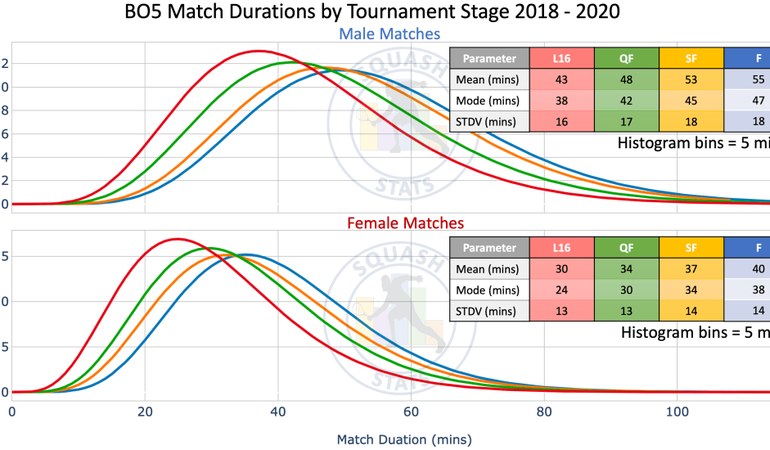
Modern professionals keep busy schedules, often playing year-round around the globe. A top-ranked player typically enters 10-15 tournaments per year, balancing major events with selected smaller tournaments. In each event, deep runs can require winning 4-5 matches, so annual match counts can reach into the 40s or 50s for those who consistently go far.
During the 2023-24 season, Ali Farag played 14 PSA events and recorded 59 match wins from 65 played, while Nouran Gohar played a slightly lighter schedule but still notched over 40 wins. Elite players can contest 50-70 matches in a year when team events and exhibitions are included. Recovery and injury management are therefore central to a squash pro's life, given the intensity and frequency of competition.
Tournament opportunities have grown, which lifts match totals. The 2024-25 PSA calendar featured a record 1,019 sanctioned events worldwide (606 men's and 413 women's), ranging from small satellite tournaments to Platinum and World Championship events. These tournaments spanned 70 countries, reflecting squash's broad international presence.
Top players focus on the major titles, but many also play seasonal opens and national championships to stay match-fit and earn ranking points. The marquee events include:
- The World Championship
- The British Open
- The PSA World Tour Finals
- Other Platinum-level tournaments, plus seasonal opens and national championships
The density of events means the highest-ranked players can be selective and prioritize peak performance at key moments. Long travel itineraries are still common: a player might go from Egypt to England to the U.S. within a few weeks during the fall season.
The schedule tests consistency and resilience, so those who stay in the top 10 for many years are not only skilled but also good at maintaining form through constant competition.
Rankings Leadership and World No. 1 Trends
Reaching World No. 1 is a career milestone, and staying there is a mark of true dominance. In the women's game, Dato' Nicol David (MAS) set the standard with a 108-month reign at #1 from 2006 to 2015, nine consecutive years atop the rankings. She passed the previous women's record of 105 months held by Susan Devoy (NZL).
On the men's tour, the longest tenure at #1 belongs to Jansher Khan (PAK), who spent a total of 97 months in the top spot during the late 1980s and early 1990s. His compatriot Jahangir Khan was #1 for a cumulative 94 months in the 1980s, including an unbroken 72-month stretch, which remains the longest consecutive streak for men. These long reigns show how thoroughly those players dominated their eras.
Only a select group of players ever reach #1. Since 2000, 15 different men and 12 women have attained the world #1 ranking. Many are multiple-time World Open champions, though a few (for example England's Lee Beachill or France's Thierry Lincou on the men's side) held #1 briefly without winning many majors.
The average age of a new #1 has tended to be the mid-to-late 20s, and most stay at the summit for only a few months or a couple of years before ceding to the next contender. That makes the extended runs of players like Nicol David and Jahangir and Jansher Khan all the more notable.
National trends in the rankings are also worth noting. In the early 2000s, Australia and England still rode the momentum of past greats. In December 2000, 7 of the women's top 10 were English, reflecting that nation's depth at the time.
The 2010s saw the rise of Egypt as a squash power. By the late 2010s, Egyptian players held 5-7 of the top 10 spots in the men's rankings consistently, with 10 occasions from 2016-2018 when 7 Egyptian men were in the top ten. Egypt's strength on the women's side also grew, with roughly 40% of the women's top 10 in recent years being Egyptian, led by El Sherbini, Gohar, and Hania El Hammamy. This Egyptian wave produced multiple simultaneous world #1s, and at one point in 2021 Egyptians were ranked #1 in the men's, women's, and junior categories.
Other countries have had their moments of supremacy: Pakistan in the 80s and 90s (the Khan era), Australia in the 90s (with Sarah Fitz-Gerald, Michelle Martin, and others), and more recently France and New Zealand have fielded #1 players (Gregory Gaultier in 2017, Paul Coll in 2022). The 2010s and 2020s, though, belong to Egypt, which continues to produce a deep group of talent that should keep it at the top for the foreseeable future.
Career Titles and Notable Records
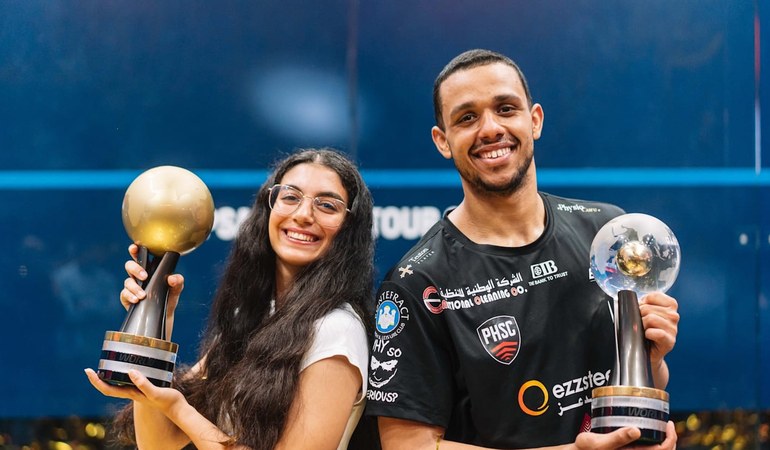
Beyond rankings, total titles won is a clear measure of sustained excellence. The all-time title leaders are a who's-who of squash legends.
In the men's game, Jansher Khan holds the record with 99 career PSA titles, followed by Jahangir Khan with 61. Among women, Nicol David amassed 81 titles, the highest ever, with Australia's Sarah Fitz-Gerald next at 62. For perspective, active male leader Mohamed El Shorbagy (ENG) has just over 50 titles, and active female leader Nour El Sherbini (EGY) has reached the mid-40s.
Men's tour, most career titles:
| Rank | Player | Titles |
|---|---|---|
| 1 | Jansher Khan (PAK) | 99 |
| 2 | Jahangir Khan (PAK) | 61 |
| 3 | Peter Nicol (SCO/ENG) | 52 |
| 4 | Mohamed El Shorbagy (EGY) | 51 |
| 5 | Ali Farag (EGY) | 46 |
Women's tour, most career titles:
| Rank | Player | Titles |
|---|---|---|
| 1 | Nicol David (MAS) | 81 |
| 2 | Sarah Fitz-Gerald (AUS) | 62 |
| 3 | Michelle Martin (AUS) | 56 |
| 4 | Susan Devoy (NZL) | 53 |
| 5 | Nour El Sherbini (EGY) | 44 |
These figures span both historical greats (the 1980s and 90s dominance of Pakistan and the 2000s dominance of Malaysia and Australia) and active players such as El Shorbagy and El Sherbini climbing the ranks.
Many of these title leaders also hold multiple World Championship titles, the sport's premier crown. Jansher Khan won a record 8 men's World Opens (1987-1996). Nicol David won 8 women's World Open titles, also a record. Those achievements add to their high standing in total titles won.
No statistical overview is complete without the unbeaten streaks and records that are part of squash lore. Jahangir Khan's 555-match streak and Heather McKay's near 20-year unbeaten run are records unlikely to ever be broken. Jahangir's streak included winning the World Open five years running and every team match he played for Pakistan in that span.
McKay's run in the 1960s and 70s was so complete that, aside from her two early-career losses, she never lost again, even after moving from Australia to compete internationally. Another striking record is McKay's scoreline in the 1968 British Open final: she won 9-0, 9-0, 9-0 in about 15 minutes. These records show how far ahead of their contemporaries these athletes were.
Professional squash has a deep statistical history: marathon matches and meteoric careers, teenagers upsetting veterans, and legends who redefined the limits of the sport. The men's and women's tours each have their own legends and trends, but both rest on the same core elements of athleticism, skill, and competitive drive.
As the sport keeps growing, with more events and higher stakes each year, new records will be set. Yet the benchmarks documented here, Jahangir's 555 wins, Nicol's 108 months at #1, Jansher's 99 titles, McKay's unbeaten career, and many more, will continue to challenge future generations of squash professionals.