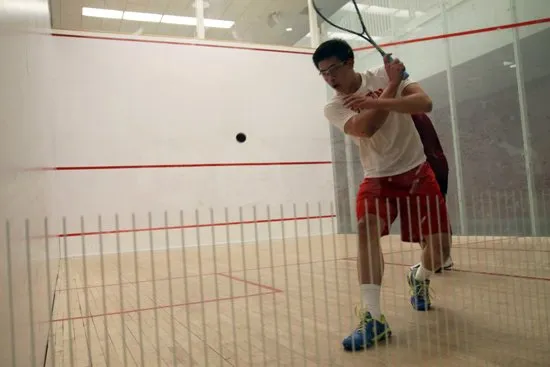
Squash is a fast-paced sport where every split second counts, and few things improve your speed and court coverage like dedicated footwork training. Whether you are a beginner or an experienced player, sharpening your footwork will help you reach tough shots with less effort and give you more time to decide your next move.
Strong movement skills let you cover the court efficiently, conserve energy in long rallies, and may help reduce the strain that leads to injury. The difference between an average player and an elite one often comes down to footwork: being quick on your feet and sharp in your anticipation.
The drills below will help you build agility, efficient court movement, and the quick decision-making that comes from being in the right place at the right time.
1. Four-Corner Footwork Drill (Star Drill)
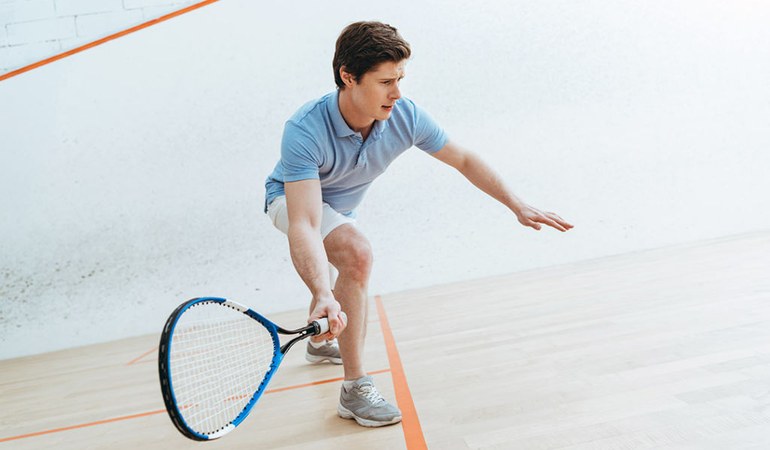
Purpose: Build explosive speed to all areas of the court and ingrain the habit of returning to the centre (the "T") after each shot. This drill trains quick, repeated sprints and gets you comfortable covering the four corners of the court in succession.
How to do it:
- Start at the T (centre of the court) in a ready position.
- Sprint to a front corner of the court (for example, front-right) and touch the wall or imaginary ball in that corner.
- Push off immediately and return to the T.
- Sprint to the next corner (for example, back-right), touch that area, and return to the T.
- Repeat for all four corners of the court in a sequence (front-right, back-right, back-left, front-left, for example).
- Rest for 30 seconds, then repeat for 3 to 5 rounds.
This star pattern trains you to move quickly in all directions and to find the most direct route back to centre. Over time, you should reach deep shots and drops more easily because your body learns the court's dimensions and angles from practice.
Tips for execution:
- Stay low and balanced: Keep your knees bent and your centre of gravity low as you move. This athletic stance lets you push off to the next corner and brake under control.
- Drive off the T: Treat the T as a launch pad, pushing off hard with your outside foot to sprint toward each corner. Focus on a powerful first step in each direction.
- Visualise a shot: As you touch each corner, imagine hitting a shot (for example, pretend to swing your racket). This keeps the drill match-realistic and engages your mind.
- Quality over quantity: Start with fewer corners or a slower speed if you are a beginner. As your fitness and form improve, increase the speed or add more sets. The goal is quick, efficient movement, not wild running.
- Measure progress: Time how long it takes to complete a full cycle of four corners. With regular practice, two to three times a week, you should see your times improve as your footwork gets faster.
2. Random Ghosting Drill (Reactive Movement)
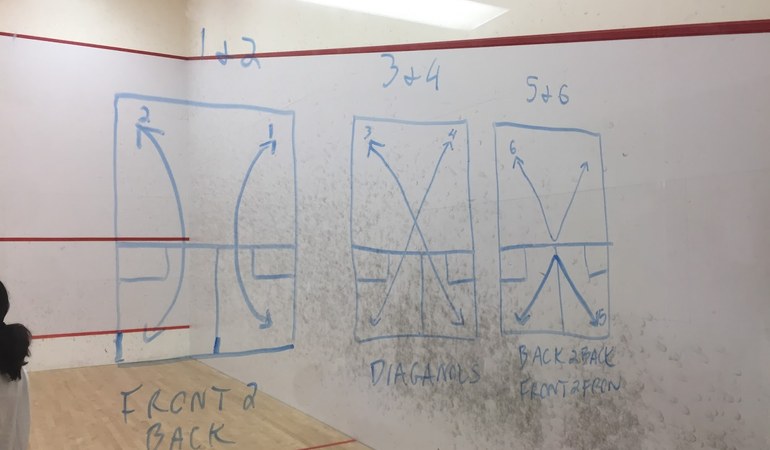
Purpose: Improve quick reactions and explosive movement to any area of the court, as you would need in a real rally. This drill trains your acceleration off the mark and decision-making under pressure, since you will not know where your next sprint will be.
How to do it: For this drill you will practise ghosting, moving around the court without a ball as if you were retrieving shots. Have a coach or training partner randomly call out or point to a direction, and react in an instant:
- Start at the T in a ready stance.
- When your partner calls a corner or area (for example, "front left" or "right mid-court"), spring toward that spot immediately. You can simulate a swing or simply touch the wall or floor at the target.
- Recover fast back to the T. The moment you get back, be ready, because your partner will call the next location unpredictably: it could be the opposite back corner, the near side wall, anywhere.
- Continue this random movement for a set period (try 30 to 60 seconds of continuous calls).
- Rest for the same duration (30 to 60 seconds), then repeat for several intervals.
If you do not have a partner, you can still do this by randomising your ghosting: for example, number the six major court zones (front left, front right, mid-left volley, mid-right volley, back left, back right) and call out numbers to yourself or use a preset random sequence. The key is that each movement is unexpected, mimicking how in matches you must react to your opponent's shots on the fly.
Tips for execution:
- Work in hard bursts: Treat each ghost sprint like a rally-breaking retrieval, pushing at a high effort as soon as the direction is called. Because this is intense, keep the work periods short and allow full recovery so you can maintain quality and speed.
- Use the split-step: Begin each interval bouncing on your toes. The moment a direction is given, perform a quick split-step (a small hop landing on the balls of your feet) and drive toward the call. The split-step primes your muscles to move in any direction and helps you react faster.
- Stay light on your feet: Focus on small, rapid steps as you accelerate, and especially as you decelerate into the corners. Avoid heavy stomping; quiet, swift footwork is usually more efficient and controlled.
- Keep your head up: Even though there is no ball, train yourself to glance where it would be. If a front corner is called, imagine watching the ball there as you move. This habit builds anticipation and keeps your mind engaged during the drill.
- Make it competitive: If you have a partner, alternate turns and see who can complete more calls in a minute, or who lasts longer at a high pace. Pushing each other keeps the drill engaging and simulates the mental pressure of a game.
With regular random ghosting, your first step should become quicker and your ability to change direction should improve, so you start reaching shots that used to get away from you.
3. Smooth Footwork Drill (Efficiency Ghosting)
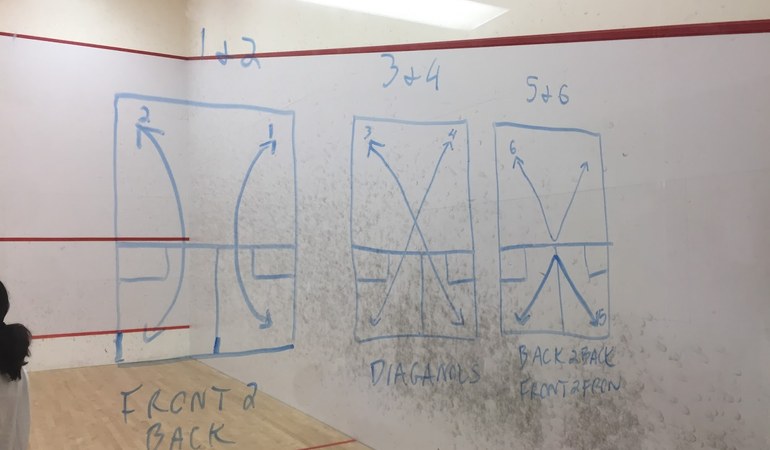
Purpose: Develop efficient, fluid movement by refining your footwork technique at a slow pace. This drill emphasises quality over speed: you train your body mechanics (step patterns, balance, lunging form) so that in a match you move with minimal wasted energy. Think of it as slow, deliberate, controlled footwork practice.
How to do it:
- Begin at the T in an athletic stance. Without a ball, ghost around the court at 30 to 50 percent of your maximum speed. Choose a pattern (for example, rotating through all six spots as in the previous drills) or random spots, but move in slow motion.
- Pay close attention to each phase of your movement. Start with a subtle split-step, then push off toward your target. Take smooth, decisive steps to reach the spot and execute a mock swing or touch.
- As soon as you finish the swing, glide back to the T, focusing on economical footwork and staying relaxed.
- Continue this cycle for a few minutes, or do sets of about 2 minutes on, 1 minute off. Because intensity is low, you can ghost for longer while keeping your focus on form.
During this exercise, your mind should be active: think about which foot to lead with and which foot to lunge on for each corner. Aim to return to the T in balance, ready to change direction.
It helps to have a coach or friend watch and give feedback, or to record yourself; at this slower pace, flaws in technique (extra steps, poor posture, wrong foot forward) become noticeable and correctable.
Tips for execution:
- Time the split-step: Practise the split-step as your opponent would hit the ball. For example, if moving to the right, land with your left foot just before your right foot so you can push off the left toward the right wall. At slow speed, exaggerate this timing to build the habit, then let it happen naturally at full speed.
- Optimise your steps: Count how many steps you take from the T to a corner. Experiment with different step lengths to find what lets you arrive in a stable lunge without overshooting or stretching too far. Many players take too many tiny steps then a huge lunge, or too few giant steps; find a middle ground that feels smooth and balanced.
- Balance in your lunge: When you reach a corner, pause for a moment. Check that your front knee is bent (not wobbling inward or too straight) and that your back leg is helping you stay balanced. You should be able to hold the position comfortably. This freeze-frame method, sometimes called shadow movement with a freeze, helps confirm your positioning and balance before you move back.
- Stay relaxed and fluid: Even though you are moving slowly, keep your upper body loose and your steps soft. This is about efficient, smooth movement. Your heart rate should stay relatively low; if you are gasping, slow down. In time, this relaxed movement carries over to intense rallies, helping you avoid tensing up or wasting energy.
- Gradually increase complexity: Once basic movements feel smooth, add variations. For instance, include a few random ghosting calls (as in Drill 2) at half speed to check that you can hold your form when things are less predictable. Or ghost with your racket in hand and simulate different shots (volleys, boasts, and so on) while still moving fluidly. The goal is to make efficient footwork second nature, so that when a real match heats up, your body chooses the smartest steps.
Footwork at a controlled pace may not raise your adrenaline, but it pays off when you can glide around the court in games. You should find yourself less fatigued, reaching more balls, and in better positions to hit strong shots, which in turn helps your decisions under pressure.
4. Agility Ladder Drills for Quick Feet
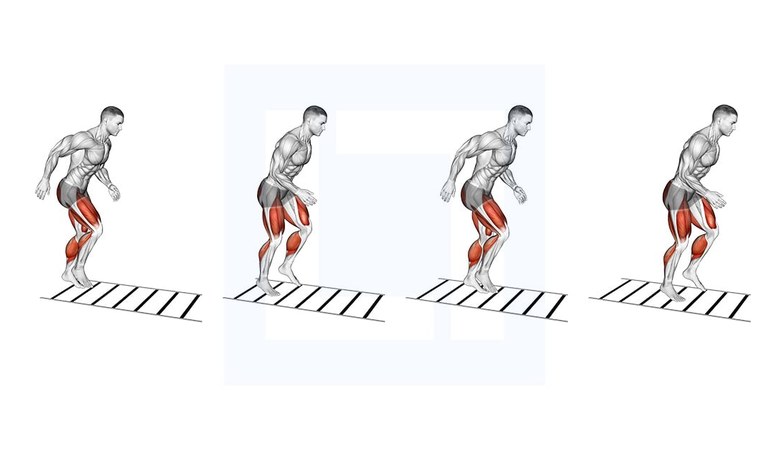
Purpose: Work on your foot speed, coordination, and agility off court so that on-court movement becomes faster and more precise. Agility ladder drills are simple exercises that train you to take quick, controlled steps and can help your overall footwork.
They also challenge the small muscles in your lower legs that contribute to quick, stable movement. Scientific evidence on ladder drills is limited, but they are widely used as a useful addition to footwork, quickness, and coordination work.
How to do it: Obtain a flat agility ladder (a rope ladder or a series of flat rungs you lay on the ground). Here are a few ladder drill examples:
- One-In, One-Out: Run through the ladder by stepping one foot in the first square, then the other foot in the same square, then move one foot into the next square, and so on. Each foot touches inside every rung before moving on.
- Two-Foot High Knees: Face forward and run through the ladder by placing both feet in each rung (one after the other) with high knees, then quickly stepping to the next rung. This encourages quick upward knee drive and fast feet.
- Lateral Quick-Step: Stand sideways to the ladder. Step into the first square with your lead foot, then follow with the trailing foot into the same square. Next, step out with the lead foot to the side of the next square, and follow with the trailing foot. Continue this in-and-out pattern down the ladder, moving laterally.
- Icky Shuffle: A popular in-in-out pattern. Step your right foot into the first square, then your left foot into the first square, then your right foot outside the ladder to the right. Next, your left foot goes into the second square, your right foot follows into that square, then your left foot steps outside to the left side. Repeat this in-in-out sequence rapidly down the ladder. It is tricky but good for coordination.
Focus on light, rapid foot placements. As you improve, you can increase your speed or try more complex patterns; there are many ladder drill variations to explore. Drills borrowed from other sports (such as soccer or boxing footwork) can also benefit your squash movement.
Tips for execution:
- Stay on the balls of your feet: Throughout all ladder drills, keep your heels off the ground. Quick footwork requires you to be on your toes. This also reduces impact and lets you change direction faster.
- Use your arms: Pump your arms as if sprinting. This helps maintain rhythm and engages your whole body, which can help your feet move quicker.
- Start slow, then speed up: Begin each pattern slowly to master the sequence of steps. Once you can do it without tripping on the ladder, gradually increase your tempo. The goal is quick, precise foot placement; accuracy comes first, and speed follows with practice.
- Short and frequent sessions: Ladder drills are demanding on the calves and on coordination. You do not need to do them for long; even 5 to 10 minutes at the start of a session helps. Consistency, a few times a week, is more effective than one long session.
- Make it sport-specific: Integrate ladder work into squash movement by, for example, doing a quick ladder run and then immediately ghosting into a corner. Or place a cone at the end of the ladder and, after the last rung, do a quick lunge to touch the cone. This ties the ladder drill into a squash-like movement, training your body to go from fast feet to a lunge or shot.
- Keep it varied: There are countless ladder patterns, so mix them up to keep your mind engaged. If you do not have a ladder, you can tape squares on the floor or mark imaginary boxes with chalk. The important thing is the quick foot movements, not the equipment.
Regular agility ladder training can make your feet feel lighter. Over time, you should find it easier to sprint and adjust your footing on the squash court. Those short, explosive steps to volley a ball or chase a drop can become more automatic as your footwork improves.
5. Cone Zigzag Sprint Drill
Purpose: Improve your ability to change direction rapidly and cover multiple court areas in one sequence. This drill uses cones (or any markers) on court to create a route that forces you to sprint, stop, turn, and sprint again in another direction. It is useful for building the kind of agility you need to retrieve a drop shot and then immediately chase a lob to the back, all while keeping balance and speed.
How to do it: Set up 4 to 6 cones on the court in a pattern that makes you move corner to corner and side to side. For example, place one cone near the front-left corner, one near front-right, one near back-right, one near back-left, and perhaps one in the centre of the court. Create a zigzag or figure-eight route that weaves through these markers. Keep the layout consistent once you design a route, so you can time yourself and track improvement.
On "Go," follow your route: sprint to each marker (touch it with your hand or racket), change direction sharply at each point, and finally sprint back to the start. You can adjust the cone positions and sequence, but once set, keep it the same so your times are comparable.
To perform the drill, do a full-speed run through the course, touching or circling the cones as required, until you return to the starting point. Time your run with a stopwatch. Rest adequately (1 to 2 minutes) and repeat for several attempts, trying to beat your previous time. This drill pushes you to find the balance between moving fast and keeping control through each turn.
Tips for execution:
- Focus on footwork in turns: As you approach a cone, take small quick steps to decelerate and curve around it tightly. This drill is not just about straight-line speed but about how efficiently you can brake and re-accelerate in a new direction. Plant your outside foot firmly and push off in the new direction once you have rounded the cone.
- Stay low and centred: Bend your knees and lower your torso when changing direction; a low stance gives you more stability and power for the pivot. If you stay upright, you will feel off-balance during sharp turns. Keep your weight over the balls of your feet so you can drive off quickly.
- Touch your targets: If your drill involves touching certain cones or walls, reach out and touch them. This makes sure you are going all the way into each corner and not cutting them short. It also forces a deeper lunge, training those muscles. When circling a cone, get close without knocking it over; a tight turn at speed is a good marker of agility.
- Consistency before speed: Run the course a few times at a moderate pace to learn the pattern. Once comfortable, increase your pace. The goal is an error-free run at high speed. If you stumble or take a wrong route, finish the run, but remember that accuracy and speed must go together to improve your times.
- Make it competitive: If you have training partners, turn this into a friendly competition. Take turns running the course and compare times. Pushing for the best time can simulate the pressure of a match, where you have to move fast even when tired.
- Track your progress: Keep a log of your times or an average of your top three runs each session. Over weeks of training, you will likely see those times drop. Even a one-second improvement matters in a squash rally. As you get faster, you can make the drill harder, for instance by adding more cones or requiring an extra touch at the farthest point.
With multi-directional sprint drills like this, you build confidence in your ability to cover the court's extremes quickly. Chasing down a drop and then sprinting back for a deep drive starts to feel more natural, and you cover the court with more agile, purposeful steps.
6. T-Recovery Challenge
Purpose: Develop the habit of always recovering to the T (centre court) after every shot. This drill trains your brain and body to return to the optimal position as quickly as possible, which is key to controlling rallies. It also works as a fitness challenge to test your speed and stamina in covering the whole court repeatedly.
How to do it:
- Take 5 squash balls (or small objects like cones) and place them around the court's perimeter, for example one in each corner and one near the middle of the front wall, or any five distinct spots you want to target.
- Start at the T. Have a stopwatch ready.
- Sprint to one of the balls, pick it up (or tap it if you prefer), then immediately sprint back to the T.
- From the T, burst out to the next ball, collect it, and return to centre again.
- Continue until you have retrieved all five balls, always coming back to the T between each retrieval.
- Stop the timer when you are back to the T with the last ball. That is your time for one full round.
Try to perform the drill as fast as possible while keeping good form. You can rest and repeat, attempting to beat your time on later rounds. This simple setup mimics a series of challenging shots and reinforces recovering to the middle after every one.
Tips for execution:
- Plan your route: Before you start the clock, quickly decide the order in which you will collect the balls. A common strategy is to go for the most distant ball first and the closest last, or the reverse, so you are not zigzagging unnecessarily. A plan saves time and makes your movement more efficient.
- Touch the T each time: When you return, get back to the T (or imagine a small circle there) and touch it with your foot as a marker. This makes sure you are truly re-centring. Many players cheat themselves by not fully returning to the middle; enforce that habit strictly in practice so it becomes automatic in matches.
- Drive out of the turn: When you grab a ball in a corner, use that low, lunging position to push off hard back toward the T. Drive with your legs to build momentum back. As soon as you reach the T, move toward the next target without delay; this drill is as much about quick transitions as raw speed.
- Stay goal-oriented: Note your time and try to improve it next session, or repeat the drill two to three times and aim for a faster time on the second or third attempt. You can also lower the time by improving your footwork efficiency (fewer steps, tighter turns) rather than just running harder. This encourages smart movement solutions, not brute force.
- Scale to your level: For beginners or juniors, five balls might be too many. Start with three balls (for example, two back corners and one front) and build up. You could also reduce the court area, doing only front-half balls to start. Advanced players can increase to six or more targets, or do multiple rounds with minimal rest. The drill is flexible; the important part is always coming back to centre.
- Competitive variation: If you have a partner, you can race side by side (on separate courts, or carefully on one court with different coloured balls) to see who finishes first. This adds pressure and simulates the urgency of scrambling in a real rally.
Working on the T-Recovery Challenge tends to carry over into matches as better habits. You start moving back to the T after each shot instinctively, which means you are better positioned for whatever comes next. Owning the T is how you control the court and the rally, and this drill helps make that instinct second nature.
7. "Shot and Ghost" Combination Drill
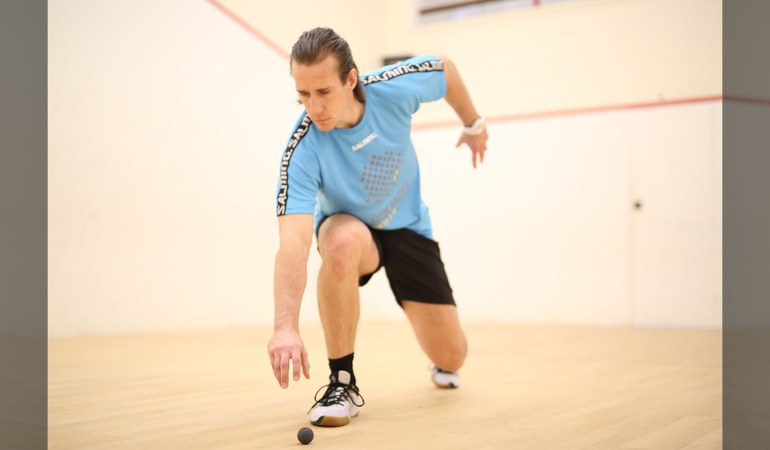
Purpose: Bridge the gap between static drills and real gameplay by combining hitting the ball with footwork movement. This drill teaches you to recover and move immediately after playing a shot, just as in a match.
It sharpens your ability to think one step ahead: you hit a shot, then prepare for the next by repositioning with a ghosting movement. It is good for stamina, focus, and integrating stroke and footwork.
How to do it: You will need a partner (or coach) and a squash ball for this drill:
- Stand at the T. Your partner stands ready to feed the ball from somewhere in front of you (for example, near the front wall).
- Your partner feeds a ball to one corner or area of the court. Move to the ball and hit a simple shot back to them; for instance, they throw a ball to the front left, you step in and play a straight drive right back to their hands. Focus on good form.
- As soon as you hit the ball and your partner catches it, turn and ghost to a different area of the court (as if you are now retrieving another imaginary shot). For example, after hitting that drive, move into a ghost toward the opposite back corner and quickly return to the T.
- Your partner then feeds the next ball (maybe to the other side or a different corner). You step out of your ghosting movement to intercept and hit that ball back to them. Again, right after the hit, you perform a ghost movement to another spot.
- Continue this sequence for 1 to 2 minutes, alternating between hitting a real ball and ghosting a movement without the ball. Then switch roles or rest.
Start with a predictable pattern (for example, your partner always feeds to the same two spots and you ghost to one designated spot) so you can get a feel for the rhythm. As you improve, make it more random: your partner can feed to any corner, and you ghost to wherever you need work. This drill keeps your footwork engaged even after hitting a shot, since there is no down time between the shot and the next movement, just like in an intense rally.
Tips for execution:
- Prioritise good form: Because this drill adds complexity, your shots or your ghosting form might slip at first. Focus on clean hits (watch the ball, follow through) and then a quality movement. It is better to do it slowly with proper technique than fast and sloppy. Speed up only when you can maintain form.
- Keep the ghosting realistic: When you move for the imaginary shot, commit to the movement; go deep into the corner or wherever you are ghosting, and plant as if retrieving a ball. This trains footwork and helps you practise recovering after your shot. Avoid cheating the ghost (such as just taking a step or two); the benefit comes from treating it like a real rally situation.
- Communicate and adjust: Work with your partner on timing. You might need them to wait a second longer after you hit before feeding the next ball, or to feed faster to give you less rest; it depends on your fitness and skill. For advanced players, reduce the wait time so you are sometimes barely back to the T before the next ball comes, forcing you to hustle. For less advanced players, allow a brief pause. The drill should be challenging but not chaotic.
- Mix up the feeds: Once you are comfortable, ask your partner to hit different shots, such as lobs, drives, or a boast, so you have to move in various ways. Also mix up your ghosting; you do not always have to ghost to the opposite corner. Sometimes ghost to the same side or a random spot. This keeps you mentally alert and mimics the unpredictable nature of squash rallies.
- Build endurance: Lengthen the drill or do multiple sets with short rests to build endurance. For example, 2 minutes on, 30 seconds off, for 3 rounds. This tests your mental focus and fitness. By the last round, when you are tired, forcing yourself to still return to the T and ghost effectively is the kind of mental toughness you need in long matches.
- Visualise scenarios: Pretend you are in an actual point. When you hit the real ball, imagine where your opponent would return it; that can be the direction you choose to ghost. This adds a decision-making element, as you are anticipating a next shot and moving for it proactively. It is a good way to train your squash IQ alongside footwork, teaching you to think ahead.
The Shot-and-Ghost drill is effective because it marries stroke play with movement. You learn to recover quickly after a shot and keep your feet alive, ready for the next ball. Over time, you start doing this in matches instinctively, playing a shot and immediately moving to intercept the next, which puts you a step ahead of your opponent.
Conclusion: Putting It All Together
Effective footwork is the backbone of every strong squash game. The drills above, from ghosting exercises to agility work, are tools to build that foundation. Consistent practice makes your movement more efficient, your feet faster, and your court coverage smarter.
Even the pros devote many hours to footwork; nearly all top players move exceptionally well and make it a priority in training. The payoff is clear: better footwork means you reach more shots, set up earlier, and have the confidence to make good shot choices under pressure.
As you add these drills, focus on quality and form. A few minutes of mindful practice can be worth more than hours of inattentive hitting. Gradually increase the intensity and complexity of drills to keep challenging yourself. It is normal to feel clumsy at first with some exercises (ladder patterns or ghosting can be tricky), but with repetition your muscles learn and your reactions get faster.
To stay motivated, keep things varied: train with a partner, turn drills into games, or occasionally film your movement and compare it over time. You can also watch professional matches or training videos to pick up footwork tips. With dedication, you will likely find that you are quicker on your feet and calmer in your mind during rallies. When your body automatically gets you to the right spot in time, you gain an extra moment to think and execute your shot.
In squash, the player who controls the court usually wins the point. By developing quick feet and a sharp, anticipative mind through these footwork drills, you put yourself in a strong position to dominate the T and improve your game.