
If you want to coach squash, four bodies set the path most of the world recognises: US Squash, England Squash, Squash Australia, and the World Squash Federation (WSF). Their systems share a shape, a ladder of levels from beginner-coach to elite, but differ in what each level demands, what it costs, and how far the credential travels once you leave the country that issued it.
The information reflects each body's published framework as of 2025.
Overview of Coaching Certification Programs
The table below summarizes the coaching certification frameworks for each organization: the certification levels, typical course format and duration, approximate costs, the governing bodies, and notable features or requirements.
| Organization | Certification levels | Format and duration | Approximate cost | Notable features and requirements |
|---|---|---|---|---|
| US Squash (United States) | Start Squash (grassroots entry course), Level 1, Level 2, Level 3 (Level 3 the highest currently offered) | Start Squash is a one-day course (9am to 4pm). Levels 1 to 3 are each a weekend in-person course (Friday evening, all day Saturday, Sunday). Levels 2 and 3 also require a post-course assignment (a 6-week or 8-week training plan). | Start Squash $200 ($250 late); Level 1 $450 ($500 late); Level 2 $750 ($800 late); Level 3 $900 ($950 late) | National governing body, recognized by the U.S. Olympic and Paralympic Committee and a WSF member. Coaches must hold a US Squash Coach Pass membership; Level 3 also requires SafeSport and a referee exam for full certification. |
| England Squash (England) | Game Changer (leaders' award), Community Development Coach, Player Development Coach, Talent Development Coach (framework launched in 2025) | Game Changer is fully online. Community Development Coach is blended (e-learning plus a half-day practical) over about 4 to 6 weeks. Player Development Coach is blended (e-learning, live webinars, two full-day practicals) over about 12 to 16 weeks. Talent Development Coach is blended (e-learning, webinars, four full-day practicals, mentoring days) over roughly 7 months. | Game Changer about 25 pounds (free for Coaches' Club members); Community Development Coach 125 pounds; Player Development Coach 270 pounds | National governing body and WSF member. England Squash subsidises part of these fees. Coaches need an enhanced DBS check and current safeguarding and first aid certificates, and must hold a coaching licence through the Coaches Club to coach unsupervised. |
| Squash Australia (Australia) | Foundation online module, then Level 1, Level 2, Level 3 (Level 3 the highest); accreditation valid for 3 years before re-validation | Foundation is an online introductory module. Level 1 is blended (online theory plus a 2-day practical). Level 2 is a more advanced blended course with online content and multi-day workshops. Level 3 is an advanced performance-coaching programme with high-performance topics, longer workshops, and assignments. | Foundation about A$60; Level 1 A$299 (includes World Squash Coaching membership); Level 2 about A$675; Level 3 higher and not publicly listed | National governing body and WSF member. Certifications follow the World Squash Coaching (WSC) curriculum. Coaches must complete integrity modules, hold a Working With Children Check, sign the Code of Behaviour, and register through the WSF system (a level-based fee). |
| World Squash Federation (international) | WSC Level 1, Level 2, Level 3, the global coach certification framework branded World Squash Coaching | In-person clinics run by WSC-accredited tutors. Level 1 is a minimum of 4 days (can split across two weekends). Level 2 is a minimum of 4 days with pre-course reading and a post-course assignment. Level 3 is a minimum of 6 days with pre-course reading and a post-course assignment. | Fees vary by host nation. For a Level 1 in Europe, the host federation pays a tutor fee of about 220 euros per day plus a levy of about 25 euros per candidate; the candidate fee is set by the host. SPIN registration fee about 16 pounds at Level 1, with additional amounts at Levels 2 and 3. | International governing body. Its Coach Education Programme (branded World Squash Coaching) provides a unified, standardized structure worldwide. Many national federations deliver WSC courses or integrate the syllabi into their own pathways. |
Each system has its own structure and emphasis, but common themes recur: a progression from an introductory coaching qualification through higher levels of expertise, a mix of theory and practical training, requirements for prior experience at each stage, and oversight by the sport's governing bodies. The sections below cover each pathway in detail, followed by a discussion of international recognition and portability.
US Squash Coaching Certification Pathway
Certification tiers. US Squash, the United States governing body, offers a grassroots Start Squash course plus a three-level coaching certification (Level 1, Level 2, Level 3), with Level 3 the highest currently available. The levels correspond to coaching increasingly advanced players:
- Start Squash: a grassroots entry course for community leaders teaching squash in schools, parks, and similar settings, with introductory, fun-based techniques and group organization.
- Level 1: coaching beginners and low-intermediate players (basic group instruction).
- Level 2: coaching intermediate to advanced club players (individual instruction and fault analysis).
- Level 3: coaching high-level and elite players (advanced coaching, long-term development, squads).
Progression pathway. A prospective coach usually starts as an active player or helper, then takes the Level 1 course. After gaining experience (US Squash asks for roughly one year of coaching at Level 1), they can progress to Level 2, and then to Level 3 after at least another year.
This stepwise structure ensures coaches have practical experience before advancing. Level 3 graduates become eligible to serve as course instructors for Level 1 and 2 certifications.
Requirements and prerequisites. Each level has specific entry requirements:
- Level 1: candidates should understand squash basics, including the six basic shots (drive, volley, serve and return, drop, boast, lob) and the technique to feed and demonstrate them. They must know the rules and basic officiating roles.
- Level 2: candidates must be Level 1 certified with roughly one year of coaching experience at Level 1, and should be able to control the ball and feed for intermediate players with a deeper knowledge of squash techniques.
- Level 3: candidates must be Level 2 certified (typically with about a year of experience at Level 2, though exceptions can be made at the instructors' discretion). They need extensive technical, tactical, and organizational knowledge and strong personal playing technique. Before final certification they must also be at least 16, pass the US Squash Level 4 referee exam, complete SafeSport training, hold US Squash membership through the Coach Pass, and hold a current First Aid and CPR certificate.
Course content and format. US Squash coach courses are conducted in person, usually at the US Squash National Center or regional hubs. Start Squash is a single day (9am to 4pm). Each of Levels 1 to 3 is an intensive weekend clinic.
The typical schedule for Levels 1 to 3 runs Friday evening (about 5pm to 8pm), all day Saturday (8:30am to 7pm), and Sunday until mid-afternoon (9am to 3pm).
Courses mix on-court practical sessions with classroom instruction. Level 1 focuses on group coaching fundamentals: lesson organization, safety, leadership, and introducing squash to new players. Level 2 has a more technical focus, training coaches to analyze and correct individual technique, develop training plans, and apply basic physical training principles. Level 3 covers advanced topics: high-level player development, sports psychology, advanced drills, and periodization.
Assessments. Each level evaluates coaching ability across categories such as technical knowledge, lesson preparation, presentation and delivery, and professionalism. Level 2 candidates must submit a 6-week coaching program after the course, and Level 3 candidates must submit an 8-week progressive training plan, alongside demonstrating high feeding skills and on-the-spot analysis of players. Failing to complete coursework or meet standards can require re-taking the course.
Format. While primarily in person, the program includes online components, such as the referee exam and the SafeSport module taken outside the course. US Squash also offers continuing-education modules and webinars for ongoing development.
Duration. Each Level 1 to 3 course runs about 2.5 days in person. The post-course assignments for Levels 2 and 3 extend the process by several weeks while coaches complete and submit their work.
Costs (excluding travel and lodging): Start Squash $200 ($250 late); Level 1 $450 ($500 late); Level 2 $750 ($800 late); Level 3 $900 ($950 late). These fees cover the course and evaluation; a candidate who fails and re-takes pays again in full. To coach actively, individuals must also hold an annual Coach Pass from US Squash, which includes background checks and insurance.
Governing body and recognition. The program is run by US Squash, the national governing body, a 501(c)(3) nonprofit recognized by the U.S. Olympic and Paralympic Committee and a member of the WSF. US Squash certifications are nationally recognized.
They are not automatically converted to WSF qualifications, but a US-certified coach is generally respected, and many concepts align with WSF standards. A coach working abroad may need to meet that nation's specific requirements, such as joining a coach registry or completing a local rules and safeguarding course. Portability is discussed in a later section.
England Squash Coaching Certification Pathway
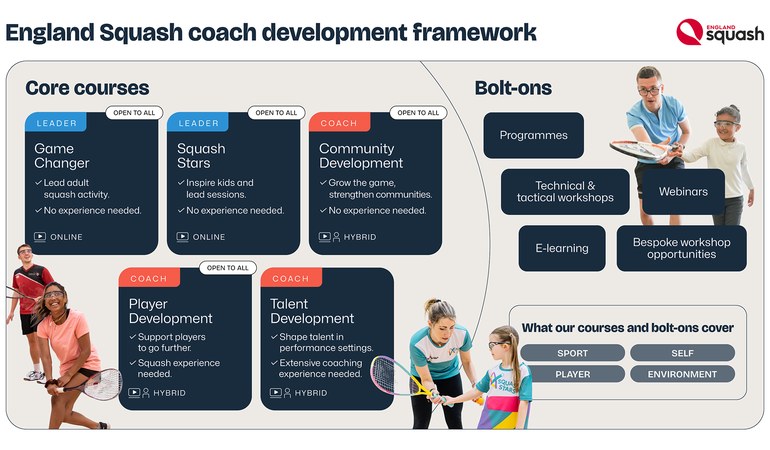
Certification tiers. England Squash launched a revised coaching framework in 2025. The new tiers move away from the old numeric Level 1, 2, 3 system and are named for the coaching role or environment:
- Game Changer: a leaders' award for young leaders or volunteers who assist in sessions and run beginner programs.
- Community Development Coach: an entry-level qualification focused on growing the game at grassroots level and making squash fun and accessible for new and social players.
- Player Development Coach: also an entry-level qualification, parallel to Community Development, aimed at coaches helping players improve and progress competitively, with a more technical and performance-oriented focus.
- Talent Development Coach: an advanced qualification for coaches working with high-performance juniors and athletes on the England talent pathway. It is the successor to the old high-performance coaching award.
Under the old system, England Squash had Level 1, Level 2 (Club Coach Award), Level 3, and a Level 4 High Performance Award (a postgraduate diploma). These have been phased out. Existing Level 1 to 3 qualifications remain valid, but new candidates follow the structure above.
Progression pathway. England's framework is flexible and non-linear.
- A prospective coach can start with either Community Development or Player Development as their first full coaching qualification, since both are entry-level and neither is required before the other. The choice depends on background and interests: Community Development for grassroots participation, or Player Development for those with stronger playing or coaching skills aiming at player improvement and competitive coaching.
- Game Changer is an earlier, optional step, often taken by young people (ages 14 to 17) or helpers who are not ready for a full coaching qualification. It lets them assist coaches and lead basic group activities for beginners under supervision.
- After qualifying as a Community or Player Development Coach and gaining experience, a coach can progress to Talent Development Coach, which requires about two years of coaching experience as a qualified England Squash coach.
England Squash emphasizes continuing professional development rather than climbing a rigid ladder. Coaches are encouraged to take extension courses, workshops, and specialty modules (for example, coaching squash in schools, Squash 57, or inclusive squash) to broaden their skills.
Requirements and prerequisites:
- Game Changer: no prior qualification or playing level required. The minimum age is 14. The course does not require a DBS check or safeguarding training to complete, since under-18s cannot coach alone. Participants need a free England Squash community membership.
- Community Development Coach: no prior certification is required, as it is entry-level. Candidates must be at least 16 to take the course and 18 or older to coach independently. To be certified, the coach needs an enhanced DBS check and current safeguarding and first aid certificates, and England Squash includes safeguarding and first aid training with full qualifications. The course suits those with limited playing background, as it focuses on facilitation and inclusion.
- Player Development Coach: also entry-level in status, but recommended for those with a reasonable understanding of squash and demonstrable playing ability (for example, rallying with control and hitting consistent forehand and backhand drives). There is no requirement to complete Community Development first. Candidates must be at least 16 (18 or older to coach unsupervised) and complete DBS, safeguarding, and first aid requirements for certification. The course assumes a higher technical grasp.
- Talent Development Coach: a more advanced award. The prerequisite is a Community or Player Development qualification plus at least two years of coaching experience as a qualified England Squash coach. Candidates must be at least 18, hold a UKAD Coach Clean certificate, and complete the application and pre-approval process, along with current DBS, safeguarding, and first aid.
Course content and format:
- Game Changer: a short leaders' course delivered online through e-learning modules covering the basics of facilitating squash sessions, leadership, communication, safe spaces, and simple drills and games. On completion, a Game Changer can assist in club programs and lead beginner group sessions within set limits.
- Community Development Coach: a blended course combining e-learning with a half-day in-person practical, completed over about 4 to 6 weeks. The content focuses on beginner and social players: introducing squash, running engaging group sessions, adapting the game for new players, and building confidence and enjoyment. It trains coaches to deliver in clubs, schools, and community settings, with a practical coaching demonstration and online knowledge checks.
- Player Development Coach: a more extensive blended course combining e-learning modules, live webinars, and two full-day practical sessions over about 12 to 16 weeks. Candidates practice one-to-one and small-group coaching, focusing on improving skills, technique, and competitive performance, with topics including fault analysis, advanced drills, and player development over time. Assessment is through observed coaching sessions.
- Talent Development Coach: a blended programme of e-learning modules, webinars, four full-day practical sessions, and mentoring days over roughly 7 months, hosted at a high-performance venue. It covers high-performance coaching, including advanced tactics, mental skills, conditioning, and long-term athlete development, with significant coursework and assessment. Enrolment is by application and is opened in cohorts.
Duration:
- Game Changer: a short online course.
- Community Development: e-learning plus a half-day practical, over about 4 to 6 weeks.
- Player Development: e-learning and webinars plus two full days of practical sessions, over about 12 to 16 weeks.
- Talent Development: roughly 7 months, with four practical days and mentoring. Courses are scheduled periodically across regions and can be found through England Squash's portal.
Costs:
- Game Changer: about 25 pounds, and free for Coaches' Club members.
- Community Development Coach: 125 pounds.
- Player Development Coach: 270 pounds.
England Squash subsidises part of these fees through its coach development funding, so the amount a coach pays can be lower. The fees include the online learning platform, the practical day or days, and the safeguarding and first aid modules for Coaches Club members.
To coach actively, a coach must join the England Squash Coaches Club (an annual fee that provides insurance and resources). Continuing professional development workshops are often low cost or free for Coaches Club members.
Oversight and recognition. England Squash, the national governing body, oversees coach education, and the framework aligns with UK coaching standards. England Squash works within the structures of Sport England and the WSF. All coaches must meet the coaching licence requirements, which include public liability insurance (available through the Coaches Club), a DBS check, and an agreed code of conduct.
Internationally, England Squash's qualifications are well regarded. The earlier UK Coaching Certificate Levels 1 to 3 in squash were recognized across the UK and often accepted in Commonwealth countries.
The new system is England-specific but modular and broadly consistent with the WSF framework in content. A coach moving abroad may have their certification recognized or may need a conversion, depending on the country. England Squash is part of the European Squash Federation, which uses WSF standards, suggesting some portability, though a formal mapping of the new qualifications to WSF levels has not been published.
Squash Australia Coaching Certification Pathway
Certification tiers. Squash Australia's coaching accreditation follows a four-tier structure including a foundational module, with each accreditation valid for 3 years before renewal:
- Foundation Coach: an introductory online module covering basic coaching principles, often the first step before Level 1.
- Level 1 Coach: coaching beginner and club-level players.
- Level 2 Coach: coaching intermediate and developing competitive players.
- Level 3 Coach: coaching advanced and elite players at national level. A high-performance tier existed in older frameworks for top national coaches, but current emphasis is on Level 3 as the highest formal certification.
This structure is aligned with the World Squash Coaching (WSC) program of the WSF, and Squash Australia has adopted the WSF's standardized syllabi into its framework, so an Australian Level 1 corresponds to a WSC Level 1, and so on.
Progression pathway:
- Aspiring coaches usually begin with the Foundation course online, which provides general coaching knowledge such as coaching ethics, risk management, and session planning, in line with Australian Sports Commission coaching principles.
- Next, they attend a Level 1 Coach course. After gaining coaching experience at clubs or schools, a coach can progress to Level 2.
- Level 2 candidates usually need to have held Level 1 for some time, often a year or more, and to be able to coach players at an intermediate level.
- Moving to Level 3 requires being an experienced Level 2 coach, often with multiple years of coaching and work with higher-level athletes.
Squash Australia also offers a bridging course for experienced coaches. Those with extensive coaching backgrounds but no formal accreditation can demonstrate experience (a minimum of 4 years for Level 1, 6 years for Level 2, and 10 years for Level 3) to obtain the corresponding WSC certification through recognition of prior learning.
Requirements and prerequisites:
- Foundation: open to anyone interested in coaching, with no playing-level requirement. It often includes the Australian Sports Commission's general coaching principles if not already completed in another sport.
- Level 1: typically requires a reasonable playing ability (able to demonstrate basic shots and feed) and a minimum age. Completion of the Foundation module is required. Candidates must provide a current Working With Children Check, a legal requirement in Australia for coaching juniors, and agree to the Code of Behaviour. No prior coaching certification is needed, as this is the first level.
- Level 2: requires Level 1 certification and practical coaching experience after Level 1, often a year or more of regular coaching. Coaches should be able to analyze intermediate skills and plan training for club competitors, with intermediate coaching-principles study as appropriate. A valid Working With Children Check is required, and coaches should keep first aid and other certifications current.
- Level 3: requires Level 2 certification and significant coaching experience, often two or more years at Level 2 and work with higher-level juniors or professionals, ideally including high-performance environments. Candidates may need advanced coaching-principles study and a current first aid certificate, and should be proficient in advanced techniques, tactics, and conditioning.
Each of Levels 1 to 3 also requires Squash Australia membership and coach registration, which involves an annual fee and agreeing to ethical standards. Integrity training covering child protection, anti-doping, and member protection is required for all coaches each cycle.
Course content and format:
- Foundation: delivered as an online course covering fundamental coaching concepts that apply across sports, including coaching roles, session planning, safety, and athlete development stages. It sets the groundwork before sport-specific training.
- Level 1 Coach: blended, with an online component (through the Squash Australia learning platform) covering rules, basic techniques, coaching methods, and lesson planning, followed by a practical course typically spanning 2 days. During the practical, participants learn to introduce squash to beginners, run fundamental drills, ensure on-court safety, and manage group sessions, and they practice coaching under a tutor's guidance. Assessment is based on participation and practical coaching demonstrations.
- Level 2 Coach: a more advanced course, often run over multiple days. It covers stroke analysis, error correction, training methods for technique and fitness, basic tactics and match preparation, and an introduction to sports science for club players. The format is blended, with online study plus on-court workshops, and coaches learn to design longer-term training plans. Assessment includes practical coaching exams and may include written or online components.
- Level 3 Coach: an intensive program coordinated nationally and run less frequently. It typically involves workshops or a multi-day clinic covering high-level topics: advanced technique and tactical coaching for elite play, periodization, strength and conditioning, sports psychology, and coaching at tournaments. Candidates may complete assignments such as a periodized training program or a player case study. Given the WSF alignment, the content mirrors WSC Level 3, with detailed fault diagnosis, long-term player development, and higher-level theory, and assessment can include a practical exam and a coaching portfolio.
Duration:
- Level 1: about 2 days in person, plus a few hours of online preparation, sometimes split into an online part and a practical part.
- Level 2: around 2 to 3 days in person, plus online learning and pre-course work.
- Level 3: several days of in-person training, possibly split, plus significant project work.
Each accreditation, once earned, is valid for three years. To maintain it, coaches re-take the level or show ongoing professional development to be re-accredited.
Costs (in Australian dollars):
- Foundation module: about A$60.
- Level 1 Coach course: A$299, which includes World Squash Coaching membership.
- Level 2 Coach course: about A$675. Coaches must also register for a WSF SPIN (Squash Personal Identification Number) to receive their WSC coaching certificate, which carries an additional fee and adds them to the WSF global coaching database.
- Level 3 Coach course: not publicly listed, but higher given the greater length and specialization.
Course dates may be run by state associations on Squash Australia's behalf, with fees set nationally.
Oversight and recognition. Squash Australia, the national governing body, administers the program in line with Australian coaching-accreditation standards. Because it uses the WSF's World Squash Coaching curriculum, coaches receive WSC certification, and an Australian coach who passes Level 1 can be recorded as a WSC Level 1 coach on the WSF's international registry.
This alignment means an Australian-qualified coach has internationally portable credentials. A Squash Australia Level 2 coach is in effect a WSC Level 2 coach, recognized across WSF member nations. A coach from another country with WSC certification can also be acknowledged in Australia more readily, though they may still need to meet local requirements such as the Working With Children Check.
Squash Australia also works with the Oceania Squash Federation and other national federations on coach development. Coaches must follow the Squash Australia Coaches Code of Conduct, complete required integrity training regularly, and maintain first aid and child-safety clearances.
World Squash Federation (WSF) Coaching Program
Certification tiers. The World Squash Federation, through its Coach Education Programme, offers three primary coaching levels worldwide:
- WSC Level 1 Coach.
- WSC Level 2 Coach.
- WSC Level 3 Coach.
There is also a framework for training WSC Tutors (coach educators) at each level. The program is branded World Squash Coaching (WSC).
Many national and regional federations have adopted or integrated these levels. The European Squash Federation uses the WSF syllabi for its European courses, as do Squash Australia and several Asian federations. The system was established to standardize coaching qualifications internationally.
Progression pathway. Coaches enter at Level 1, then progress to Level 2 and Level 3.
- A player or coach starts with Level 1 when they begin coaching, often delivered by their national federation using WSF materials.
- After at least one year, they can progress to Level 2.
- An experienced Level 2 coach who has been working with competitive players can, after at least one year, undertake Level 3.
The WSF requires all candidates and coaches to be registered through a SPIN (Squash Personal Identification Number) to track qualifications. Each level is recorded on the WSF database, which serves as a form of international coaching record.
Requirements and prerequisites:
- Level 1: the minimum age is 17. Candidates should have a sufficient playing standard to feed and demonstrate basic shots to beginners and understand squash fundamentals. Some federations require a pre-course check of rules knowledge.
- Level 2: candidates must hold Level 1, with a minimum of one year between Level 1 and Level 2 (or accepted recognition of prior learning). They should demonstrate more advanced skills and experience coaching intermediate players, and be comfortable with fault analysis for club-level players.
- Level 3: candidates must hold Level 2, with a minimum of one year between Level 2 and Level 3 (or accepted recognition of prior learning), and coaching experience with advanced players or squads, ideally at national-junior or professional level. Their squash knowledge across technique, tactics, fitness, and psychology must be comprehensive, and some federations require a coaching CV or a selection process for limited places.
Course content and format:
- Level 1: a minimum of 4 days, often structured as two weekends, and very practical. Topics include the role of the coach, coaching ethics, the basic biomechanics of the squash swing, teaching the grip and basic strokes, organizing drills for new players, and an introduction to rules and refereeing. The approach is often game-based, using mini-games and simple exercises to get novices playing quickly. There is an end-of-course assessment of the ability to coach a beginner, with the focus on practical competence rather than a post-course project.
- Level 2: a minimum of 4 days including practical coaching and classroom theory, with pre-course reading and a post-course assignment. It covers intermediate and advanced technique (such as swing analysis, footwork, volleys, and drops), tactical coaching, physical-training concepts for squash, and coaching psychology basics. There is a practical assessment in which candidates coach a lesson and demonstrate fault correction.
- Level 3: a minimum of 6 days, with pre-course reading and a post-course assignment, often held less frequently and sometimes as an international workshop. Content covers high-performance coaching: advanced technique refinement, error detection at elite level, tactical analysis of top-level matches, sports science (periodization, nutrition, and sports psychology for competition), and athlete management. Assessment is thorough, with significant post-course assignments such as an annual training program or case-study analyses, plus a practical evaluation. Level 3 is designed to produce coaches capable of training national-team players.
Duration:
- Level 1: a minimum of 4 days, often two weekends.
- Level 2: a minimum of 4 days, plus pre-course reading and a post-course assignment.
- Level 3: a minimum of 6 days, plus pre-course reading, post-course work, and mentorship.
The WSF recommends a gap between courses to gain practical experience, and many coaches do not go beyond Level 2 unless they are on a performance-coaching track.
Costs. WSF course fees vary because courses are usually hosted by national federations with the WSF.
- For a Level 1 course in Europe, the host federation pays the tutor fee (about 220 euros per day) and a per-candidate levy (about 25 euros) to the WSF, which is usually built into the participant's fee. The fee charged to candidates is set by the host federation.
- Level 2 and Level 3 courses generally cost more, given the longer duration and higher tutor level.
- Coaches must also hold a WSF SPIN, with a registration fee of about 16 pounds at Level 1 and additional amounts at Levels 2 and 3. The SPIN is required to register for a course and to receive certification.
- Some WSF courses are subsidized by regions or by Olympic funding, especially in developing squash nations.
Oversight and recognition. The WSF Coach Education Programme is overseen by the WSF coaching structure, which develops the syllabi, trains the WSC Tutors authorized to deliver Levels 1 to 3, and maintains standards. The WSF works with the regions and member nations to roll out courses, so continental federations such as the European Squash Federation and the Asian Squash Federation often organize courses with WSF approval.
A WSF coaching certificate is internationally recognized as the standard. Coaches who hold a WSC qualification can coach in any WSF member country, although they may still need to register with the local federation or meet local legal requirements such as background checks or insurance.
The portability is high: a coach with WSC Level 2 from one region is generally accepted in another, since the qualification is understood globally. Many countries without their own full coaching system rely on WSF courses to train their coaches.
Some large federations, such as US Squash and England Squash, historically ran separate certifications, but they generally acknowledge WSF levels, and there is a trend toward convergence. European federations have largely integrated the WSF levels under the ESF and WSC branding. The WSF also keeps a registry of certified coaches, which helps verify credentials across borders.
International Equivalency and Portability of Certifications
Because national coaching structures differ, a common question is how portable a coaching certification is from one country to another. Here is a summary of equivalency and recognition.
WSF as a baseline. The WSF coaching levels serve as a de facto international benchmark. A coach with a WSC certificate is generally recognized in any country. Most federations understand what a WSC Level 2 coach can do (coach intermediate and advanced players) and will accept that as qualification at roughly that level domestically. The WSF maintains a coach registry and can issue a record that a coach can show to prospective employers or federations.
Countries aligned with the WSF. Many national certifications are WSC certifications under another name. Australia's Levels 1 to 3 correspond to WSC Levels 1 to 3, since they use the same syllabus and require WSF registration. Numerous European and Asian countries run WSF courses, often in local languages, so coaches from those countries receive WSC qualification, and portability is straightforward.
England Squash and US Squash. Both have historically had their own systems, and both are converging with the WSF framework in many respects.
England Squash's new system does not use level labels, but the Community Development Coach and Player Development Coach are entry-level coaching qualifications, broadly comparable to a coach able to work with beginners and club players. The Talent Development Coach addresses high-performance coaching.
An England-qualified coach moving abroad keeps a valid qualification but may need to provide documentation to the new country's federation. England Squash has not published a direct conversion chart for the new qualifications, so any mapping to WSF levels should be treated as approximate until the body confirms it. The earlier England Squash Level 2 was often accepted as broadly equivalent to a WSF Level 2.
US Squash's certifications are nationally focused, but US Squash is part of the Pan American Squash Federation and the WSF, so the bodies acknowledge each other's standards. There is no automatic reciprocity agreement, but in practice a US Level 2 or 3 coach moving to another country would usually have their credentials assessed and recognized as a solid qualification, perhaps with a local rules or safety course rather than full re-certification.
Conversely, a coach with a WSF or England Squash certification coming to the US would need a US Squash Coach Pass (which involves SafeSport and a background check) and may be asked to become familiar with US-specific systems, but might not need to re-take US courses if the level is deemed equivalent.
Other national systems:
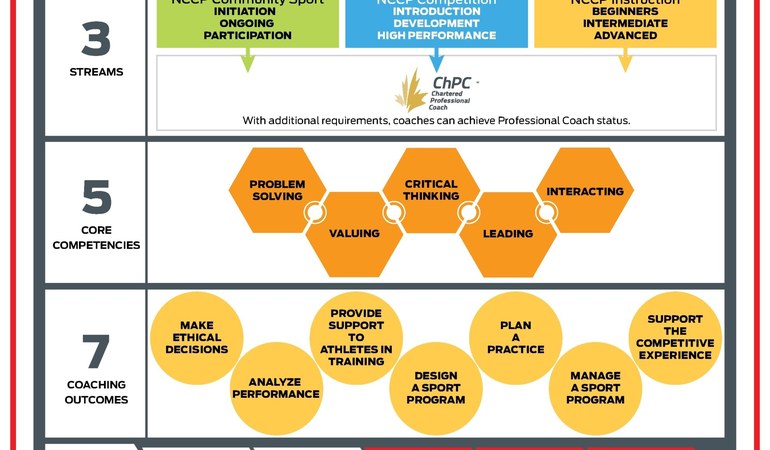
- Canada uses the National Coaching Certification Program (NCCP), a multi-sport framework. Squash Canada's pathway runs across streams (Community Sport, Instruction-Beginners, Instruction-Intermediate, Competition-Introduction, and Competition-Development), earning credentials such as Community Squash Instructor, Squash Instructor, Club Coach, and Provincial Coach, which broadly correspond to introductory, intermediate, and competition coaching. Squash Canada has noted that its coach pathway is under review and requirements may change. Canadian certifications are recognized within Canada and viewed as high standard, but a coach seeking a formal international stamp may still need a WSF certification.
- Asia: many Asian countries have adopted WSF courses or use older UK-based levels. India's national federation, for example, runs WSF Level 1 and 2 courses periodically, so coaches there can be WSF-certified, and foreign qualifications are often accepted as well. Cross-recognition occurs in practice, with coaches trained under one country's system coaching in another.
- Continental efforts: the European Squash Federation has a coach licensing scheme that mirrors the WSF, issuing diplomas at Levels 1 to 3 that are WSF-approved. A coach with an ESF Level 2 can generally coach across European member nations.
International portability. There is no single global license, but the systems are interlinked, and the WSF framework provides a common language.
- A coach with any of the major certifications can usually apply for recognition in another country. This often involves the new country's federation verifying the certificate and possibly requiring the coach to join the local registry or complete a short orientation, especially on child-protection laws or insurance.
- For example, an England Squash coach moving to Australia might be asked to obtain a SPIN and could be granted the equivalent WSC level, along with a Working With Children Check and any local induction.
- Some federations have memoranda of understanding that facilitate mutual recognition, and Pan-American bodies often cross-credit via the WSF.
Limitations. Insurance and legal coaching rights are national matters. Even a highly qualified coach must usually meet local requirements, such as joining the national governing body and obtaining background checks. A certification alone does not automatically permit coaching, so a foreign coach in England still needs a UK DBS check and insurance through the Coaches Club.
High-performance levels. At the very top, the network is smaller and less formal. Many top coaches are former professional players who may not hold a formal Level 3 award. For consistency, a WSF Level 3 or an England high-performance qualification are both seen as top-tier, and national federations handle anything beyond Level 3 through custom programs or mentorship.
A coach's certification from one of these major systems will generally be understood and often honored worldwide, especially when accompanied by WSF registration. The trend is toward harmonization: the WSF's unified structure means that whether a coach started in the US, England, Australia, or elsewhere, their qualifications map onto a common framework.
Coaches seeking international opportunities should obtain a WSF SPIN and be ready to provide evidence of their certification and experience. With squash being a global sport, this portability of coaching credentials helps raise the standard of coaching across countries.