
Strings and their tension are easy to overlook, yet they account for up to 50% of a racquet's performance. How tightly they are pulled shapes the power, control, spin, and feel of every shot. What follows is how to set yours: what low, medium, and high tension actually do, how the string material changes the picture, and a simple starting point for casual players.
How String Tension Affects Racquet Performance
Tension sets the balance between power and control, and also affects spin and feel.
Power vs. Control: The Trampoline Effect
The string bed acts like a trampoline: looser strings stretch and rebound more, so looser strings give more power, tighter strings give more control. At low tension (around 20 to 25 lbs) the strings deform more, store energy, and snap back for a livelier shot with less effort. At high tension (26 to 30 lbs) they deflect less, returning less energy but placing the ball more precisely.
Physically, power comes from the trampoline effect, set by dwell time (how long the ball stays on the strings) and string stretch. Lower tension increases dwell time and rebound velocity for more power; higher tension shortens dwell time for more control and less free power. The common belief that tighter strings add power is false, the reverse is true.
In practice: if your shots fall short, drop a few pounds for more pace at the same swing effort; if you spray the ball or struggle to control volleys and drops, add tension to firm up the bed, though you will swing harder for length. Pros span the range: Gregory Gaultier used around 14 to 16 lbs for power, while others string in the high 20s for control. Casual players need not go to extremes.
Sweet spot and forgiveness: lower tension enlarges the sweet spot and is more forgiving on off-center hits, which is why beginners often benefit from slightly lower tension. Higher tension shrinks the sweet spot, rewarding clean central contact, which suits advanced players with cleaner hits.
Spin Potential
Tension affects spin, though less than in tennis, since squash players mainly use slice (backspin or sidespin) on drops and trickle-boasts. A looser bed lets the strings move and bite the ball more, enhancing spin, an effect that is stronger with open string patterns. But very loose strings make spin harder to control, since the ball leaves at less predictable angles. A tighter bed gives a stable surface for deliberate slicing, but the short contact time means spin relies on technique.
If spin matters to your game, lean to the lower end of your range, but not so loose it gets wild. Most club players will not notice much spin difference between 24 and 28 lbs; string type and texture matter more for spin (covered later).
Feel and Comfort
Lower tension feels softer and cushioned, absorbing shock, so players with tennis elbow or arm issues often prefer looser tension and softer strings. The downside is a mushy, less responsive feel with dampened feedback, which can hurt touch shots. Higher tension gives a firmer, crisper feel with immediate feedback and confident placement, at the cost of more vibration and stiffness that can strain the arm over time, especially with stiff strings. That is why most squash players avoid very high tension. For most casual players a moderate tension balances shock absorption and feedback. Material matters too: a stiff polyester at medium tension can feel harsher than a soft multifilament at high tension.
Quick Reference: Low vs. High Tension Characteristics
The table below contrasts the extremes on key performance aspects.
| Aspect | Low tension (around 20 to 24 lbs) | High tension (around 28 to 30 lbs) |
|---|---|---|
| Power | High trampoline effect; more string stretch gives greater power with less effort. Shots fly off the strings, helpful for deep drives. | Minimal string give, so the ball gets less power from the string bed and you supply more effort. Hard hitters can still generate power, but it is not free. |
| Control | Less inherent control; the ball can rebound at slight angles if timing or contact is off. The larger sweet spot offers forgiveness on off-center hits, but precise targeting is a bit fuzzier and shots may feel a touch unpredictable. | Greater control and precision; the firm string bed provides a consistent, predictable response. You can aim shots more accurately as there is less string distortion. The sweet spot is smaller, so mishits are more erratic and lose pace. |
| Spin | Strings move and snap back more, which can enhance spin generation with more bite on the ball. Extended dwell time can make spin harder to control, so you might get more spin but less consistency in placing it. | Strings are static with little snapback, so spin comes mostly from your technique. A tighter bed can bite the ball quickly, good for slice, but the short contact time limits how much spin is imparted. It is easier to control trajectory, but you do not get extra spin from the string bed. |
| Feel and comfort | Soft, cushioned feel. A more elastic impact reduces shock to your hand and elbow, comfortable for long sessions. Feedback is dampened, which can make touch shots feel less precise. | Firm, crisp feel. Immediate feedback on contact, so you can feel exactly where and how you hit the ball. This aids touch and awareness. The flip side is more vibration and a harder feel on impact, which can be taxing for the arm over time. |
These refer to the extremes within typical squash ranges; most players settle in the middle.
Comparing Tension Levels: Low, Medium, and High
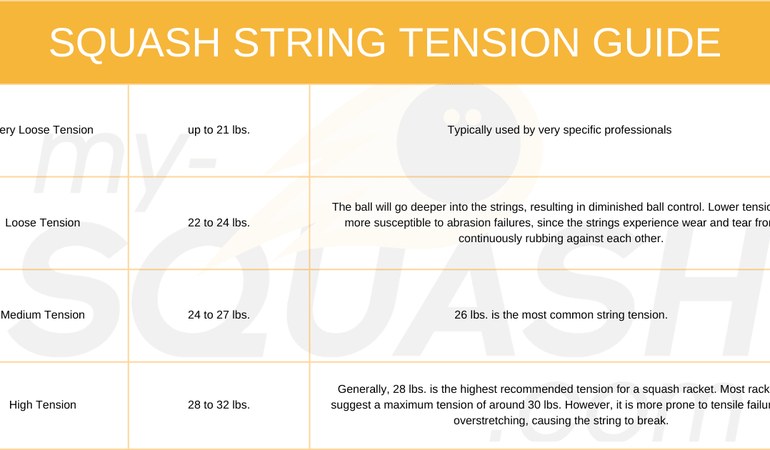
Squash racquets are typically strung from about 20 to 30 lbs (9 to 14 kg), with most makers recommending roughly 24 to 30 lbs. Factory racquets often arrive at mid-20s (about 25 to 27 lbs).
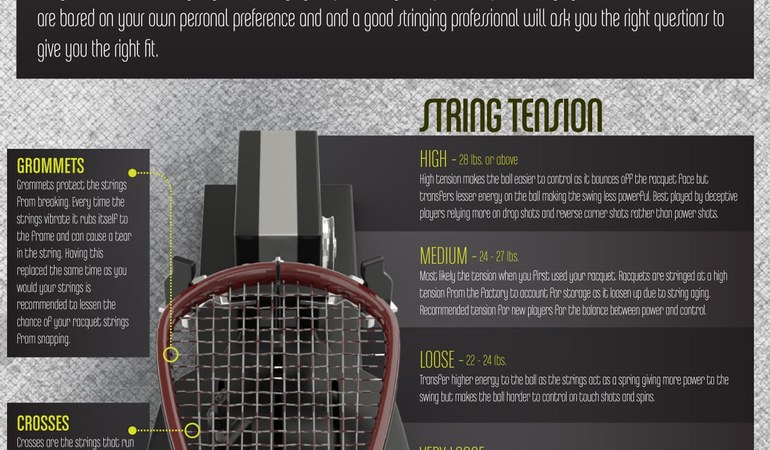
Low tension, around 20 to 24 lbs: more power and a larger margin for error, easier length, favored by hard hitters. The feel is soft and pockety, with reduced control on delicate drops. Below about 21 lbs is rare, since control near the front wall becomes poor. Good for slower swing speeds or players struggling for power, but do not start too low.
Medium tension, around 25 to 27 lbs: the goldilocks zone for most club players, balancing power and control with a decent sweet spot. If unsure, start at 25 to 26 lbs; about 26 lbs is a commonly cited average. New racquets often ship tighter (27 lbs or more) to allow for tension loss in storage, then settle into the mid-20s.
High tension, around 28 to 30 lbs: control and a crisp, fast feel with pinpoint accuracy, but little help generating power, so it needs good technique. It suits volleyers and strong hitters who want to avoid over-hitting. Stringing above about 30 lbs is not recommended, since it risks frame damage or string breakage and the racquet can feel dead.
Any tension drops as you play: string at 28 lbs and it may play like 26 after a few weeks. Managing that and restringing frequency are covered below.
String Materials and Brands: Interaction with Tension
Material and construction matter as much as tension, since the same tension feels very different on a plush multifilament versus a stiff polyester.
Natural gut: made from animal intestine, rarely used in squash due to cost and durability. It has exceptional elasticity and tension retention, giving high power, great control, and a soft, arm-friendly feel even at higher tensions, and it remains the performance benchmark. Using a natural gut tennis string in squash means roughly half the performance for four times the price. Babolat VS Gut is famous in tennis; there is no mass-market squash gut.
Synthetic gut (nylon): a solid-core nylon string, common on beginner and factory racquets. Inexpensive, with moderate power and a comfortable feel, but it loses tension quickly: one report showed a multifilament nylon lost about 17% of its tension after stringing, 45% more than a comparable Zyex string. Players often string nylon 1 to 2 lbs above target to allow for the drop. Most pre-strung racquets use synthetic gut around 1.20 mm at mid tension. Examples: Dunlop Synthetic Gut, Prince Synthetic Gut.
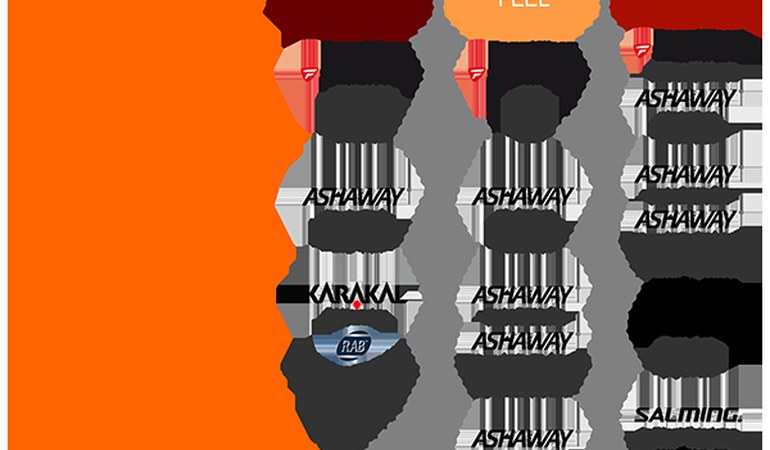
Multifilament: many fine fibers bundled to mimic gut, giving improved power, comfort, and feel, and very popular at intermediate and advanced levels. It holds tension better than synthetic gut (not as well as gut or Zyex) and balances power and control; being softer, it can be strung slightly tighter and stay comfortable (27 lbs in a multi can feel fine where poly would be harsh). Multis can lose around 10% or more on the first day and fray or break faster than poly. The big names are Tecnifibre and Ashaway: Tecnifibre 305 (a 305 mm squared cross-section multi, the iconic green string), plus DNAMX and X-One Biphase; Ashaway's SuperNick series (SuperNick XL, SuperNick ZX) with a textured, control-oriented feel. Head, Dunlop, Prince, and Karakal also offer multifilaments.
Zyex strings (PEEK material): a high-tech polymer popularized by Ashaway, with very high elasticity and excellent tension retention. Lab tests showed Zyex-based strings lost as little as around 9 to 12% tension versus nylon's around 17%. Its low dynamic stiffness (closer to gut) gives good power and a softer feel, playing crisp but powerful without feeling mushy, so you can string in your normal range rather than overly high. Examples: Ashaway UltraNick 18 (a 1.15 mm Zyex multifilament core) and Ashaway SuperNick ZX (Zyex mono core with a multifilament wrap, textured for spin). They cost more but go dead more slowly, so you restring less often.
Polyester and other stiff monofilaments: uncommon in squash. Polys are durable and spin-friendly in tennis but stiff and low-powered, feeling board-like in a light squash racquet, and the smooth squash ball slides on them, reducing spin and feel. Poly also loses tension through creep and is harsh on the arm. Most stringers advise against it; if used, string about 10% lower to soften it. Hybrid stringing (poly mains, softer crosses) is uncommon in squash. Some players use a tennis poly such as Luxilon ALU Power or Tecnifibre PolyCode (Ashaway's Monogut ZX is actually Zyex, not polyester).
Other materials: Kevlar and aramid are super stiff and abrasive, making a squash racquet feel like a plank, so they are not recommended. "Titanium" strings are usually just a coating; liquid crystal polymer appears in some high-end tennis strings. Sticking to gut (rare), multifilament, synthetic gut, or Zyex keeps you in good shape.
Brands to know:
- Tecnifibre: the 305 and DNAMX lines, both great multifilaments.
- Ashaway: the SuperNick and UltraNick lines, with multifilaments and Zyex tech.
- Dunlop: often provides factory strings, and their premium Dunlop Precision is a multi.
- Head: the Reflex 1.20 squash multi and Evolution.
- Prince: had SuperSyn and others.
- Karakal: popular squash strings like the Karakal Nano 125.
- Oliver, Salming, and Wilson: also have string products.
- UNSQUASHABLE: the Tour-Tec Pro string, a multifilament designed to mimic gut's playability.
How materials interact with tension:
- Soft string (gut or multifilament): string a bit higher for control without losing all the power or comfort.
- Stiff string (polyester or aramid): string lower to avoid a board-like feel and to protect your arm.
- Thinner gauge plays bouncier (it stretches more), effectively looser, so you may increase tension or simply enjoy the extra power.
- Thicker string can be strung a bit lower and still control well, but it feels less lively.
- Some strings are more tension-sensitive: a cheap nylon plays very differently at 25 versus 28 lbs, while a high-end Zyex performs evenly across tensions.
Best Practices for Stringing Squash Racquets
Stay within the recommended tension range: check the frame, usually marked with a max (often 30 lbs) or a range like 20 to 30 lbs. Exceeding the max risks cracking or warping the frame and may void the warranty; going far below can make the racquet uncontrollable and stress the frame.
Use a good stringer or a well-calibrated machine: different machines (drop-weight, crank, electronic) can yield different real tensions, so 28 lbs on one may feel like 26 on another. Stick with one stringer for consistency, and calibrate if you string your own. String the crosses top to bottom to protect the frame shape, avoid pulling strings too fast (friction weakens them), and clamp correctly.
Mind the head shape: teardrop (open-throat) racquets have longer strings that stretch more and play looser, so they are often strung a bit tighter than closed-throat heads, for example 27 lbs on a large teardrop versus 25 lbs on a smaller head for equivalent stiffness. Adjust a pound or two when switching models.
Account for tension loss: all strings lose tension over time, with most of the drop in the first 24 to 48 hours; a nylon can lose around 10% or more by the next day. String slightly higher than target with strings that lose tension quickly, or pre-stretch multifilament nylon before installing. Do not pre-stretch polyester (it gets too stiff); gut and Zyex hold tension well and need no pre-stretch. Your 27 lbs today may be around 25 lbs in a week.
Restring regularly: a common guideline is to restring as many times per year as you play per week, so twice a week means at least twice a year, and four or more times a week may mean every few months. Restring at least once a year even if you play less, since strings go dead. If the racquet has lost its zing or you are swinging harder for the same result, restring rather than waiting for a break, since dead strings underperform and can strain your arm.
Stringing patterns: patterns vary (dense 14 by 18, open 16 by 15). A dense pattern feels stiffer (more control) at the same tension, while an open pattern is livelier and breaks strings faster. Adjust roughly +1 lb for an open pattern and -1 lb for a dense one. Some racquets offer interchangeable patterns, like Head's Adaptive Fan Pattern.
Avoid mixing incompatible strings: stick to squash strings or known crossovers. Tennis polyester is not advisable (the ball slides and the feel is poor). Thick tennis strings (1.30 mm and up) are too stiff for the smaller frame; some 17 to 18 gauge (around 1.20 mm) tennis multifilaments can work, but results vary. Popular squash strings are 1.10 to 1.20 mm nylon multifilaments because that formula suits the sport.
Inspect grommets and frame: when restringing, check the grommets for damage that can snag and break strings, and inspect the frame for hairline cracks before it fails on the machine or on court.
Recommendations for Casual Players

Start in the mid-range: if unsure, begin around 25 lbs (about 11 to 12 kg), close to many factory defaults, then judge from that reference point.
Match tension to skill and style:
- Beginner or slower swing: 22 to 24 lbs for extra power and a forgiving sweet spot while you develop technique.
- Intermediate: 24 to 27 lbs for a blend of power on drives and control on volleys and drops.
- Advanced or strong hitter: 27 to 30 lbs to rein in the ball for accuracy, accepting reduced comfort and string life.
Consider conditions: in cold conditions the ball is less lively and strings feel stiffer, so you might drop a pound or two; in warm conditions or at altitude the ball is bouncier, so some go slightly tighter. Most courts are climate-controlled, but minor tweaks can help.
Match tension to string type: mid tensions suit a multifilament or synthetic gut; with a polyester, string lower (try about 24 lbs instead of 26). A very thin, bouncy string may want a touch more tension. Not all strings feel the same at the same number, so ask whether a string is on the powerful or control side and adjust by a pound.
Watch how your game responds: if soft shots fly too long, go tighter next time; if you cannot get depth or it feels like hitting with a plank, go looser. Arm soreness or excessive vibration suggests dropping a couple of pounds or changing strings; a too-mushy feel suggests raising tension.
Adjust in small steps: change only 1 to 2 lbs at a time, since even 1 lb is noticeable. Iterate over restrings (try 25, then 27) and note the tension and string used until you find your number.
Maintain your strings: realign the strings after play, especially at lower tensions, and restring before they die or break at a bad time. A quality string job costs on the order of $30, far less than a new racquet, and replacing worn factory strings with a good multifilament at the right tension is one of the most cost-effective upgrades in squash.
Example scenarios:
- A beginner on a starter racquet strung around 26 lbs with basic nylon could drop to about 24 lbs with a good multifilament for more power and a bigger sweet spot.
- An intermediate all-rounder might stay around 25 to 26 lbs but upgrade the string, restringing three to four times a year.
- An advanced league player who hits hard and volleys might choose 28 to 29 lbs with a premium 17 gauge string, restringing every four to six weeks as high-tension strings lose playability faster.
For most casual players, use a good multifilament at around 25 lbs, then adjust a pound or two: looser for beginners who want easy power, tighter for strong hitters who want control. The rule is simple: loose for power, tight for control, and balance for a bit of both. Combined with the right string and regular maintenance, it is a reliable way to get the most out of your racquet.