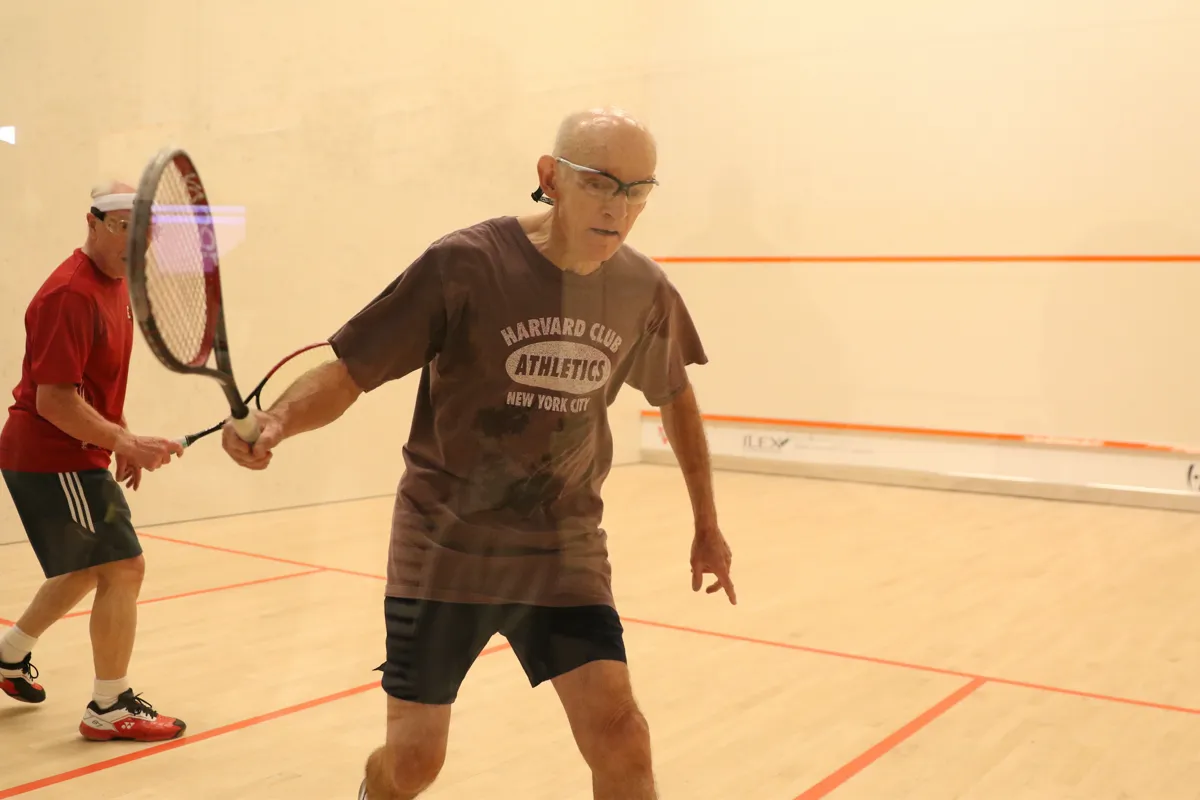
Introduction
The squash swing is a complex, explosive movement that links the entire body, from the ground up, to produce a fast, accurate shot. A good swing efficiently coordinates multiple joints and muscle groups in sequence, maximizing power and control while reducing injury risk.
Biomechanical analysis of squash strokes is useful in several ways:
- Coaching: to teach proper technique.
- Performance: to hit harder and more accurately.
- Injury prevention: by reducing harmful loads.
- Modeling: to quantify forces and motions.
Studies using high-speed video, 3D motion capture, force plates, and electromyography (EMG) have clarified the key phases of the swing, muscle activation patterns, joint kinematics and kinetics, and common technical errors. This article gives an in-depth overview of forehand and backhand swing biomechanics, drawing on sports science research and practical coaching knowledge.
Phases of the Squash Swing
A squash swing can be broken into distinct phases, each with specific biomechanical characteristics and objectives.
Preparation and stance
The player sets proper footwork and body position before the swing. For a forehand, a right-handed player typically leads with the left foot; for a backhand, the right foot leads. A stable, wide stance with knees bent lowers the center of gravity and aids balance.
The body turns sideways (toward the side wall on the side of the incoming ball) as the player tracks the ball. This loading position aligns the body with the shot and begins storing energy in the legs and trunk. Grip and racket preparation are also set here, with the racket held up and the wrist cocked so the racket head sits above the handle before the swing.
Backswing (wind-up)
The player winds up by rotating the trunk and shoulders away from the target while drawing the racket back. On the forehand, the torso turns toward the back-right corner; on the backhand, toward the back-left corner. The arm is taken back with the elbow relatively close to the body (not flared too high) and the racket head often raised above the shoulder. The non-racket arm often counter-balances, for example pointing toward the ball or side wall, to aid stability.
During this phase, many muscles are pre-activated and stretched, storing elastic energy: the hips and trunk rotate and coil, the shoulder girdle muscles stretch (the pectorals on the forehand, or the posterior shoulder on the backhand), and the forearm muscles prepare for the later pronation or supination.
Bending the knees and loading the back leg are critical; this prepares a powerful push and keeps the body low for a better swing plane to the low-bouncing squash ball. In short, the backswing creates a whole-body spring, maximizing the distance and the number of muscle groups over which force will be applied.
Forward swing (acceleration)
This phase releases the stored energy in a coordinated, proximal-to-distal sequence. The legs drive first: the player steps into the shot, pushing off the back leg and transferring weight onto the front leg while moving the body toward the ball.
Immediately after, the hips and trunk rotate toward the target (the front wall). For a right-hander, this means rotating leftward on a forehand and rightward on a backhand, bringing the torso to face the front at impact. This trunk rotation initiates the upper-body motion and creates a powerful torso twist.
Next, the shoulder and arm swing through: the upper arm adducts horizontally and the shoulder internally rotates, driving the racket forward. The elbow extends rapidly, and the forearm pronates (forehand) or supinates (backhand), while the wrist begins to un-cock (a controlled flick) just before contact.
This sequence, often called the kinetic chain, follows a timing in which each segment reaches peak speed slightly before the next, more distal segment, summing their velocities. In an efficient swing, the legs, hips, trunk, shoulder, arm, and finally the forearm and wrist act in order to maximize racket-head speed. Research confirms this proximal-to-distal pattern: in squash forehands, peak angular velocities travel from trunk to shoulder to forearm to wrist, much as in other racket sports.
By the end of this phase, just before impact, the body has shifted forward with the front knee bent, the trunk facing mostly forward (though often still slightly side-on relative to the target for control), and the arm extended.
Impact (contact)
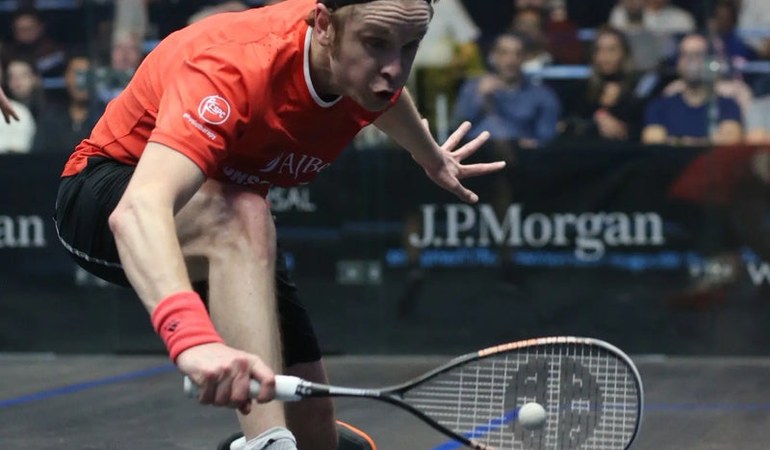
The critical instant of the swing is when the racket strikes the ball. Ideally the ball is contacted slightly in front of the lead foot and within comfortable reach, not too close to the body. At impact, the arm is nearly fully extended (a straight but not locked elbow) and the wrist is close to neutral or slightly extended, not fully flicked yet, which preserves control.
The racket-face angle and swing path matter: for a straight drive, coaches recommend a slightly open face with a swing that cuts down and across the ball (right to left for a right-hander's forehand) to impart a little slice, keeping the shot low and tight to the wall. Biomechanically, the racket should be moving fastest at impact; motion capture shows that racket angular velocity at impact accounts for much of the variation in ball speed.
The main contributors to this peak speed are shoulder internal rotation together with forearm rotation, wrist action, and near-full elbow extension. Of these, shoulder internal rotation is the single largest contributor to racket-head speed, with wrist flexion and forearm pronation adding meaningful but smaller shares. In a backhand, a comparable role is played by forearm supination or pronation (depending on grip) and shoulder rotation, similar to a frisbee-throwing motion with the racket arm.
Skilled players achieve greater forward racket speed at impact than less-skilled players; one study of forehand drives found that highly skilled players had faster racket velocities and a more closed (downward) racket face at impact, whereas less-skilled players swung slower and with a more open face. This indicates that good mechanics, an efficient swing path and good timing, produce both higher speed and better control of ball trajectory.
Follow-through and recovery
After the ball is struck, the arm and racket continue through in a follow-through, which decelerates the arm safely and produces a smooth finish. The wrist acts like a hinge; it stays firm through impact and is then allowed to release naturally after contact. In a good follow-through, the racket continues along the shot direction, which aids accuracy.
The muscles, especially in the shoulder and arm, brake the limb: the rotator cuff and biceps help decelerate the rapid arm rotation and elbow extension, reducing stress on the joints. The player's weight is now fully on the front leg.
A defining feature of squash, distinct from tennis, is quick recovery: right after the shot the player must push off the front leg to return to the center of the court. In a good swing, the front leg that bent and acted as a buffer during the shot now drives backward. The player reloads by springing back toward the T (center) with a slight hop or shuffle, knees bent, ready for the next shot.
A good follow-through thus flows into efficient movement; landing the lunge with a bent knee and balanced posture allows a quick push-off without losing stability. This phase also dissipates the forces safely. If a player were to halt the swing abruptly at impact, the sudden stop could raise injury risk; the follow-through lets momentum resolve gradually. After the follow-through, the player resumes a neutral, athletic stance, completing the cycle.
Each phase relies on coordinated contributions from several joints. The backswing stores energy through stretch and rotation, the forward swing releases that energy in sequence (legs, then trunk, then arm, then racket) to maximize speed, impact requires precise alignment and timing to transfer energy to the ball, and the follow-through ensures controlled deceleration and readiness to move again. Errors in any phase can lead to weaker shots or higher injury risk, as discussed later.
Kinematics: Swing Mechanics and Coordination
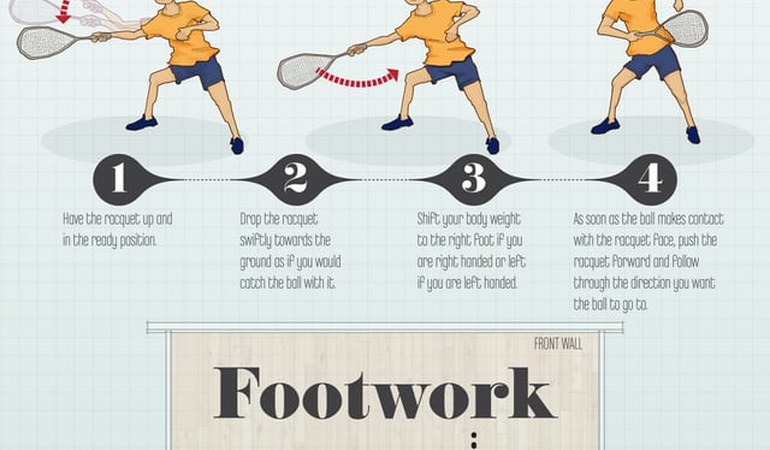
The kinematics of the squash swing show how skilled players generate powerful, efficient strokes. A hallmark of a good swing is the synchronized rotation of body segments, the swing plane and the kinetic chain.
In squash, the swing plane is typically a slightly inclined vertical plane, because players cut down on the ball to keep it low. The plane varies with shot type, for example a higher backswing and more downward cut for a dying length shot versus a flatter swing for a hard drive. Key kinematic aspects include the following.
Trunk rotation and flexion
The torso contributes significantly to swing power. During the swing the trunk rotates toward the shot. Elite players use rotation rather than excessive forward bending; a study comparing skill levels on the backhand found national-level players had greater trunk forward flexion at impact, whereas international-level players stayed more upright and relied more on rotation and shoulder action.
Less trunk flexion (keeping the torso up) can improve swing efficiency and reach, while excessive bending may signal compensation for poor timing or positioning. Good technique involves some forward lean for balance and to reach low balls, but it should be controlled, with the trunk mainly rotating in the transverse plane to add racket speed. Trunk rotation is one of the segmental movements that contributes most to racket motion at contact, which underlines how important it is to turn the shoulders and torso.
Shoulder and arm motion
The shoulder joint goes through a combination of motions. On the forehand, the shoulder is often abducted (upper arm away from the body) in the backswing and then rapidly adducts and internally rotates during the swing. On the backhand, the arm may start more adducted across the body and then extend outward.
A 3D analysis noted that at impact, elite backhand players tended to have the shoulder in slight adduction (arm closer to the body), whereas less-skilled players were in abduction (arm flared out). Tucking the elbow in under the shoulder rather than chicken-winging it out is mechanically efficient; it allows better use of trunk rotation and protects the shoulder.
The shoulder's internal rotation is a major source of power: internal and external rotation of the upper arm, combined with forearm rotation and wrist action, largely determines racket-head speed and orientation, and shoulder internal rotation is the largest single contributor of the three. Research has shown a proximal-to-distal sequence where peak angular velocities progress from trunk to shoulder rotation to forearm pronation to wrist flexion in the squash forehand. The shoulder must transfer energy to the arm at the right moment; rotating too early or too late reduces the sum of speeds.
Elbow action
The elbow acts mainly as a hinge for power transmission and reach. During a good swing, the elbow moves from a flexed position in the backswing to nearly full extension at impact. Joint-angle measurements in an intermediate player showed elbow extension on the order of 30 to 36 degrees short of full lock at impact, essentially an almost straight arm, which is commonly seen in well-executed shots.
This extended arm at the critical instant is desirable because it shows the player used the full range of arm extension to accelerate the racket, and a fully straight arm at contact also positions the player well for the recovery lunge and maximizes reach. Hyperextending the elbow or forcefully locking it out can increase injury risk (valgus stress), so the slight bend matters.
Elbow extension contributes to racket speed, but it is not the sole driver; forearm rotation and shoulder rotation account for a large share of racket-head velocity relative to pure elbow extension. A strong triceps extension is part of the chain, but timing it with the shoulder and forearm rotation is what produces an explosive shot.
Forearm rotation (pronation and supination)
Forearm rotation is a distinctive element of squash swings. Because squash swings often involve some cut or slice, forearm rotation helps control the racket-face angle and add spin. On a forehand the forearm pronates through impact, much like turning a doorknob inward. On a backhand many players supinate the forearm (turning the palm upward) in the latter part of the swing, similar to the frisbee-throw analogy.
Several studies highlight this motion. Woo and Chapman (1991) observed that in squash forehands a pronation of the forearm and flexion of the wrist were important for power generation, with a clear proximal-to-distal sequence. More recently, Williams and colleagues (2020) found skilled players have a significantly larger forearm pronation and supination range of motion than less-skilled players during the forehand drive, indicating they use forearm rotation more effectively.
Proper forearm rotation keeps the racket face oriented correctly (not overly open) at impact and contributes to ball control. Inadequate pronation on a forehand might leave the face too open, sending the ball high or too central; skilled players time the rotation so the face is just slightly open or near vertical at impact for a low trajectory.
Timing is crucial: peak forearm rotation velocity should coincide with impact. If the forearm rotates too early, the player may lose racket-head speed or mishit; too late, and the ball may slide off the strings with less directed force.
Wrist mechanics
The wrist in squash acts as a controlled hinge that can add whip to the swing but must be precisely managed. Unlike tennis, where a big wrist snap is generally not taught for groundstrokes, squash players do use a late wrist flick, particularly on deceptive shots or last-second adjustments.
In a good drive, the wrist is firm but not locked through most of the forward swing. It is slightly extended (bent back) during the backswing and then moves toward flexion as the racket comes through. Peak wrist flexion often happens just after contact, which means the wrist contributes more to the follow-through than to pre-impact speed and helps with control.
EMG data show significant activation in the wrist flexor and extensor muscles during the swing, but the pattern is similar across different backhand shot types, suggesting the wrist action is fairly consistent in basic swings and mostly stabilizes the racket. High-skill players often hold a more extended (cocked) wrist at impact than lower-skill players, in line with keeping the wrist firm through impact for control and then releasing.
After contact, the wrist naturally continues to flex forward in the follow-through. The combination of forearm rotation and wrist motion is sometimes called wrist snap, though it is really a coordinated forearm and wrist action. The wrist provides fine-tuning of the racket-face angle and adds a little last-moment acceleration, but a good swing avoids excessive early flicking and sequences the wrist motion last in the chain for a controlled yet powerful strike.
In a well-coordinated swing these kinematic elements blend together. Motion analysis of elite players shows they reach higher ranges and speeds in key joint motions (shoulder internal rotation, forearm pronation, and so on) than lower-level players without sacrificing control.
They also show different kinematic signatures depending on the stroke; a full drive involves larger, faster joint movements than a soft drop shot. A study of three stroke types (drive, volley, drop) found drives had the greatest rates of shoulder internal rotation, forearm pronation, elbow extension, and wrist flexion, whereas drop shots used much smaller ranges and slower motions. Players modulate the same fundamental movement for different outcomes; the swing is adaptable but always relies on proper sequencing and timing.
Picture the squash swing as a multi-link whip: the legs initiate, the hips and trunk follow, then the shoulder, elbow, and wrist in turn, each link accelerating and then passing momentum to the next. If one link is out of sync (for example the arm moves too early, before the body rotation), the chain breaks and the swing loses efficiency.
Coaches emphasize leading with the body and letting the arm lag slightly, rather than muscling with the arm too soon. This kinetic-chain concept is backed by biomechanical evidence across sports, and in squash a proximal-to-distal sequence has been explicitly documented. Good kinematics means the whole body works as one unit, producing a smooth, powerful swing plane that sends the ball accurately to the target.
Muscle Activation Patterns (EMG Insights)
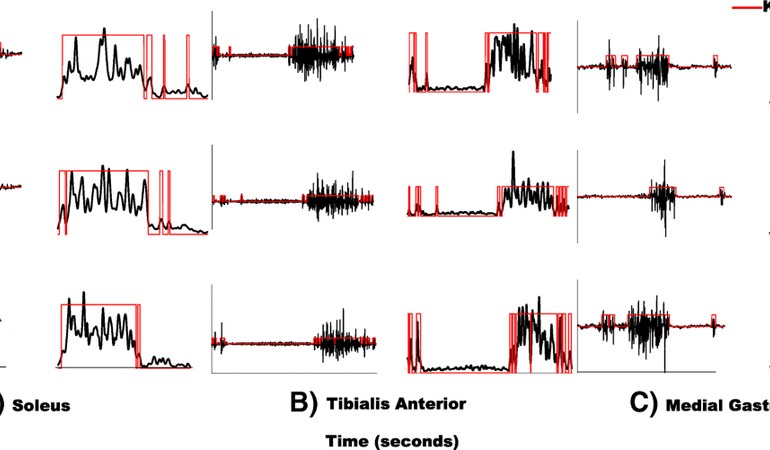
A squash swing is a full-body effort, recruiting muscle groups from the legs and core up through the shoulder and forearm. EMG studies have identified key muscle activation patterns during forehand and backhand strokes, showing how the musculature contributes to each phase.
Lower body
The swing begins in the legs. Muscles of the rear leg during the backswing, such as the gluteus maximus and quadriceps, fire to initiate the push-off, while the lead leg's quads and glutes engage eccentrically to brace the lunge and then concentrically to propel the body back.
One EMG study found significant activation of the gluteus maximus in squash backhands, especially when lunging out to the front court. The gluteus medius and hip stabilizers also activate to maintain balance during the stepping and lunging motion. As the player steps into the shot, the calf muscles (gastrocnemius and soleus) help control the ankle and provide a final push.
EMG data from junior elite players performing ghost swings recorded notable lower-limb activity; the rectus femoris (quad) and biceps femoris (hamstring) help stabilize the knee during the lunge and swing, with differences between mid-court and front-court shots in how much these muscles are used. In short, the legs and hips create a stable, strong base, and high activity in the glutes, quads, and hamstrings is needed both to generate force and to absorb impact safely.
Core (trunk) muscles
The core links the lower and upper body and plays a dual role: generating rotational power and stabilizing the torso. The oblique muscles (internal and external obliques) are heavily involved in trunk rotation; for a right-hander, the left external oblique and right internal oblique fire strongly when rotating the trunk to the right (as in a backhand), and the opposite pairing fires for a forehand rotation.
The rectus abdominis and erector spinae co-activate to maintain torso posture and transfer force upward. EMG measurements confirm high activation in these areas, including significant activity in the rectus abdominis during a backhand swing. Strong core engagement is evident during the swing's transition; during the backswing the abs and obliques tighten to coil the torso, then during the forward swing they contract powerfully to uncoil.
The core muscles also protect the spine by limiting excessive torso sway or arch. Trunk muscle activation is continuous throughout the swing, peaking as the shoulders rotate through impact. This is why coaches stress core strength for squash players; a strong core ensures stability and aids power transfer, and core training is recommended to improve swing biomechanics.
Shoulder girdle and upper arm
The shoulder complex involves many muscles: the deltoids (anterior and posterior), pectoralis major, latissimus dorsi, and the rotator cuff group (supraspinatus, infraspinatus, teres minor, subscapularis), all contributing at different times.
For the backhand, a 2024 study compared muscle firing in two shot variants (straight and crosscourt) and found the anterior deltoid was highly active during the swing and follow-through, particularly in straight drives, whereas the posterior deltoid was more active throughout the swing when hitting crosscourt. This makes sense: a straight backhand drives the arm forward (an anterior motion), while a crosscourt backhand pulls more across the body (engaging the posterior shoulder).
In general, the anterior deltoid and pectoralis major are prime movers in bringing the arm forward for the forehand, similar to a throwing motion, whereas the posterior deltoid and mid-back muscles (such as the rhomboids) help in the backhand, like a reverse throw. The latissimus dorsi can aid both strokes by adducting and extending the shoulder; on a forehand it helps bring the racket down and through, adding power as the arm is lowered from the backswing.
The rotator cuff muscles, particularly the subscapularis (an internal rotator) and infraspinatus and teres minor (external rotators), are crucial for controlling shoulder rotation and stabilizing the joint during the fast motion. These small muscles often fire eccentrically to decelerate the arm after impact or to fine-tune the arm's path.
Upper arm (elbow) and forearm
The triceps brachii is a major mover, extending the elbow during the forward swing. EMG data show triceps activity surging during the acceleration phase and into the follow-through, especially on powerful drives. The biceps brachii acts as a stabilizer during the backswing (controlling racket position) and as a brake in the follow-through (to decelerate elbow extension). One study found biceps activation varied with movement pattern, differing between hitting after a mid-court movement and after a front-court lunge, which suggests body position influences how much the biceps is used.
The forearm muscles, notably the wrist flexors (such as flexor carpi radialis), the wrist extensors (such as extensor carpi radialis), and the pronator teres and supinator, are very active in the squash swing. These muscles control the racket angle and contribute to racket-head acceleration.
EMG in squash strokes shows substantial forearm activity throughout the swing, with the pronators particularly taxed on forehands and both supinator and pronator active on backhands for controlling the racket face. In both forehand and backhand, the wrist flexor and extensor groups co-contract to stabilize the wrist at impact, which ensures the wrist does not collapse and that energy is transmitted to the ball. These muscles then help snap the wrist through and prepare for quick grip changes for the next shot.
The table below summarizes key muscle groups and their roles in the squash swing.
| Muscle group | Main muscles | Role in the swing |
|---|---|---|
| Lower body | Gluteus maximus and medius, quadriceps, hamstrings, calves | Drive the stepping lunge (power from the ground), stabilize the legs during the swing, absorb impact on landing, and initiate the recovery push-off. High glute and quad activity generates and handles ground reaction forces. |
| Core (trunk) | Obliques (internal and external), rectus abdominis, erector spinae | Rotate the torso and maintain posture, transmit leg drive to the upper body. High oblique activation for rotational power; abs and back co-contract for stability. Key for controlled trunk motion and preventing collapse. |
| Shoulder girdle | Pectoralis major, latissimus dorsi, anterior and posterior deltoid, rotator cuff (for example subscapularis, infraspinatus) | Accelerate the arm and racket. The pec and anterior deltoid drive the arm forward, especially on the forehand; the posterior deltoid and upper back engage more on the backhand. The rotator cuff centers the shoulder and assists internal rotation (subscapularis) or deceleration (external rotators). |
| Upper arm (elbow) | Triceps brachii, biceps brachii | The triceps extends the elbow for power; the biceps controls swing length and decelerates in the follow-through. It also stabilizes the elbow during rapid forearm rotation. Active in all swing phases, with usage varying by footwork pattern. |
| Forearm and wrist | Forearm pronators and supinators, wrist flexors and extensors (for example flexor carpi radialis and extensor carpi radialis) | Forearm rotation adjusts the racket face and adds racket-head speed; the wrist muscles stabilize and then flick the racket through. Co-contraction at impact gives a firm wrist, then a controlled release. Critical for finesse and final acceleration. |
This coordination shows why the squash swing is such an athletic movement; it recruits everything from the legs to the fingertips. The timing of muscle firing is as important as the magnitude. The glutes and quads must fire early to drive the movement, the core and shoulder muscles fire next to rotate and swing the arm, and the forearm muscles fire last to snap the racket through.
EMG studies also note that different shot types or conditions change the muscle demands: a deeper front-court lunge increases glute and hamstring use, whereas a quick mid-court stroke may rely a bit more on the upper body when there is less time to set the legs. Muscle activation patterns can also differ between elite and amateur players.
Elite players often show more synchronized and sometimes higher peak activations in key muscles but for shorter durations, indicating efficient, targeted muscle use. Amateurs may show more prolonged or erratic firing, either from poor timing or from using extra muscles to compensate for instability. An amateur might over-rely on the arm muscles (deltoid, triceps) because they did not generate enough force from the legs and core, leading to fatigue and possible arm injury. Over-reliance on the arm is a common error in novices, confirmed by both research and coaching experience. Proper training, such as strength and conditioning focused on the legs and core, can improve the balance of muscle activation, letting players use the big muscles for power and the smaller muscles for control.
Understanding these muscle patterns also matters for injury prevention. If certain muscles (for example the rotator cuff or forearm extensors) are under-conditioned or overused, injuries like rotator cuff tendinitis or tennis elbow (lateral epicondylitis) can occur. Knowing that the forearm muscles fire intensely with each swing explains why grip and forearm conditioning are important to avoid tendon strain. Similarly, high glute activation indicates that weak glutes could put more stress on the knee during lunges. EMG-driven insight helps tailor training programs (specific strength exercises or muscle endurance work) to the demands of the squash swing.
Ground Reaction Forces and Footwork
A good squash swing is not only about upper-body mechanics; footwork and the use of the ground are foundational. Squash players often hit while lunging or in a wide stance, so ground reaction forces (GRFs) and foot mechanics matter for both performance and injury risk. Force-plate studies have quantified these forces, especially during the lunge that commonly accompanies squash shots.
When a player lunges into a forehand or backhand, the leading foot contacts the ground forcefully. Force-plate studies of squash lunges report peak vertical ground reaction forces of roughly 1.9 times body weight for a standard lunge, rising to about 2.25 times body weight for a break-foot lunge. These are demanding loads on the lower limbs, though somewhat lower than the badminton lunge, which can exceed 2.5 times body weight.
A study of junior squash players measured lunge forces for forehand and backhand ghost swings and found no major difference in peak force magnitude between forehand and backhand lunges; both sides generate high forces when done with proper footwork. The lack of difference suggests players should train both legs equally for lunging strength, since squash demands the ability to lunge to either side.
Differences did appear with skill and experience: experienced juniors handled the lunge impact differently than less experienced juniors. Specifically, the study found the following.
- Experienced players (older juniors) tended to have a higher initial impact peak (a quick spike when the foot first contacts, likely a heel strike) but lower subsequent loading than less experienced players.
- Developing players (less skilled) showed a lower immediate impact peak but a higher secondary force, meaning they likely put the foot down flatter and then absorbed the weight less effectively, producing a larger force as they fully loaded the leg.
In plain terms, skilled players executed a more controlled lunge: they might land heel then toe (a small initial impact) and bend the knee more on landing, spreading the force out and reducing the loading rate. Less skilled players often landed with a stiffer leg or more flat-footed, producing a sudden jolt of force and less ability to absorb that shock, which indicates they were not using eccentric muscle control as effectively. The inexperienced group used less ankle and knee flexion to cushion the landing.
These findings have direct implications.
Performance
A stable, strong lunge lets a player hit from a solid base. If you can plant firmly without slipping or wobbling, you can transfer force upward into the swing more effectively. A deeper lunge (lower center of gravity) can also put you in a better position to swing along the desired plane, especially for low balls.
Force-plate data combined with kinematics show that knee angle at touchdown matters; bending the knee more on landing, to a point, allows better absorption and a quicker transition to pushing off again. Experienced players often show a flexed knee on contact and then use that stored elastic energy to rebound.
Injury prevention
The lunge is closely linked to injuries in squash, particularly knee (patellofemoral pain, meniscus) and ankle injuries. The high forces, repeated many times, can strain these joints. Good biomechanics reduce risk: keeping the knee from collapsing inward (valgus) and roughly above the ankle (not far past the toes) helps distribute forces safely.
The study above implies that learning to soften the landing by using the muscles to cushion impact is crucial; inexperienced players who have not developed the necessary coordination and strength experience higher impact load, which could contribute to knee pain or injury. From a coaching perspective, teaching correct lunge technique (heel to ball-of-foot landing, knee flexion, proper alignment) is key.
The conclusion of that junior study was that developing players tend not to use the high impact forces efficiently and have not yet learned to reduce the effect of impact loading. Over time that inefficiency could turn into chronic knee stress, so drills and strength exercises for deceleration, such as lunge exercises focused on controlled landings, can make a big difference.
Ground force for power
Squash coaches often talk about using the ground for power. This means pushing against the ground to initiate the swing, much like a sprinter pushing to start a race. Force-plate evidence supports that a strong push-off generates considerable horizontal and vertical force.
Squash players do not jump in the air on most swings (except sometimes when volleying high balls), but they still generate horizontal braking and propulsive forces. A powerful lunge into the ball followed by a push-back off the front leg uses the ground both to hit and to recover.
Some coaches use the idea of loading the ball of the foot: as you step in, you coil and then explode off the ground, which translates into a faster swing and a quick return. A force platform would show a spike in horizontal force at the moment of direction change, from moving forward to pushing back. In other sports such as golf, training on force plates has shown athletes can learn to maximize ground reaction force patterns for more power; in squash, while research is sparse, it is reasonable that optimal timing of the push, just as you swing, contributes to shot speed.
Balance and center of gravity
Footwork also determines balance. A good swing requires that the player not be off-balance at impact. If the weight distribution is wrong, for example too much on the back foot or the player falling sideways, some energy that could go into the ball is instead used to stabilize the body. Off-balance hits also lead to error and injury.
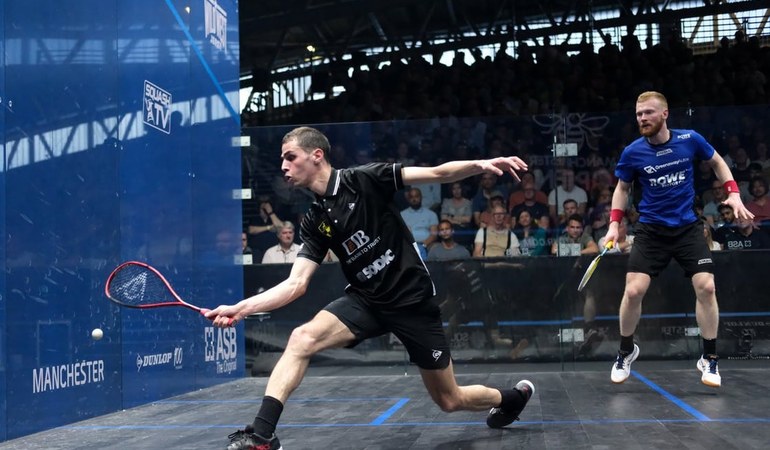
Proper lunge form (one foot well in front, the other trailing, a wide base) keeps the center of gravity between the feet rather than tipping over. A stable, wide stance provides a solid foundation, with weight evenly distributed and knees bent for agility; the legs form a platform so the upper body can rotate and swing freely. If a player reaches without moving the feet, common in amateurs, they will be stretched out and unstable, which leads to a weak or imprecise shot and possibly a twisted ankle or pulled muscle.
Ground reaction forces underlie the base of the kinetic chain. A good squash swing involves not just swinging the racket but also driving with the legs in a coordinated way. From a modeling perspective, the player-ground interaction is the first link: force plates measure the input (forces from the ground) that ultimately lead to the output (ball speed).
Good players channel these forces efficiently upward; poor technique wastes them or introduces harmful spikes. Training therefore often includes footwork drills (such as ghosting) and strength work (such as lunges and split squats) to improve a player's ability to generate and absorb forces. Squash-specific routines emphasize lunges because they build the body's ability to decelerate and handle impact, which lets players hit hard and move explosively with less injury risk.
Joint Loading and Injury Prevention Considerations
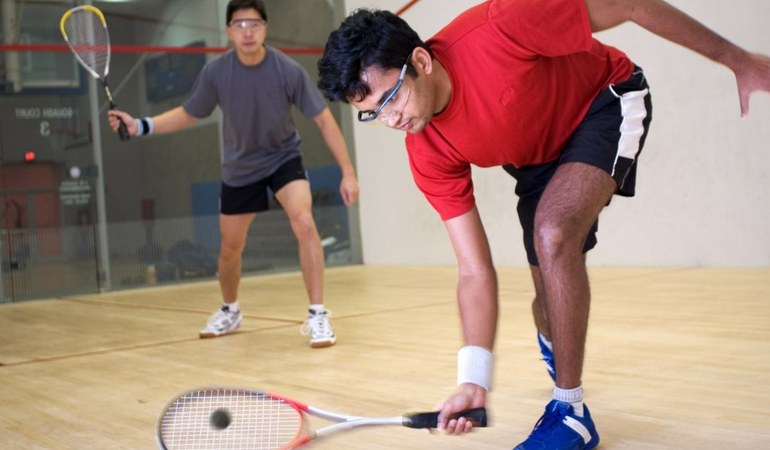
Understanding the forces and moments at various joints during the swing is important for preventing injuries and prolonging a playing career. Squash is high-intensity and can load the shoulders, elbows, wrists, knees, and ankles. Good biomechanics aim to distribute these loads safely and avoid excessive stress on any single joint.
Shoulder joint
The shoulder experiences large torques from rapid arm rotation and deceleration. In the acceleration phase, the internal rotator muscles (subscapularis, pectoralis major, latissimus) generate high torque to power the swing. At the end of the follow-through, the external rotators (infraspinatus, teres minor) and the posterior shoulder must absorb that energy.
If a player has muscle imbalances, common in racket sports where internal rotators become stronger and tighter than external rotators, the shoulder can be prone to injuries like rotator cuff tendinitis or labral strain. A cross-sectional study noted differences in shoulder rotator strength and postural control between players with and without shoulder pain, which underlines that how the shoulder handles load, and the player's posture, can influence injury risk.
A few things reduce shoulder loading:
- Keeping the elbow bent during early acceleration (shortening the lever arm until just before impact).
- Engaging the trunk so the shoulder is not generating power alone.
- Following through so the shoulder decelerates gradually.
Coaches advise not to arm the ball, which is both a performance and an injury tip; using only the arm to hit, without body support, overloads the shoulder. A flexible torso and shoulder can also dissipate force, whereas a very stiff upper body transfers more shock to the shoulder joint. Strength and conditioning programs for squash include rotator cuff strengthening and scapular stability work so the shoulder can handle repetitive swings.
Elbow joint
Squash players can suffer elbow tendon injuries similar to tennis elbow (lateral epicondylitis) or golfer's elbow (medial epicondylitis), from the strain on forearm tendons during gripping and swinging. The swing itself, done correctly, should not overstress the elbow ligaments, since the arm is mostly extended at impact and the elbow is not bending extremely at that moment.
Improper technique such as hyperextending the elbow at impact or using a flicky elbow motion can strain it, and off-center hits that cause racket vibration can travel to the elbow. At impact the elbow sees a combination of compressive force (traveling up the arm from racket-ball contact) and some varus or valgus moment depending on swing plane. A fully locked elbow at impact increases these joint-surface forces; a slight bend and muscular engagement help absorb them.
EMG shows the triceps and biceps engaging to stabilize the elbow, and this co-contraction is protective. For injury prevention, players are coached not to jam the elbow (keep a comfortable reach) and to keep a firm but not death grip on the racket, since too tight a grip transmits more shock. A proper grip size and a racket with good vibration damping also help reduce elbow load. The elbow is generally less prone to acute injury in squash than the shoulder or wrist, but chronic issues can arise from overuse or technique flaws.
Wrist and hand
The wrist carries significant load because it is the final link transmitting force to the racket. Sudden changes in wrist motion or excessive ulnar or radial deviation (sideways bending) can cause strain, and wrist injuries such as tendinopathy of the wrist extensors or flexors are not uncommon. In a good swing the wrist motion is controlled and mostly in the flexion-extension plane, with little side-to-side deviation, which is safer for the joint.
The highest forces through the wrist occur at impact when the racket decelerates against the ball, and the forearm muscles must contract hard to stabilize it. Repetitive impact without adequate strength can inflame the wrist tendons. The strong co-contraction at impact shown by EMG suggests that training these muscles, through exercises like wrist curls and pronation and supination work, can fortify the wrist.
Technique adjustments like hitting the ball in front of you, so the wrist is not bent awkwardly, and keeping a firm wrist so it does not collapse on contact, also reduce harmful bending. Players should be wary of excessive wrist snap on every shot; trick shots with a lot of wrist are part of squash, but overusing them can lead to injury, so use them situationally.
Knee and ankle
As covered in the footwork section, the knees and ankles take the brunt of force in lunges, and studies show high moments especially at the knee. The knee undergoes a large flexion moment when decelerating the body and also experiences rotational and lateral forces if the lunge or foot position is poorly aligned. A toe-out versus toe-forward lunge can change how forces are distributed between the knee and ankle.
Proper alignment, with the knee tracking in line with the foot, is crucial to avoid ligament strain such as an MCL strain from the knee caving inward. The ankle, especially the front ankle, can be subject to dorsiflexion stress and inversion or eversion moments; rolling an ankle when changing direction is a classic squash injury. Good shoes with grip and some support help handle these loads, and different shoe types can shift how much load goes to the knee versus the ankle (for example, minimalist shoes may reduce knee load but increase ankle load).
For injury prevention, strengthening the quadriceps (for knee stability) and the calf and peroneal muscles (for ankle stability) is recommended, as is practicing lunges to refine technique. A well-performed lunge, knee bent and stable with the heel down, spreads forces and reduces injury risk. Avoid hyperextending the back knee during the swing; keeping the back leg straight with the heel up can strain the Achilles and limit shock absorption, whereas a slightly bent back leg helps.
In terms of mechanical efficiency versus joint loading, an efficient swing is usually a safer swing. Efficiency means forces are distributed through the kinetic chain rather than concentrated abnormally. If a player fails to rotate the trunk, they may overstress the shoulder (inefficient and higher injury risk). If they do not bend the knees, the back may round and take more load, leading to back pain.
Biomechanical modeling often looks at joint moments; in a well-executed swing you would expect moderate moments at many joints rather than an extreme moment at one. If a model showed extremely high torque at, say, the shoulder compared with the trunk or elbow, that could indicate the player is arming the shot, and coaching might be needed to redistribute the load, perhaps by using more leg drive or trunk rotation.
Fatigue is another factor: as muscles tire, form deteriorates and joint loads often increase because dynamic stability decreases. A tired player might start snapping more with the wrist, stressing it, because the legs and core are contributing less. This underscores the need for endurance training and for actively focusing on technique even when winded during long matches, to prevent sloppy, injurious swings.
On basic biomechanical modeling: an inverse-dynamics model can calculate joint forces and moments during the swing. Exact numbers are scarce for squash specifically, but analogous racket sports give an idea; the tennis serve, for example, can generate shoulder internal rotation torques of roughly 50 to 65 Nm in elite players, with some studies reporting higher.
Squash swings are generally less forceful than a full tennis serve, but the repetition and rapid pace can compensate. Coaches and sports scientists sometimes use high-speed video and modeling software to analyze a swing and identify whether any joint is under abnormal stress. For example, a model may reveal that a player is loading the lower back by over-flexing the trunk, as seen in less-skilled backhand players who had more trunk flexion. With that knowledge, coaches can adjust toward a more upright posture, shifting load to the legs and reducing back strain.
Common injuries in squash that relate to biomechanics include the following.
- Tendon overuse injuries: rotator cuff, Achilles, patellar tendon, wrist extensors.
- Joint degenerative issues: knee cartilage wear from repeated lunges, lumbar spine issues from repeated flexion and rotation.
- Muscle strains: such as abdominal or groin strains from twisting improperly.
- Acute sprains: ankle, from poor foot placement or slipping.
Each has a biomechanical link. A good swing minimizes these by following key principles: use the major muscle groups (legs, hips) for power, maintain alignment, avoid extreme joint positions, and ensure smooth transitions of force.
A biomechanically sound swing not only hits the ball better but spreads the work across the body. The forces of hitting a squash ball, while smaller than hitting a tennis ball because the ball is lighter, are still significant, especially because squash rallies involve hundreds of swings in quick succession. By paying attention to joint loading, through both observation and modeling, coaches can design techniques and conditioning programs that keep players performing well and free of injury.
Differences Between Forehand and Backhand Mechanics
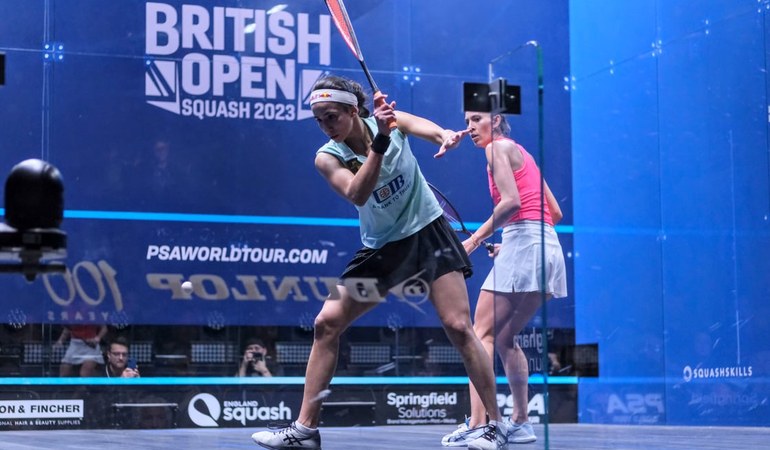
While the fundamentals of a good swing apply to both sides, there are biomechanical differences between the forehand and backhand. Understanding them helps with tailored coaching and performance.
Stance and body rotation
On the forehand (for a right-hander), the torso rotation is typically a bit more open than on the backhand. Forehand drives often allow a larger range of trunk rotation because the player can turn the right shoulder far back and then uncoil fully. On the backhand, the range is sometimes restricted by anatomy as the right shoulder comes across the body.
Kinematic data from intermediate players showed that at impact the trunk rotation angle was actually greater for backhands (about 14 degrees rotated) than forehands (about 4 to 8 degrees) in one analysis, though this may reflect the reference frame, since the player may still be slightly turned at contact on the backhand. In practice, many players feel they get more torso contribution on forehands.
Backhands rely a bit more on lateral trunk flexion (side-bending toward the ball) to get the racket in position, whereas forehands use more axial rotation. A player might drop the right shoulder on a wide backhand (a bit of side tilt) to create a good swing plane; coaches note that dipping the shoulder on the backhand side naturally helps you swing down on the ball for better length.
Shoulder and arm position
Forehand strokes often keep the elbow relatively close and slightly bent leading into impact, then extend. Backhands, especially when the ball is wide or behind, sometimes force the player to straighten the arm earlier and swing in a more sweeping motion. A research review emphasized that all strokes are best executed with the elbow kept close to the trunk and under shoulder level.
This is easier on the forehand; on the backhand, players must avoid letting the elbow flare up, a common chicken-wing error that reduces power and control. Shoulder rotation also differs: in forehands the shoulder goes from externally rotated in the backswing to internally rotated at the hit, like a throw; in backhands the shoulder motion resembles more of a horizontal abduction and adduction (like a chest fly) combined with internal rotation.
A study on backhand accuracy showed better players adducted the shoulder at impact (arm closer in), whereas weaker players were slightly abducting (arm drifting away), which reinforces that tight technique is key on the backhand.
Dominant muscle groups
Forehands tend to recruit the pectoralis major and anterior deltoid more (a forward pressing motion), while backhands engage the posterior deltoid and possibly the middle trapezius and rhomboids more (pulling the arm across). EMG evidence shows that in backhand straight versus crosscourt, the anterior deltoid was more active for the straight and the posterior deltoid for the cross.
In a forehand drive, there is also more use of the triceps as you throw the arm out. In a backhand, the biceps may engage slightly more in the late follow-through to decelerate, since the arm goes across the body and needs to be pulled back.
Leg use can also differ: on a forehand drive a right-hander typically steps in with the left foot and gets a strong push from the right leg; on the backhand, stepping with the right foot gets a push from the left. Some players have a noticeable imbalance, with a stronger lunge on one side; the goal is symmetry.
Range and stroke variability
Many players find they can hit a wider variety of shots on the forehand side, since it is naturally more open. The backhand often lags in power for amateurs, requiring more focus on technique to generate the same pace.
High-speed video of elite players shows they achieve comparable racket speeds on both sides, though sometimes with slightly different mechanics. Wrist involvement can differ: many top players have a sharp wristy flick on the backhand for deception (hold then flick crosscourt), using more last-second pronation, whereas on the forehand deception often comes from body positioning and holds rather than pure wrist.
Shot trajectories and contact points
On the forehand the contact point can be a bit further forward and away from the body. On the backhand, if the contact is too far forward the player risks reaching and losing power, so the optimal contact on the backhand is often slightly closer to the body than on the forehand.
This means the backhand often operates with the racket closer to the body's midline at contact, which can limit swing-arc length. Good backhand technique therefore emphasizes a full backswing and follow-through to compensate. A kinematic study noted that in volleys the racket was more in front of the shoulder at impact than in drives; although that was about volleys, it hints that different shot types, and by extension different sides, adjust the contact relative to the body.
Accuracy versus power emphasis
Players sometimes have more accuracy on one side and more power on the other. Biomechanics can explain this: if a player's technique is cleaner on the backhand but they lack strength, they may place it well but not hit as hard; on the forehand, strength can mask some technical inefficiency.
A study of backhand accuracy (national versus international players) found the better players not only had different kinematics (less trunk flexion, more shoulder rotation) but also significantly better ball-placement control. This suggests that subtle biomechanical differences, such as racket-face control through the shoulder and wrist, translate into accuracy. Similar analyses on the forehand would likely show that wrist control or follow-through affects accuracy.
For coaching, these differences mean each stroke may need specific drills. To improve backhand power, a coach might focus on strengthening the posterior chain and ensuring the player uses the core and legs, since it is tempting to arm the backhand if it feels weaker. Drills might isolate the feeling of shoulder rotation and weight transfer on the backhand, which some players naturally do less of. On the forehand, a common issue is taking too big a swing because it feels easy to wind up; coaches sometimes shorten an overly loopy forehand swing for efficiency in fast rallies, while on the backhand they may encourage a bigger swing to generate more pace.
While the good-swing concept applies to both sides (efficient kinetic chain, and so on), the forehand and backhand have inherent nuances. Perfecting each requires attention to those nuances: making sure the backhand is not neglected in trunk rotation or leg drive, and making sure the forehand does not become uncontrolled because it is easy to use. Elite players reach a balance where both sides are weapons, each executed with optimal biomechanics for that side.
Common Technique Flaws and Biomechanical Corrections
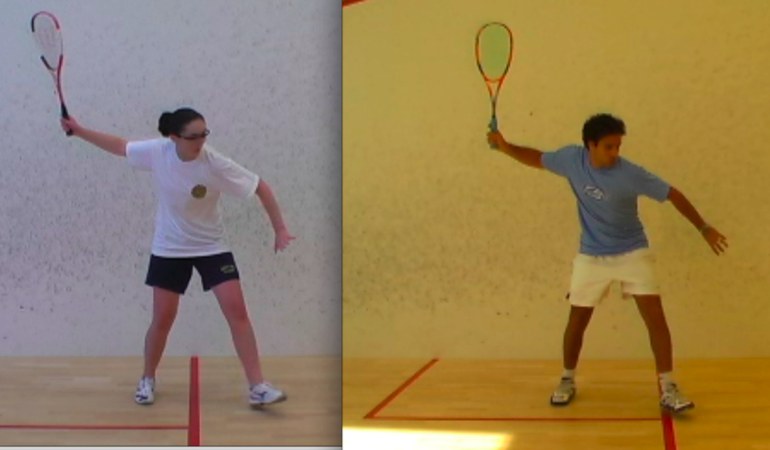
Even at advanced levels, players can have technical flaws that reduce swing effectiveness or increase injury risk. Looking at these issues through a biomechanical lens allows targeted corrections. Here are some typical errors and how to fix them.
Overusing the arm (a broken kinetic chain)
A common error, especially in beginners, is trying to generate power solely with the arm (shoulder and elbow) while neglecting the legs and torso. This means the kinetic chain is cut off; the large muscles of the hips and core are not contributing, so the smaller shoulder muscles do extra work. The result is often weaker shots and a sore shoulder or elbow.
Coaches spot this when they see little trunk rotation and an almost straight-armed swat at the ball. The correction is to teach the player to initiate the swing with the body: use your legs and hips, and turn your shoulders. Useful drills include shadow swings focused on sequencing, for example deliberately pausing at the backswing to load the legs, then turning the hips before the arm comes through. Coaching guidance notes that many players try to generate power only with the arm and advises using the entire body to create energy. When done right, the player immediately feels more power with less effort, a sign of improved efficiency.
Improper footwork and balance
If a player is out of position, even good swing mechanics will not save the shot. A common flaw is hitting off the back foot or with the feet too close together, leading to off-balance contact. This happens when the player is late to the ball or does not lunge properly; the body leans back with weight on the back leg, causing an upward, uncontrolled swing, and the ball lacks length or goes high. Backward lean removes the contribution of forward momentum and can force odd angles at the shoulder.
The fix is to improve footwork: take that extra small step or shuffle to get into a stable position with weight moving into the shot. Footwork drills build the agility and coordination needed. One tip: make sure the last step (the lunge) is directed toward the ball and that the player is not so late that they have to stretch. If caught out of position, it is often better to adjust and play a different shot, such as a defensive lob, than to attempt a full power drive off an unstable base. Over time, better anticipation and foot speed reduce poor footing. Video analysis helps; players can see if they were reaching or off-balance at impact and adjust.
Rushed swing and poor timing
Some players have all the right elements but rush the sequence, which hurts timing. This may show up as swinging before the feet are set, or snapping the wrist too early. A rushed swing sacrifices control because the phases overlap incorrectly, leading to mishits, and it causes inconsistency, where one shot is great and the next flies off because the contact point was off.
The correction is to develop a consistent rhythm; experienced players look almost relaxed even though the swing is fast, because each part happens in order rather than all at once. Practicing slow, deliberate swings instills this rhythm. One drill is to count the phases (one on the backswing, two on the hit, three on the follow-through) to add cadence. Another is to feed the ball with plenty of time so the player learns to wait for the right moment, then gradually increase speed.
The goal is correct temporal sequencing: the peak of hip rotation, then a split second later the peak of shoulder rotation, then the arm, and so on. A player who rushes tends to peak everything together. Video motion analysis with timing markers can help advanced players see whether their shoulder rotation peaked too soon. Smoother timing also reduces joint stress because no single part jerks suddenly.
Inconsistent swing plane (racket angle)
Suboptimal technique often shows up as varying racket angles between swings. On one drive the player might drop the racket head too low (coming up at the ball), and on the next chop too steeply. This inconsistency in swing plane leads to inconsistency in the shot. The cause is often a lack of a fixed reference: differences in foot positioning, the arm not returning to the same slot each time, or poor perception of the racket face.
Skilled players show remarkably consistent swing planes for a given shot type, which is linked to better accuracy. An analysis of accurate versus inaccurate forehand drives showed that more accurate shots had less variability in trunk and racket angles, whereas inaccurate ones fluctuated.
The fix is to drill the specific shot mechanics with lots of repetition focused on form. Coaches might use targets and require 10 drives with identical form, emphasizing the follow-through toward the target to control the plane. Keeping the elbow at a consistent height and not changing grip pressure mid-swing also helps. The goal is to reduce kinematic variability, doing the same joint motions each time. Strengthening the forearm and shoulder gives the player more control over the racket path.
Wrong grip or grip tension
A weak or incorrect grip can undermine an otherwise good swing. If the grip is too open (like a tennis forehand grip used on a squash forehand), the player cannot pronate properly, and the swing will not make full use of the forearm muscles. A grip that does not let the racket face close forces a compensatory motion, such as rolling the wrist excessively, to keep the ball down.
Grip pressure also matters: choking the handle too tight limits wrist snap and tires the forearm muscles early, while gripping too loose can let the racket twist on impact. A poor grip compromises power and accuracy, so practice holding the racket with the proper grip for consistency.
The correction is grip training: making sure the V between thumb and forefinger is on the correct bevel, with a grip that is firm but not straining. Players can shadow swing focusing on grip feel, or drill switching between forehand and backhand grips quickly to get comfortable. A sound grip lets the wrist and forearm work through their full range (pronation and supination) without contorting. Sometimes a small grip adjustment fixes chronic mis-hits or pain; for example, too continental a grip on the backhand can stress the wrist, and moving to a slightly more open face grip can align the joints better.
Lack of follow-through
Some players, trying to control the ball, cut their follow-through short and almost poke at the ball. This usually harms control and definitely cuts power. Abruptly stopping the swing sends the deceleration forces into the arm rather than dissipating them over a smooth follow-through. It can also signal a fear of hitting out or a lack of confidence in directing the ball.
The fix is to encourage a complete, fluid follow-through where the racket goes through the ball toward the target. A useful cue is racket to target: after hitting, the racket face should briefly point where you intended the ball to go, which confirms the player swung through the line of the shot. A full follow-through also positions the player better for recovery. If a player worries about hitting it out, the solution is not to decelerate mid-swing but to adjust the angle or swing earlier; staying committed to the swing is key.
Eyes and head position
Although not strictly a mechanical issue, many players lift the head (looking where the ball will go too early), which can alter the swing plane or balance. Lifting the head can pull the shoulders up, causing the racket to lift or the player to lose focus on the ball, leading to mishits. The standard cue, watch the ball, addresses this. Keeping the gaze on the impact zone a fraction longer helps keep the whole body aligned through contact.
These flaws and fixes show that even subtle issues have biomechanical roots. Modern coaching often uses video motion analysis to catch them; slow motion can reveal an early wrist break or a stance issue the naked eye misses. At the highest level the differences are razor thin, so some players work with biomechanists to refine things like the angle of the racket face by a few degrees or the timing of the hip turn. Research on stroke variability suggests that highly skilled players show less variability in certain joint angles at impact than less-skilled players, which means consistency is a hallmark of mastery and comes from eliminating these flaws.
Correcting these errors also makes play safer. Using the whole body rather than just the arm spares the shoulder tendons; good footwork spares the knee from awkward twists; a proper grip avoids wrist strain.
The perfect squash swing is as much about avoiding common pitfalls as it is about executing ideal movements. By systematically addressing poor mechanics, through drills, strength training, and conscious practice, players can substantially improve their swing's effectiveness. Biomechanical feedback, whether simple cues or advanced technology, speeds this up by pinpointing where things go wrong. In time, the corrected technique becomes second nature, and the swing becomes more powerful, more accurate, and more resilient against the physical stresses of the game.
Applying Biomechanics: Coaching and Modeling
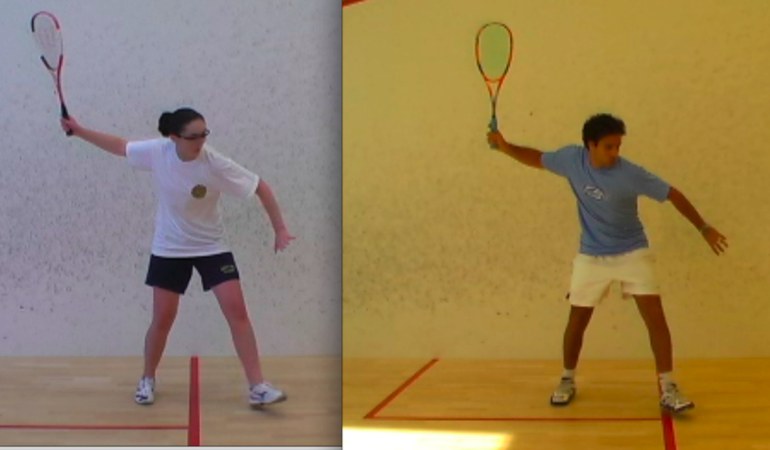
These biomechanical insights can benefit both elite and amateur players. Coaches now have access to tools like 3D motion capture and wearable EMG, but even without them, an understanding of biomechanical principles guides more effective instruction. Watching the world's best also gives players a clear visual model of efficient technique.
From a coaching perspective, the key takeaways are as follows.
- Emphasize the kinetic chain: drills that force players to use the legs and core (for example medicine-ball throws that mimic squash swings) reinforce generating power from the ground up.
- Use video analysis for visual feedback. Many issues, such as a too-early swing or an insufficient backswing, become obvious on video, and players can compare their form against professionals. Even basic apps with slow motion and angle drawing help measure how much trunk rotation a player achieved or whether the racket face was open.
- Use conditioning that matches the specific muscle demands: forearm endurance exercises (to maintain grip and wrist stability in long matches), rotator cuff strengthening (to balance the shoulder), and single-leg exercises (to improve lunge strength and stability). EMG insight about which muscles are key keeps training targeted. If glute max is important, program squats and lunges; if the anterior deltoid is heavily used, include shoulder presses or resisted arm swings.
- Use injury-prevention protocols: dynamic warm-ups for the hips and shoulders to prepare those joints for explosive rotation, and flexibility work (especially hips, hamstrings, shoulders) to allow full range of motion without strain. A cool-down with stretching can help reduce muscle imbalances.
- Account for individual differences: not every player has the same body proportions or flexibility, so a coach may adapt the ideal technique slightly for the individual, within the bounds of sound mechanics. A very tall player might have a naturally larger swing arc, so the coach might allow a slightly shorter backswing to improve timing in fast rallies.
From a modeling perspective, a squash swing can be analyzed with link-segment models and simulation software. Researchers build a model of segments (foot, shank, thigh, trunk, upper arm, forearm, hand and racket) with joint parameters. By inputting motion-capture data (marker trajectories) and using inverse dynamics, they compute joint angles, angular velocities, and joint moments.
This kind of modeling has been used to distinguish elite from non-elite swings. A 2020 study built a detailed model to compare skilled and less-skilled players and found differences such as greater forearm pronation and wrist extension in the skilled group. Coaches can use such findings; if a player is not using wrist extension, drills to improve it or a grip adjustment may help.
Models also help in understanding cause and effect. A forward-dynamics model (input muscle forces, get motion) could in principle test technique changes in simulation. Some insights are straightforward: a model could show that a given shoulder internal rotation speed yields a certain racket speed, reinforcing that to hit harder, improving shoulder rotation (technique or strength) helps.
One useful concept is proximal-to-distal sequencing combined with long-axis rotation of the limbs. Woo and Chapman (1992) studied this in squash and highlighted the role of long-axis rotation (forearm pronation, upper-arm internal rotation) as the missing link in achieving maximal speed. Without those rotational components, you rely only on planar motions like elbow extension and get less speed. This is a good example of research telling players what to focus on: simply extending the arm is not enough; you need the snap of rotation.
The mental image a player holds can also be biomechanically informed. Coaches use metaphors like throwing the racket through the ball on the forehand or throwing a frisbee on the backhand to trigger the correct sequence. These analogies have a biomechanical basis, since throwing motions naturally use the kinetic chain. Good teaching cues are often boiled-down biomechanics.
Conclusion
The perfect squash swing is a coordinated set of biomechanical actions: a well-timed sequence of muscle activations and joint movements that starts from a strong, grounded stance and ends with a controlled follow-through and recovery. Through biomechanics, we can see how power and accuracy are achieved: through efficient use of the kinetic chain (legs to trunk to arm to racket), an optimal swing plane and timing, and activation of the right muscles at the right time.
Both forehand and backhand share these principles, though each has nuances that players must master. Data from EMG, motion analysis, and force plates provide objective evidence of what top players do differently; they rotate faster, use forearm and wrist rotation more, and handle ground forces more effectively than less-skilled players.
For coaches and players, these insights translate into concrete strategies: develop a strong core and legs to support the swing, practice technique to synchronize the body segments, and pay attention to form to avoid overloading joints. Preventing injury goes hand in hand with improving performance, since many inefficient movements are also the ones that cause strain. A mechanically sound swing sends the ball with pace and precision and distributes forces in a way the body can handle repeatedly.
In the modern game, where rallies are long and the ball is fast, the benefits of optimizing biomechanics are large. Players who swing efficiently conserve energy and stay consistent under pressure, and they are less prone to breaking down even after hundreds of swings. A flawed technique leaks energy, fatigues the player, and produces errors at crucial moments.
Biomechanical modeling and analysis continue to refine our understanding of the squash swing, and they already give a framework for identifying what makes a swing elite. Key differences in joint angles and variability between top players and others offer clear targets for developing athletes. They also help dispel misconceptions; the fastest swing is not about sheer upper-body strength or wild wrist flicking, but about timing, coordination, and using the whole body in harmony.

In practice, players should focus on fundamentals: stable footing, full rotation, smooth acceleration, and a mindful follow-through. Common mistakes like arming the ball or poor footwork should be corrected systematically, using both coaching experience and biomechanical feedback. Drills that reinforce proper movement patterns, and exercises that strengthen the necessary muscles, will ingrain the mechanics of a good swing.
The biomechanics of the squash swing show it to be an efficient chain of motions when done well. By learning from research and applying it on court, players at all levels, from beginners learning the basics to elite athletes seeking marginal gains, can move closer to that perfect forehand and backhand. The result is better performance, harder and more accurate shots, along with improved safety and enjoyment, as players let their bodies work with the mechanics rather than against them.