
A modern squash ball looks like nothing much: a hollow rubber sphere about 40 mm across that sits dead in your hand and barely bounces until you have hit it for a few minutes. Getting it to behave that precisely took more than 150 years of changing materials, sizes, and manufacturing.
This is how the squash ball went from inconsistent lumps of natural rubber to the engineered double-yellow-dot ball used in professional play, why the coloured dot on the side tells you which ball suits your level, and what the physics of bounce, heat, and pressure has to do with warming one up.
Historical Overview of Squash Ball Development
Early squash balls did not resemble the little black ball we know today. The sport got its name around 1830 at Harrow School in England, when students found that a punctured rackets ball (from the older game of rackets) would "squash" on impact and give a softer bounce. This softer, squashy ball made the game more varied and gave rise to "squash rackets" as a distinct sport.
Early balls were often made of natural rubber, which by the mid-19th century had become the preferred material. These primitive balls were inconsistent, but they offered more control than the hard balls used in rackets, which helped shape the new sport's character and name.
During the late 19th and early 20th centuries, squash grew in popularity while equipment standards were still developing. Different manufacturers experimented with ball sizes and finishes until formal specifications emerged. By the 1920s, efforts were underway to standardise the ball's dimensions and properties.
Companies like the Avon India Rubber Company produced balls in various diameters (roughly 3.65 cm to 4.3 cm) and offered both matte and varnished (glossy) balls. Another early producer, the Silvertown Company, made a black-enamelled ball about 3.9 cm in diameter. These variations show how manufacturers were trying to find the ideal size and surface. In 1926, the first official specifications for squash balls were recorded, a key step toward uniformity in the sport.
Significant improvements came in the mid-20th century. Up to the 1950s, most squash balls were made of natural rubber, which was sensitive to temperature and wear. In 1960, Slazenger introduced the first synthetic squash ball, made from butyl rubber, to improve consistency. Butyl rubber gave more stable performance than natural rubber, with less variation in bounce between hot and cold conditions. This mattered because players had long noticed big differences in ball behaviour depending on court temperature.
The traditional colour of squash balls also changed over time: older players recall that balls were once commonly green before manufacturers switched to the now-familiar black, possibly because of the cost of dye or to assert brand identity. Even before black became standard, some companies offered other colours, such as special-edition balls in blue, red, and orange, though these were novelties and black remained the usual colour for competitive play.
In 1970, Dunlop (which had acquired Slazenger by then) introduced a coloured dot system to mark different ball speeds. Balls had previously been sold simply as "slow" or "fast," but the coloured dots denoted each ball's bounce characteristics (described in detail below).
The double-yellow-dot ball came later: it was produced in 1999 and adopted around 2000 as the competition standard, replacing the earlier single-yellow-dot ball. By that point the double yellow had become the official ball for professional play worldwide. According to industry accounts, the double yellow began partly as a branding move, since a customer asking for a "double yellow" was specifically seeking Dunlop's product, while a request for a "single yellow" could be filled by any brand.
The World Squash Federation later standardised the dot colours across all brands to match Dunlop's scheme, making the coloured dot system a universal standard. In the early-to-mid 1990s, North America, which had long used a different, harder ball for its own version of the game, transitioned to the international soft ball, unifying squash globally.
Technological and Material Innovations in Squash Balls
Over the decades, squash ball design has seen continuous material and technological change. One major area has been the rubber composition. Early balls of pure natural rubber were very sensitive to temperature and behaved inconsistently.
The introduction of butyl rubber in 1960 by Slazenger was a significant advance, because butyl is a synthetic elastomer that holds its elasticity more evenly across temperatures, making the bounce more predictable in both warm and cool conditions.
Manufacturers also began adding other compounds to fine-tune performance. Modern squash balls are typically made from a high-grade rubber polymer blend (often based on butyl) with additives that improve durability and bounce. Dunlop, for example, developed a proprietary formula known as N-1SR3, an elastic hydrocarbon polymer made with 12 different compounds, designed with input from professional players. This construction delivers the durability and consistent rebound for which Dunlop balls are known. Additives such as sulphur are mixed into the rubber to aid vulcanisation (cross-linking of the rubber molecules), which improves resilience and helps the ball keep its shape under repeated impact.
Another key development was the refinement of the speed and bounce categories, shown by the double-yellow dot and the other dot-marked balls. The dot system let manufacturers create balls tailored to different skill levels and conditions:
- Double-yellow dot: the slowest bounce, making rallies more challenging and longer for advanced players.
- Single-yellow dot: slightly bouncier for strong club players.
- Red dot: medium bounce for intermediates.
- Blue dot: high bounce for beginners.
This was a genuine technical adaptation, not just marketing: each ball is engineered, through rubber formulation and sometimes size, to have a specific bounce profile and speed. The double yellow uses a formulation that gives very low bounce unless the ball is thoroughly warmed up, while beginner balls use a livelier compound and are sometimes made slightly larger to increase bounce out of the box. These changes greatly improved the accessibility of squash: newcomers can start with a friendly, bouncy ball, while professionals get a ball that suits the fast, tactical game at high levels.
Manufacturing techniques have also improved. Squash balls are made by moulding two half-spheres from raw rubber, then joining them. The process was once fairly rudimentary but has been refined for precision. Rubber pellets are heated and compressed in moulds to form the hemispherical halves, and the heat cures the rubber so it hardens into shape. Each half is called a half shell, and typically half of them are moulded with an identifying dot while the other halves are plain. The two halves are then glued together and the seam is smoothed.
Modern quality control keeps the two halves aligned and the internal air volume consistent. Dunlop, for example, tests its balls rigorously, measuring diameter and weight, checking seam strength, and running compression and rebound tests in the lab. The seam is a critical point, since it is where nearly all balls eventually crack after heavy use.
Improvements in adhesive technology and curing processes have made seams much more reliable, delaying the inevitable split. Where older balls might have split or gone out of round more quickly, modern manufacturing produces balls that survive many intense matches. The matte, textured surface used now, rather than the glossy finish of some early balls, also helps the ball grip the wall and floor and improves playability. Through better rubber chemistry, design features like the dot system, and precise manufacturing, squash balls have become a highly optimised piece of sports equipment.
Squash Ball Types and Dot Color Meanings
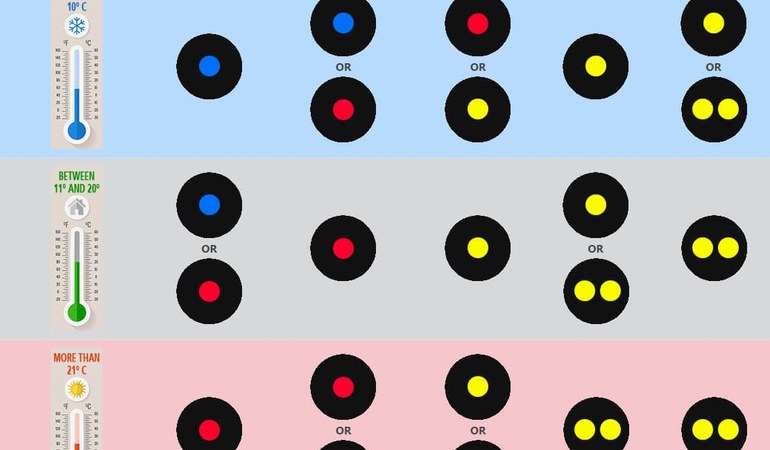
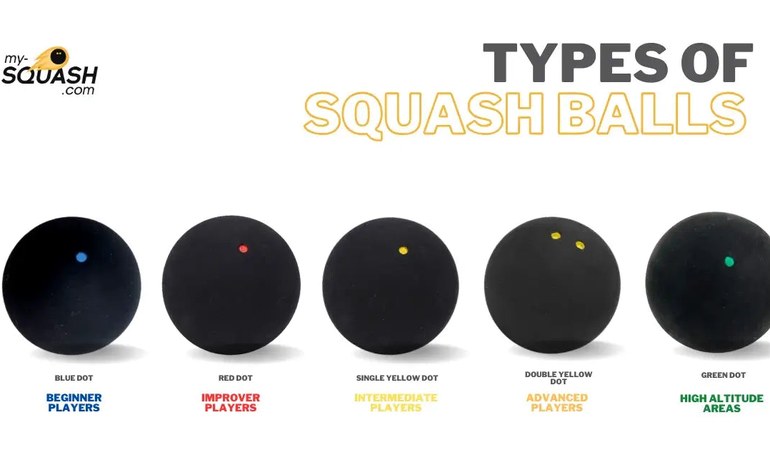
One of the most distinctive features of modern squash balls is the coloured dot system, which indicates the ball's speed (bounce) and the level of play it suits. All standard squash balls are made to the same diameter (about 39.5 to 40.5 mm) and weight (about 23 to 25 g), but their playing characteristics differ. The dot colour codes the bounce, which is set largely by the rubber composition and, in some cases, the ball's size. Here are the common types and what their dot colours mean.
| Dot colour | Level / name | Speed and bounce |
|---|---|---|
| Double yellow | Pro (official tournament ball) | Extra-slow, lowest bounce of all |
| Single yellow | Competition / advanced | Slow, low bounce, one step livelier than double yellow |
| Red | Medium / Progress | Medium speed, higher bounce |
| Blue | Fast / Intro | Fastest and bounciest standard ball |
Double Yellow Dot (Pro)
This is the official tournament ball used by professional players and in virtually all adult competition. It is sometimes called the "Pro ball." It has extra-slow speed and the lowest bounce of all the balls.
When cold, a double-yellow ball feels quite dead, so players must hit it hard for a few minutes to warm it up. Once at playing temperature, it bounces to a normal playable height, still lower and slower than other balls. The double-yellow dot rewards good technique and power, and it suits advanced and professional play. Dunlop's double-yellow dot is the standard ball approved by the WSF, PSA, and the women's professional body, and it was one of Dunlop's signature developments.
Single Yellow Dot (Competition/Advanced)
The single yellow is a slow ball with a low bounce, one step livelier than the double yellow. It is often used by intermediate to advanced club players or in amateur competition. It is the same size as a double-yellow ball but is designed to have about 10% longer hang time, so it bounces a little higher.
That slightly increased bounce makes it easier to keep warm and moving, especially for players who do not generate as much power as a professional. It is a good transitional ball for those improving but not yet ready for the ultra-slow pro ball.
Red Dot (Medium/Progress)
A red-dot ball is a medium-speed ball with a higher bounce. It is often about 6% larger in diameter than a standard ball, which increases bounce and gives players more reaction time. Red-dot balls are typically used by improving beginners or juniors who have some basic technique.
Dunlop markets the red dot as the "Progress" ball, with roughly 20% longer hang time than the pro ball. That means longer rallies and an easier time keeping the ball in play, which helps learners build proper skills without the game feeling too fast or the ball dying too quickly.
Blue Dot (Fast/Intro)
The blue dot is the fastest and bounciest standard squash ball. It is usually made slightly larger than a pro ball (Dunlop's blue-dot "Intro" ball is about 12% larger) and uses a much bouncier rubber compound. Its bounce is very high, which makes it ideal for beginners and juniors who are brand new to squash. It barely needs warming up, and even when cold it rebounds reasonably well.
The extra hang time, up to about 40% longer than a double-yellow ball, gives newcomers plenty of time to react. Coaches often start new players with blue-dot balls to help them sustain rallies and build confidence. As skills and fitness improve, a player can progress through the levels:
- Blue dot (brand new players)
- Red dot
- Single yellow
- Double yellow (advanced levels)
Special-purpose balls
Beyond the four main dot colours, there are a couple of special-purpose balls. Green-dot (or white) balls are designed for unusual conditions.
- Green dot (high altitude): where the air is thinner, such as in mountain cities, a normal ball does not bounce as well, so a green-dot ball is slightly faster to compensate. The World Squash Federation recognises a green-dot ball as the high-altitude standard for places like Mexico City or Denver. Some manufacturers historically used an orange dot for a high-altitude or extra-bouncy ball, but the green dot is the common standard now.
- White ball (visibility): a white ball is not different in bounce, since it usually has the same properties as a double-yellow dot, but it is coloured white for visibility on glass courts. Professional matches in all-glass show courts often use a white ball because a black ball is hard to see against dark backgrounds or seating. Other than colour, the white ball is the same slow speed as the regular double yellow.
These types let players choose a ball that suits their level and environment, so the game is neither too fast nor too slow. The dot system has become an integral part of squash, guiding players worldwide in picking the right ball.
Notable Manufacturers and Brands in Squash Ball Evolution
Throughout squash's history, several manufacturers have driven innovation and led the market. In the early days, from the late 19th to the early 20th century, companies like Avon India Rubber and Silvertown were among the first to produce squash balls, experimenting with sizes and finishes. These firms supplied the growing sport with its essential equipment before formal standards were set.
By the mid-20th century, Slazenger emerged as a key player. Slazenger was an established sporting goods brand, famous for tennis balls as well, and in 1960 it introduced the first squash ball made of butyl rubber, marking the shift from natural rubber to a synthetic material engineered for better performance. The butyl ball was more consistent across temperatures, which helped players, and it showed that material science could improve the game.
Slazenger and Dunlop's histories then converged: Dunlop Rubber took over Slazenger in 1959, and both brands eventually came under the same ownership. Today the Slazenger name is no longer seen on squash balls, as Dunlop became the flagship brand, but Slazenger's mid-century contributions are an important part of the story.
Since the 1970s, Dunlop has been the dominant force in squash balls. Dunlop pioneered the coloured dot classification system, which made it easier to market different balls to different player levels, and it kept improving the manufacturing quality and longevity of the balls. By the 1990s, Dunlop had updated its range and built a dominant worldwide presence. For decades it has been the official supplier of squash balls to the World Squash Federation and the Professional Squash Association.
The Dunlop Double Yellow Dot Pro ball is the only ball used in professional international competition, and Dunlop is often described as the world's number one squash ball brand. It reached this position through extensive product testing and quality control. Every Dunlop ball is tested for:
- Weight and size
- Stiffness
- Seam integrity
- Bounce consistency
Engineers run compression tests, cut balls open to inspect construction, and stretch the rubber to confirm durability. This focus on engineering has made Dunlop balls a benchmark for reliability, since players know a Dunlop double yellow will behave predictably and last a good number of games. Dunlop has also worked with professional players to refine its rubber formula, as with the N-1SR3 technology, reflecting collaboration between athlete feedback and manufacturing.
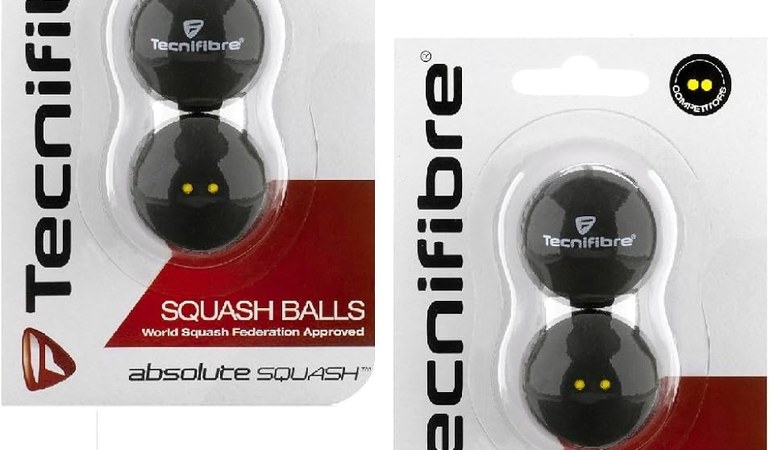
Other brands are present in the market, though none has unseated Dunlop in recent times. Wilson, HEAD, Prince, Tecnifibre, and others produce squash balls, often in a range similar to the dot system. HEAD and Prince have sold single and double-yellow-dot balls, and smaller brands like Black Knight or Karakal have their own training balls. Some have tried to differentiate with minor tweaks or marketing, but they generally follow the standard sizes and dot colour codes set by the WSF.
One reason Dunlop stays on top is that it has consistently driven innovation, whether by introducing new ball types or improving rubber longevity, and secured the major tournament contracts. Dunlop, which carries Slazenger's legacy, is the clear leader in squash balls, Slazenger is remembered for its early innovation, and a few niche brands play a minor role. The combined work of these manufacturers has given us the refined squash balls used by millions today.
Scientific and Engineering Aspects of Squash Ball Performance
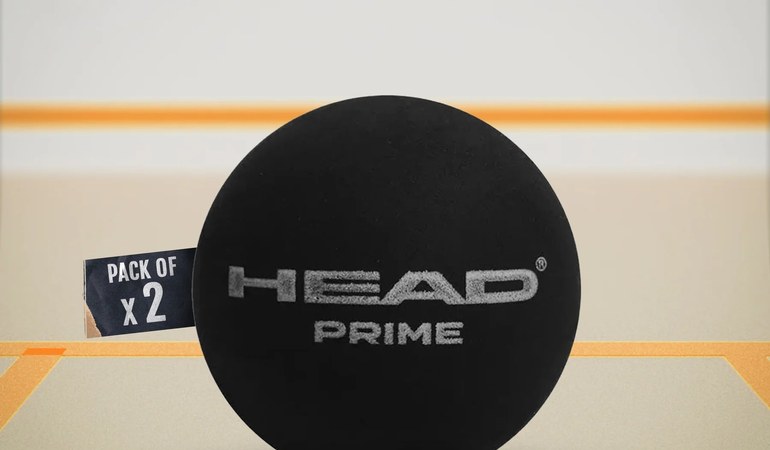
A squash ball's performance is governed by some fundamental scientific and engineering principles. Understanding them explains why squash balls behave as they do, especially the need to warm up a ball and the differences between ball types. The key factors are:
- Bounce dynamics (energy return)
- Material compression
- Temperature sensitivity
- Internal pressure effects
Bounce and energy return
When a squash ball hits a wall or floor, it deforms (squashes) significantly, then bounces back. The fraction of energy it returns, versus how much is lost mostly as heat, is described by its coefficient of restitution. Being made of soft rubber, squash balls are not very bouncy compared with something like a superball or a tennis ball, and a lot of kinetic energy is lost on each impact as the rubber stretches and heats up.
On a cold first hit, a ball feels very dead because the rubber is not flexing efficiently yet. As the ball keeps deforming with each hit, it heats up, the rubber becomes more flexible, and it loses less energy to internal friction, so the bounce improves with play. This is why players hit the ball repeatedly at the start of a match, to raise its temperature to an optimal range.
A well-designed ball uses a rubber compound that can deform and rebound effectively. The right mix of elasticity and stiffness lets the ball compress on impact and then spring back, propelling it off the floor. If the rubber is too hard, it will not deform enough and bounce stays low; if it is too soft without resilience, it deforms but does not snap back, again giving low bounce. Engineers therefore tune the elastomer so the ball squashes and regains shape efficiently, maximising bounce height for a given material.
Temperature sensitivity
Temperature plays an outsized role in squash ball behaviour. Because the ball combines a rubber shell with the air inside it, two things happen as it warms:
- The rubber softens slightly, reducing internal energy losses.
- The air inside expands, raising the internal pressure.
Both effects make the ball bounce higher. The difference is dramatic, since a ball that barely bounces when cold can become quite springy when hot. A modest rise in ball temperature can produce a substantial increase in bounce height, which is why keeping the ball warm is essential for normal play.
At typical court playing temperature, the ball's internal air stabilises around 45 degrees Celsius, an equilibrium where the energy lost to heat and the energy retained are balanced for consistent bounce. Below that, the ball feels flat. Above it, which can happen in a long, hard rally, the ball can get even livelier, and players sometimes notice that after several fast rallies the ball is very bouncy, making the game faster. Good players adjust their shots as the ball changes through a match.
Internal air pressure
The air pressure inside the ball is at ambient level when the ball is made, unlike a pressurised tennis ball filled with gas above atmospheric pressure. As the interior air heats up during play, the pressure rises slightly, helping the ball push back to its spherical shape more quickly on impact. If the ball cools down, or in a cold environment, the internal pressure drops and the ball deforms more on each bounce, giving a lower bounce height.
Altitude also matters, because at high altitude the outside air pressure is lower, which makes the ball's internal pressure relatively higher by comparison. This can make the ball fly faster and bounce more, which is why a different ball, the green dot, is used at altitude to dampen the liveliness. Humidity can have a minor effect too, since very humid air might make the surface a little stickier or add a tiny amount of weight if the rubber absorbs moisture, possibly reducing bounce slightly. These factors are subtle, but top players are keenly aware of how the ball changes with conditions.
Compression and material engineering
The ball's design involves trade-offs in material hardness, wall thickness, and internal volume. The rubber must be soft enough to compress, so the ball grips the wall and floor a little and does not just skid or shatter, but resilient enough to spring back. Manufacturers carefully choose rubber compounds, blending natural and synthetic rubber with additives like carbon black or silicone, to balance compression and durability.
When the ball is struck, it compresses and the rubber molecules briefly store energy, then release it as they return to shape. Some of that energy inevitably becomes heat in the rubber, which in turn helps later bounces by warming the ball. The engineering goal is to maximise energy return without making the ball too bouncy for the sport.
That is why the pro ball is deliberately low-bounce at first: it keeps rallies longer and more challenging and emphasises player skill. The ball is squashable enough that a hard hit can flatten it significantly against the wall. High-speed photographs of a squash ball hitting a wall show it flatten to a fraction of its normal thickness on impact. The ball survives this thousands of times because of the vulcanised rubber's strength and the reinforced seam.
Durability and the seam
For durability, the two-piece construction is a focal point. The seam, being a join of two pieces, is inherently a weak spot, so modern manufacturing optimises the glue and curing to make it as strong as possible. Dunlop and others test seam strength by compressing balls forcefully to confirm they do not split easily.
Over time and repeated heating and cooling cycles, the rubber can lose elasticity and the seam can slowly weaken, which is why even a well-made ball eventually cracks, typically along the seam. Engineers have experimented with different seam placements and even double-layer balls (racquetballs, for instance, use a two-layer rubber design), but for squash the single-layer, two-halves model has proven best for playability.
Players accept that balls are a consumable item and replace them after a certain amount of play. Continual improvements in materials mean today's balls hold their bounce and integrity longer than those in the past, so where an older ball might go soft or split after only a few hard matches, a modern top-quality ball can last many sessions before showing cracks.
So the next time a ball feels dead on the first hit, that is the design doing its job: the rubber has not warmed up enough to bounce yet. Hit it a dozen times and the same ball comes alive. It is a small piece of kit, but every part of it, the compound, the size, the dot on the side, was chosen to make the game play the way it does.