
Introduction
Squash is a fast sport that places heavy demands on your eyes and visual reflexes. Just as you train your legs for speed and your arms for power, you can train the visual skills your game relies on.
Vision is a key part of athletic performance, and skills such as tracking, focusing, and reacting can be sharpened with practice, though the evidence on how much eye drills transfer to match play is mixed.
The drills below suit players of all levels and serve two goals: sharpening on-court vision (ball tracking, peripheral awareness, faster reactions) and protecting your eyes (preventing injury and easing strain).
Tracking the Ball and Visual Focus
Being able to see and follow a fast-moving ball is fundamental to playing well. A hard-hit squash ball can exceed 200 km/h (about 125 mph), so your eyes need to respond quickly. Here are some exercises to work on your ball-tracking and focus.
"Yes-Yes / No-No" Drill
This exercise trains you to keep your eyes on a target while your head moves. Hold a small target (such as a playing card) at arm's length. Nod your head up and down as if saying "yes," then shake it side-to-side as if saying "no," all while keeping your eyes fixed on the card.
The drill helps stabilise your gaze during movement, similar to keeping your eyes on the ball while your body shifts on court. Start slowly, then speed up as you improve.
Advanced variations include moving the card in the opposite direction to your head, or walking forward and backward as you do the head movements. The aim is better dynamic visual acuity, the ability to keep the ball in clear view even while you are running or lunging.
Flashlight Pursuits ("Follow the Light")
In a darkened room, shine a flashlight or a phone torch against a wall and move it around. Keep your head still and follow the moving light with your eyes alone, tracing patterns (up-down, side-to-side, diagonals, circles).
Then switch it up: turn the light off and on at random spots, forcing your eyes to jump (saccade) quickly to the new position. This drill mimics tracking a flying ball and works the muscles that move the eyes.
Smooth-pursuit exercises like this may help keep your eye muscles responsive when done regularly. Aim for about 5 to 10 minutes, three times a week.
Near-Far Focus Drill
Squash demands rapid focus shifts. One moment you are watching the ball as it meets your racket, the next you are looking down the court at it coming off the front wall. To practise refocusing, do a near-far drill a few times a week.
Take two targets, for example a playing card with a letter on it and a calendar or magazine page. Place one about 18 inches (45 cm) from you and the other roughly 10 feet (3 m) away at eye level.
Focus on the closer target for about 5 seconds, noting fine details, then snap your focus to the far target for 5 seconds. Keep switching for a minute or two. This trains your eyes to adjust focus quickly between distances, much like picking up the ball at varying depths, so you can spot it early off the front wall and then watch it onto your strings.
Solo Ball-Tracking Practice
Whenever you are solo drilling on court, make a habit of consciously watching the ball through its whole flight. When practising drives, try to see the ball leave your racket, travel to the front wall, and return. This conscious tracking builds focus.
Even in solo hitting, "keep your eye on the ball" is a trainable skill, not just a cliche. Some apps offer moving targets and patterns for players who tend to lose sight of the ball.
Whether you use an app or mindful solo hitting, the goal is the same: more consistent visual tracking, so you are less likely to be caught out by the ball's speed or direction.
Peripheral Vision on Court
In squash you need to track the ball and also stay aware of your opponent's position and the rest of the court. You often cannot look directly at your opponent, especially when they are behind you, so peripheral vision matters.
Peripheral vision is the ability to detect movement and objects outside your direct line of sight. Working on it can help you widen your field of view and make better decisions during rallies.
Small Head Movements Technique
A common coaching tip is to use subtle head turns to engage your peripheral vision without fully looking away from the ball. For example, when you have played a drop shot at the front and your opponent is moving behind you, tilt your head slightly so that, out of the corner of your eye, you catch a glimpse of their position.
Even a blur or silhouette can tell you whether they are hanging back or rushing in. That quick check lets you pick a smart follow-up shot, a lob to the back if they are too close, or a crosscourt if they are leaning to one side.
Practise this in friendly games: after you hit, briefly register your opponent's location peripherally as you move, instead of staring only at the front wall. Over time these quick side glances become a habit that improves your awareness on court.
Peripheral Awareness Drill
Off the court, try a peripheral vision exercise. Stand in a hallway or room with plenty of objects around. Pick a spot straight ahead, such as a picture on the far wall, and focus on it.
While keeping your eyes on that spot, use your side vision to observe and describe objects in the periphery, perhaps pictures on the wall, furniture, or people moving at the edges of your sight. Afterward, turn your head to check how accurate you were.
As that becomes easy standing still, try it while walking slowly forward. The aim is to take in more information at a glance. On court, that can mean catching your opponent's movement or the ball rebounding oddly off a side wall while you are mainly watching the ball.
Corner Drill for Peripheral Vision
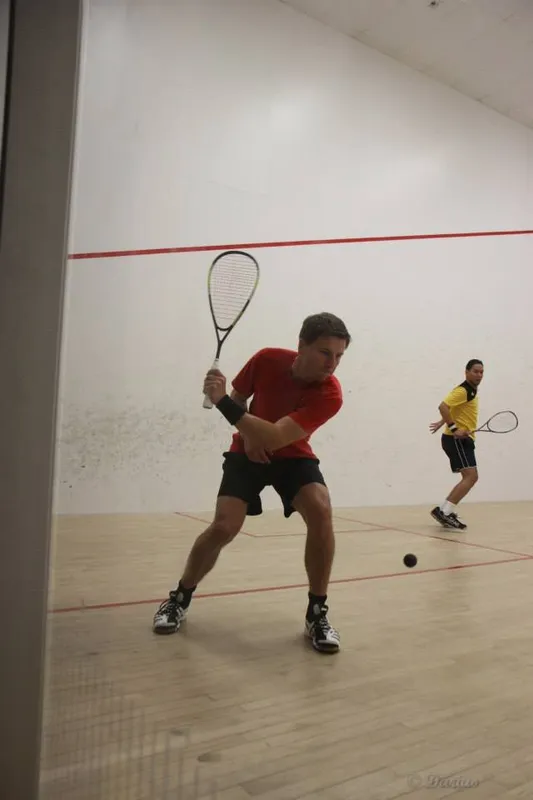
A squash-specific version uses a conditioned game with a partner, where one player is restricted to the front half of the court and the other to the back. Your partner feeds balls that you must always hit to the back, and they will always hit to the front.
The condition: after your partner hits, they deliberately stand in either the back left or back right corner. Your job is to use peripheral vision to note which corner they are in as you move to the ball, then hit your shot to the opposite side.
This forces you to stay aware of where your opponent is without looking directly at them, and to direct the ball away from them. It might feel tricky at first, and you may need to exaggerate a head turn to spot them, but with practice you will get faster at sensing their position and begin to fold peripheral checks into normal play.
Reaction Time and Eye-Hand Coordination
Fast reflexes can be the difference between a good retrieval and watching the ball bounce twice. Working on your visual reaction time and eye-hand coordination can help you volley sooner, adjust to mis-hits or nicks, and keep up with the pace of the game. Here are some drills and tools for those split-second responses.
Wall Ball Catch
A simple but effective drill is playing catch against a wall. Stand a few feet from a solid wall and toss a ball against it, then react and catch it as it rebounds. Use a squash ball or a bouncier ball like a tennis ball.
Start with your dominant hand, then switch to your non-dominant hand, then alternate. This makes you react to the ball's rebound angle and speed, working your central vision and timing.
To raise the difficulty and bring in peripheral vision, ask a partner to throw balls off the wall from different angles, high, low, left, or right, so you react unpredictably. You will drop plenty at first, but as your eyes and brain adapt you will get quicker at locating and grabbing the ball.
Juggling
Juggling is a useful tool for athletes. It trains you to track multiple moving objects and coordinate your hands accordingly. According to a report in Wired, juggling builds hand-eye coordination in ways that can improve reaction time, reflexes, spatial awareness, and concentration.
Start with two balls if you are a beginner, then work up to three. A few minutes a day can support the brain's visual and motor connections, and learning to juggle has been linked to increases in grey and white matter. It also works well as a warm-up for your eyes and hands before a match.
Reaction Ball
Consider a reaction ball, a small, unevenly shaped rubber ball that bounces off at random angles. Stand in an open area, drop it from shoulder height, and try to catch it after one bounce. Because it darts off unpredictably, it trains you to react quickly.
Set yourself a challenge, such as catching it five times in a row, and you will work on visual reaction time and footwork at once. Some coaches use reaction balls in junior training to make reflex work fun. If you do not have one, you can make a rough version by crumpling tape unevenly around a regular ball so its bounce is less true.
Light Reflex Drills
For a higher-tech option, some athletes use light-based reaction trainers such as BlazePod or FITLIGHT systems. These are small lights or targets that flash randomly, and you run and tap them or reach with your racquet, reacting to a visual cue as fast as you can.
If you do not have access to these, you can improvise: have a partner call out "Left" or "Right," or hold up coloured cones, and you lunge in the called direction as if retrieving a ball. The aim is to train your brain to process a visual signal and trigger a physical response quickly, which is what happens when you see the ball and move or swing.
Strobe Glasses Training (Advanced)
At higher levels, some players use stroboscopic eyewear during practice. These goggles flicker between clear and opaque, giving you brief snapshots of the action and forcing your brain to make the most of limited visual information.
In one study, athletes tossed and caught balls while wearing strobe eyewear, and their hand-eye coordination improved; a Duke University programme has also tested strobe training with baseball players.
It is not necessary for most players, but if you are keen you might try a consumer version to add a challenge to solo practice. Use them carefully, starting with simple drills rather than full-speed games until you are used to the effect.
Eye Strain Relief and Injury Prevention
Looking after your eyes matters as much as building performance. Squash is usually played on indoor courts under artificial lighting and involves long stretches of intense focus, which can leave the eyes tired or dry over time.
The sport also carries a real risk of eye injury from a fast ball or an opponent's racquet. This section covers how to care for your eyes so you can play comfortably and safely.
Protective Eyewear, a Must
First and foremost, always wear proper squash goggles, whether you are a beginner or a professional. Racquet sports are among the leading causes of sports eye injuries, and a squash ball is just the right size to enter the eye socket, where a full-speed impact can do serious damage.
Ophthalmologists estimate that wearing certified squash goggles can prevent around 90% of squash-related eye injuries. Even top professionals have been hit in the eye during matches. Some specialists put the risk at roughly a 1 in 4 chance of being hit in the eye over a regular player's career, which is not worth taking.
Choose goggles with shatter-resistant polycarbonate lenses that meet a recognised standard; lensless eye guards do not protect adequately, because the ball can still deform on impact and reach the eye. Modern squash eyewear is lightweight, resists fogging, and has little effect on your field of view.
Make it as routine as a seatbelt: every time you step on court, put your goggles on.
Palming for Relaxation
After a long session or an intense match, your eyes may feel tired or dry. A simple cooldown is palming. Rub your hands together to warm them, close your eyes, and gently cup your palms over your eye sockets to create a warm, dark space. Rest your elbows on a table or against your body so you can relax.
Do not press on your eyeballs, just let the warmth and darkness settle them. Stay there for 30 to 60 seconds or longer, breathing slowly. This can help relax the muscles around the eyes and ease mild tension from sustained focus.
If you get tension headaches after playing, palming may help with those too. Try adding a minute or two to your post-match cooldown or your breaks.
The 20-20-20 Rule
If you have been focusing hard for a long stretch, give your eyes periodic breaks. A popular guideline is the 20-20-20 rule: every 20 minutes, look at something at least 20 feet away for about 20 seconds.
On court between rallies or games, that might mean glancing at the back of the court or out of a window, anywhere farther than the front wall. The short pause lets the focusing muscles relax after long spells on near targets. It is the same advice eye-care professionals give people who work at screens.
Evidence for the exact numbers is limited, and longer breaks may help more, but it works well as a simple reminder to rest your eyes. It is not always practical to time in a match, but in training you can blink and look into the distance for a few moments while picking up balls between drills.
Eye Circles and Stretches
Just as you stretch your body after exercise, you can gently move your eyes to keep them comfortable. Try slow eye circles: look up to the ceiling, sweep your gaze in a circle clockwise over about 3 to 4 seconds, then repeat anticlockwise. Do this a few times.
Another option is the figure-eight trace: imagine a large horizontal figure-8 in front of you about 10 feet away and, without moving your head, trace it smoothly with your eyes. Blink normally throughout to keep your eyes lubricated.
Stay Hydrated and Keep Blinking
This is not an exercise, but it is worth noting. Indoor courts can have dry air, and when we concentrate we often forget to blink, which leads to dry eyes. Make a point of blinking more often during play to refresh the tear film.
Drink water regularly, since good hydration supports eye health along with everything else. If you are prone to very dry eyes, lubricating drops (artificial tears) before play can help, and it is worth seeing an eye-care professional if dryness is a persistent problem.
Integrating Vision Exercises into Training
Now that we have covered a range of drills, how do you fit them into your routine? The key is consistency and gradual progress, just like physical training. Here are some tips.
- Warm-Up and Cool-Down: Add a couple of vision drills to your pre-game warm-up and post-game cool-down. During warm-up, do a quick near-far focus drill or a few flashlight tracking sweeps to wake up your visual system. Afterward, do palming or gentle eye circles to relax. This makes eye care a habit every time you train.
- Short, Frequent Sessions: You do not need hours. Short, frequent sessions work best, and even 5 to 10 minutes a few times a week can be worthwhile. Pick two days a week for a mini vision circuit at home, for example 10 minutes on flashlight tracking, a peripheral awareness drill in your hallway, and some juggling. Because these drills are not physically tiring, you can do them on rest days or after light workouts.
- Use as Active Rest: During hard squash drills or fitness work, use vision drills as active rest. Between sets of court sprints or ghosting, stand and do a 30-second focus exercise, such as eye tracking or a quick round of the yes-no head drill. It keeps you engaged while you catch your breath and adds practice for your eyes.
- Make It Relevant: As with any training, you will stick with it more easily if it is enjoyable and tied to your performance. Try the catch-and-react drills with a friend and keep score of who drops fewer. Or use an app that turns eye exercises into games so it does not feel like a chore. Stay mindful on court of the skills you are practising: notice whether you are picking up the ball earlier or making more volleys after a few weeks of tracking work, or whether you are less surprised by your opponent's shots thanks to better peripheral cues.
Conclusion
Squash is a sensory and mental game as well as a physical one. Training your eyes and visual processing may help you react sooner, hold better awareness, and cut avoidable errors, though results vary from player to player.
The exercises above, from ball-tracking drills and peripheral vision practice to reaction-time games and relaxation techniques, are practical and need little equipment, a flashlight, a few balls, perhaps a set of juggling balls or a reaction ball, and they adapt to any level.
Most importantly, protect your eyes: certified polycarbonate goggles are the single most effective step you can take, and the drills are a complement to them, not a replacement. Next time you hit the court, give your eyes some attention alongside your footwork and swing.