Building a home squash court is an ambitious project that requires careful planning to meet World Squash Federation (WSF) standards. A standard singles squash court is essentially a four-walled room built to precise dimensions, with specific wall finishes, flooring, lighting, and ventilation.

This guide walks you through the specifications, materials, costs, and construction process for an indoor regulation singles squash court. It also covers tips for tackling challenges like soundproofing and making the space multipurpose.

Squash Court Specifications (WSF Standards)
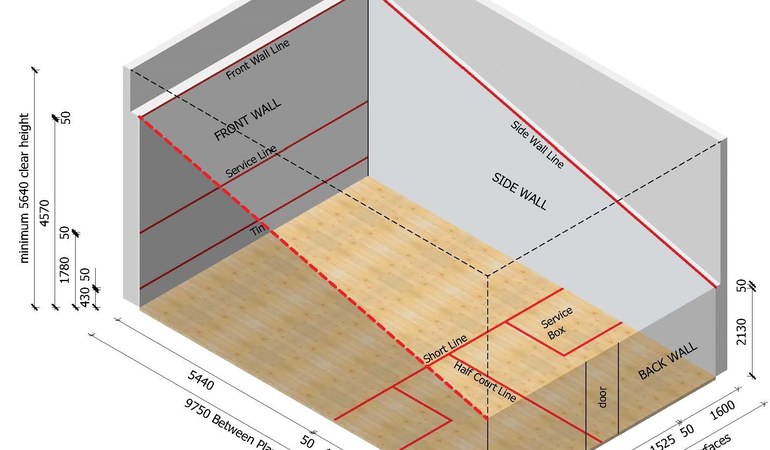
Image coming soon

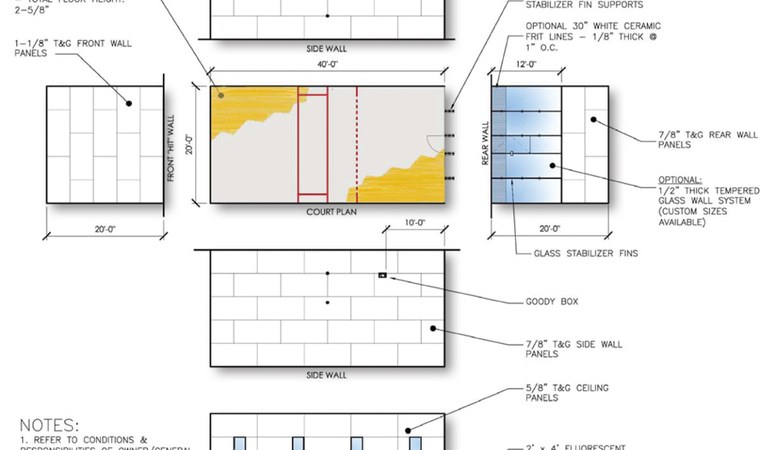
Dimensions and layout. A regulation singles squash court's internal dimensions are 9.75 m long by 6.4 m wide (about 32 ft by 21 ft). The height from the floor to the lower edge of the front wall out-line is 4.57 m (15 ft), and to the lower edge of the back wall out-line is 2.13 m (7 ft).

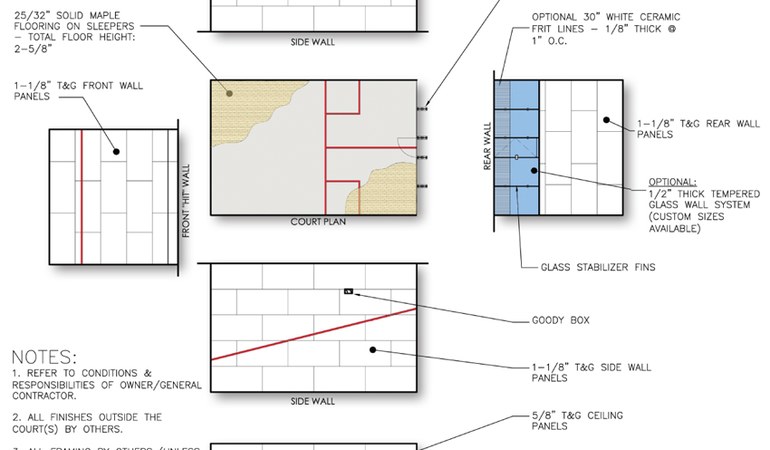
The court is marked with red boundary lines: a front wall out-line at 4.57 m high, a service line on the front wall at 1.83 m (6 ft), and a tin (board) along the bottom of the front wall at 48 cm (19 inches). The side wall lines slope down from the 4.57 m front out-line to meet the 2.13 m back out-line.

The short line is marked on the floor 5.49 m from the front wall, dividing the court into front and back halves. The two service boxes, each 1.6 m by 1.6 m (about 63 by 63 inches), are marked in the front corners of the back half. All dimensions are measured to the finished interior surfaces of the walls, so you must account for wall thickness when building the enclosing structure.

Wall surfaces. Under WSF rules, all four walls (front, two sides, and back) form the playing surfaces and must be solid, flat, and hard with a smooth matte finish. Typical squash court walls are built from masonry coated with a high-strength plaster, from prefabricated high-density panel systems, or a combination of the two.

The front and side walls in most permanent courts are solid (plaster or panels mounted on masonry or stud framing), while the back wall is often a glass wall for visibility and access. The WSF allows any wall construction that provides an accurate and even ball rebound. That means no dead spots, cracks, or hollow sounds: the bounce should be uniform wherever the ball strikes any wall.

Use materials designed for squash courts, such as dense squash court plaster (a resin-infused gypsum that resists chipping) or WSF-accredited wall panels engineered to withstand impact. Walls are usually painted white or a light color, with a minimum reflectance of 50% per WSF guidelines, for good ball visibility. The red court lines can be applied with durable tape or paint, should be 50 mm (2 inches) wide, and should contrast with the wall color.

Flooring. Squash court floors are traditionally solid hardwood, typically maple or beech boards installed over a cushioned subfloor. The floor must feel firm for a fast rebound yet offer slight shock absorption for player comfort. A proper squash floor is a sprung (suspended) wood floor with rubber pads or sleeper systems underneath, giving it a bit of flex.

The surface is left unsealed with a lightly textured finish; this matte finish improves grip and keeps the court from becoming slippery. The wood is usually light in color, often a natural wood tone, and marked with a few painted lines for the half-court line and service boxes.

Some manufacturers offer pre-engineered squash flooring systems; for example, Junckers SylvaSquash hardwood boards are WSF-accredited and designed with a slightly rough surface for traction. While hardwood is by far the most common choice, a few courts use synthetic sports flooring, but any floor must meet the WSF rebound and safety criteria.

Ceiling height and lighting. Overhead clearance is critical. The minimum clear height is 5.64 m (18.5 ft) above the floor across the entire court, measured to the underside of the lowest obstruction, including lights. If you have a ceiling, it must sit above this height so that it is out of play; any ceiling or fixture below 18.5 ft would likely interfere with high shots. Many squash courts are built with no ceiling, open to the roof trusses, as long as nothing hangs below that height.

Lighting must be artificial, usually ceiling-mounted LED or fluorescent fixtures, and bright and even. The WSF recommends an average illumination of 500 lux at floor level, with a minimum of 300 lux uniformly. In practice this means installing enough fixtures to eliminate shadows and dark spots on the walls and floor.

Modern LED panels or high-bay lights with diffusers work well; position or recess them so they do not blind players looking up for lobs. Lights, ducts, and any hanging objects must not protrude into the clear space above the court (nothing below 5.64 m) to avoid interference. The interior of the court, walls and ceiling if enclosed, should have a matte white or light finish to maximize lighting and contrast with the dark ball.

Ventilation and climate. A squash court is an enclosed space that can get hot and damp during play, so good ventilation is important. The WSF specifies at least four fresh air changes per hour when the court is in use. In a home court, plan for either an HVAC supply and return or a simple exhaust fan system to keep air circulating.

Aim for a comfortable temperature of around 20-24°C (68-75°F) during play, in line with WSF guidance of about 22°C; cooler temperatures make the ball less bouncy, so moderate warmth is preferred. If the court sits within your home's HVAC zone, make sure the vents do not create strong airflow that could affect the ball.

Soundproofing measures can sometimes conflict with ventilation, so add acoustic dampers in ductwork if needed. Also consider a dehumidifier or insulation if your climate is humid, because condensation on a cold wall can make it slippery. In short, keep the court dry, well-lit, and well-ventilated for the best playing conditions.

Materials and Construction Breakdown

Image coming soon

Building a squash court involves specialized materials for each component. Below is a breakdown of the key parts, walls, floor, back wall and door, and ceiling and lighting, along with recommended materials and options for each.

Walls (front and sides). These walls must be sturdy and smooth. Common approaches include the following.

  • Masonry plus plaster: Construct walls from concrete blocks or brick, then apply a layer of hard plaster formulated for squash courts. Squash court plaster, such as Armourcoat Squash Plaster, is a resin-reinforced gypsum that creates a flat, durable surface able to withstand constant pounding. It is applied about 12 mm thick over a base coat and finished to a smooth, matte texture. This traditional method yields a solid wall, though plaster can crack or spall over time if not done properly, leading to inconsistent bounces. Using a high-quality WSF-approved plaster and professional application minimizes this risk; the surface can last many years and be re-plastered when needed.
  • Panel system: Many modern courts use prefabricated high-density wall panels mounted on a framework. Sand-filled panel walls, for example, have large composite boards attached to a steel frame with sand infill to add mass. Other panel systems use engineered wood or fiber panels that bolt to metal studs. These systems aim for no seams or dead spots; Fiberesin panels, for instance, are known for consistent rebound and are WSF accredited. Panels are typically pre-finished matte white. The advantage of a panel system is faster installation and a reliable true bounce with a quality product. The downsides can be cost and the need to assemble the support structure perfectly flat. Cheaper panel kits may show slight hollow sounds if not dense enough; top-tier systems from suppliers such as ASB, CourtTech, and Fiberesin use continuous surface designs to avoid this.
  • Hybrid: In some home builds, people use plywood or MDF board laminated to studs as a budget wall, but standard wood sheets alone will not match the durability or bounce consistency of proper squash panels or plaster. If you go this route, consider adding multiple layers and possibly a fiberglass or laminate surface, and be aware it may not fully replicate a true court feel.

Whatever the method, all wall surfaces should be flush. Even at wall joints or corners there should be no protrusions or recesses that could deflect the ball. Corners are typically square (90-degree angles) and must be plumb; use a laser level during construction to keep walls from leaning. Plan for the wall finish to overlap the floor edge slightly or sit on top of the finished floor, so no gap is left at the bottom where balls or dirt can collect.

Floor. The floor assembly usually consists of a sprung sports flooring system.

  • The top surface is solid hardwood boards (about 18-22 mm thick, often 7/8-inch strips). Maple is popular in North America; beech or ash in Europe; any hardwearing, close-grained wood works. These boards are typically tongue-and-groove and nailed or screwed to a sub-frame.
  • The substructure can be sleepers (joists) or an interlocking panel undercarriage with rubber pads. Junckers, for example, offers subfloor options such as clip systems or batten systems that create a slight air gap and resiliency. You can also use 2x3 or 2x4 joists placed on rubber pads spaced per spec to achieve uniform bounce and flex.
  • A vapor barrier sheet is laid between the concrete slab and the wood floor to prevent moisture damage. This matters in ground-level or basement courts.
  • The finished wood surface should be sanded matte, with no glossy polyurethane finish, usually just a light oil or seal that does not create shine. Squash floors are unusual in that they are not highly polished; a slightly roughened raw wood is preferred for grip. Game lines for the service boxes and half-court line are painted with specialty floor paint or taped.

Alternate floors: While less common for squash, some multi-sport courts use synthetic flooring such as rubberized or acrylic surfaces. These may sacrifice some bounce quality and are harder to slide on. If using multi-sport flooring, make sure it is accredited for squash or at least provides a consistent bounce.

Back wall and door. The back wall is where players enter and exit, and it can be either solid or transparent.

The modern standard is a glass back wall, typically 12 mm tempered glass panels with aluminum or steel support posts, or a frameless fin system. A glass wall usually comes in two or three large panels with a central door. Glass is ideal for viewing, whether for an audience or simply an open feel, and it is durable against ball impact.

The glass is tempered, and sometimes laminated, for safety, and should have a fine etching or dot pattern so it is less transparent and does not disorient players. The door in a glass wall is also glass, mounted on special hinges at one side, and often has a spring-loaded closer. Make sure all glass meets safety standards (often BS6206 or ASTM C1048 for sports glass). Glass back walls come with a flush metal frame at the floor and often a header or support beam at the top; these must align with the floor and ceiling so the wall is flush and the ball cannot slip through any gap.

A cheaper alternative is a solid back wall with a door. This can be built like the other walls (plaster or panels) with a doorway cut-out. A standard wood or metal door can be used, but it must sit flush on the inner side so the interior wall is smooth for play when closed.

A flush wooden door with a high-pressure laminate surface, painted to match the wall, is common. Pad or recess any handles, since protruding knobs are not allowed and would be hazardous. Typically a knob-less latch or a low-profile handle is used on the outside, with nothing sticking out on the inside.

If using a solid back wall, keep in mind the WSF out-line on the back wall at 2.13 m high. Many non-glass back walls omit the back line because the ceiling or top of the wall is close to that height anyway. To be safe, mark the back wall line at 2.13 m; anything above it is out. With a full glass wall, the same line is usually marked on the glass, often as a strip of tape or an etched line.

Door dimensions: A squash court door is usually around 2.1 m tall by 0.75-0.9 m wide, a bit narrower than a standard house door. It should open outwards, never into the court, and it needs to be self-closing for safety. Plan the door threshold to sit flush with the floor, with no step. For glass doors, most use a floor spring or overhead closer that brings the door gently shut.

Ceiling and lighting fixtures. If your court will have a ceiling, for example when building inside an existing room, the interior ceiling surface should ideally be at least the minimum height of 5.64 m (18.5 ft) or higher. It can be a regular drywall ceiling or open to the roof structure. Ceilings are typically painted matte white and kept free of protrusions. Avoid hanging lights or fans below the clear height.

Often, lights are recessed flush with the ceiling or mounted high to the sides. With a 20-foot ceiling, for example, you might hang LED light panels at 18 feet on the side edges, angled toward the walls to illuminate them evenly. The lighting system should deliver 300-500 lux uniformly on court. A common solution is four to six LED troffer lights or high-bay LED fixtures mounted overhead.

LED avoids flicker (the stroboscopic effect) and reduces heat. Cage or recess the lights so a stray ball cannot hit a bulb directly. If the court is under a roof with skylights or windows, note that the WSF does not allow transparent roofing or glare; windows must be covered with blinds when the court is in use, since natural light can cause glare or uneven lighting.

Miscellaneous components. Two other components are worth including.

  • The tin: In professional courts the tin is a panel on the lower part of the front wall that makes a loud sound when struck by the ball, signaling an out, much like a net in tennis. You can buy a squash court tin, usually an 18-inch-high sheet metal panel installed from the floor up to the 48 cm tin line. It is optional for a home court, but it adds authenticity and audible feedback for low shots. It should project no more than a few millimeters from the wall, if at all; many are designed to be flush or nearly so. Some tins have foam behind them to alter the sound. Alternatively, you can paint the lower 19 inches of the front wall a different color instead of installing a physical tin; the rules allow a visual marking, but the metal gives the classic buzzer noise.
  • Fixings and trim: Use flush-mounted hardware wherever possible. Any outlet covers, light switches, or ventilation grilles inside the court should be flat and ideally below the 0.48 m tin line or above the 5.64 m line, where they will not be hit. If you need an AC vent in the court, install it just above floor level or at the very top of the wall, and use a flat grille with chamfered edges, or consider behind-the-wall ducting. Pad or bevel any unavoidable small protrusions. Corners between walls can be left sharp, since players are aware to avoid them, but some builders slightly round the corner or use a white corner guard for wall protection; if you do this, keep it very low-profile.

Materials List Summary

The list below summarizes the key materials you will need for building the court.

  • Wall surfaces: high-strength squash plaster (such as Armourcoat), prefabricated squash wall panels (such as Fiberesin or ASB systems), and masonry (concrete block or brick) with a bonding agent if plastering. Walls must be rigid, smooth, and matte. Use WSF-approved wall systems where possible for reliable bounce, and finish in a light color, usually white.
  • Flooring: squash court hardwood boards (maple or beech), a subfloor sleeper system with rubber pads or a prefabricated sport floor undercarriage, a vapor barrier sheet, and a floor finish of oil or wax (no glossy poly). Order roughly 700 sq ft of hardwood to allow extra for cuts. Include shock-absorption pads or sleepers at the manufacturer's spacing, and mark lines with durable paint or tape.
  • Back wall and door: 12 mm tempered glass panels with mounting hardware and a glass door with closer and latch for a glass wall, or the same plaster and panels as the other walls plus a flush solid-core door for a solid wall. Glass kits often include metal framing and hinges. For a solid wall, frame a door opening of about 7 ft by 30-36 in. Use shatterproof glass for a glass door, and keep all interior surfaces flush when the door is closed.
  • Ceiling: drywall or plywood if installing a ceiling, optional acoustic insulation above the ceiling for soundproofing, and matte white paint. A ceiling inside the court is out of play if it is above 18.5 ft. If lower, treat it as an out-of-court surface and mark an out line. Typically painted white for reflectance.
  • Lighting: high-output LED fixtures (4000-6500 K color temperature recommended for clarity), mounting hardware (recessed cans, brackets, or safety cages), and electrical wiring, conduit, and switches installed to code. Plan for roughly six to eight lights of about 100 W LED equivalent each to reach around 500 lux. Use multiple circuits or dimmers if you want adjustable lighting, place switches outside the court, and avoid lights directly above the front wall to prevent glare in players' eyes.
  • Ventilation: a quiet wall or ceiling-mounted exhaust fan, a fresh air intake vent or door grille, and optional ductwork to the HVAC system. Aim for at least four air exchanges per hour. A simple solution is a high vent on one side and a low vent on the opposite side for passive airflow, plus a fan. Keep vents flush and not too large, using multiple small vents if needed.
  • Court lines and tin: 50 mm wide red tape or paint for lines, a metal tin panel (17-19 inches high) with screws or adhesive, and floor paint for the service boxes. Use a laser level to place lines accurately (front wall 15 ft and 6 ft lines, back wall 7 ft line, and side wall connecting lines). Good-quality vinyl tape can work on walls; paint may chip on plaster, so some prefer replaceable tape. The tin can be bought prefabricated; mount it securely so it does not rattle.

Required Tools and Equipment

Image coming soon

Building a squash court is a construction project that needs many standard tools and a few specialized ones. If you are doing it yourself, make sure you have or can rent the following.

  • Measuring and layout tools: A laser level, or a long spirit level, is indispensable for marking out the court lines on walls and keeping walls plumb. Also have tape measures (at least a 10 m tape), chalk lines for floor markings, and marking pencils. A laser distance measurer helps verify the 9.75 m length and 6.4 m width precisely.
  • Power tools: A heavy-duty drill (with masonry bits for concrete) and a driver for screws, a circular saw or miter saw for cutting wood (floor boards and studs), and possibly a rotary hammer for anchoring frames into concrete. If using plaster, an electric mortar mixer or drill attachment helps mix plaster and render. An angle grinder can be useful for cutting metal (frames or the tin) or sanding off high spots.
  • Scaffolding and ladders: Given the height of squash courts, have a safe way to work on high walls and the ceiling. A mobile scaffold tower, or at least a 12-15 ft A-frame ladder, is needed to install lights and paint lines. For a DIY build, scaffolding is strongly recommended for applying plaster or installing panels on the high front wall.
  • Plastering tools (if applicable): A plaster hawk board, trowels (preferably a high-quality straight trowel for the finish), a darby or straightedge to screed the plaster flat, mixing buckets, and plaster floats. Also masonry brushes or sponges for finishing touches. If you are not experienced in plastering large surfaces flat, consider hiring a professional just for that step, since the quality of the wall finish is crucial.
  • Flooring tools: A pneumatic floor nailer (for tongue-and-groove hardwood) speeds up installation and ensures a tight fit. Alternatively, screws and a power driver can be used per board if the floor system recommends it (some sport floors are screwed down rather than nailed). You will also need a pry bar or pull bar to tighten rows, spacers, and a mallet. A drum sander or orbital sander may be needed if you have to sand the floor after installation; some floors come pre-finished or are finished after installation.
  • Glass installation tools: For a glass wall or door, you will need suction-cup lifters to safely carry the panels, and possibly scaffolding to hold a panel in place while securing it. A torque wrench or drill attachments for the specialized fasteners that come with the glass wall kit are usually required. Wear glass-handling gloves and have at least two or three strong helpers, since the panels are heavy and can weigh 200 lbs or more each.
  • General construction: Hammers, saw horses, screwdrivers, utility knives, a caulking gun for adhesive or sealant, paint brushes and rollers for walls and lines, and safety gear (gloves, eye protection, and dust masks, especially when mixing plaster or cutting wood).
  • Cleaning and finishing: Large sponges or cloths for plaster cleanup and wiping down walls before painting lines, a shop vacuum to remove dust (especially before laying the floor and before painting), and straight-line guides such as painter's tape for painting.

DIY vs Contractor: Cost Estimates

Image coming soon

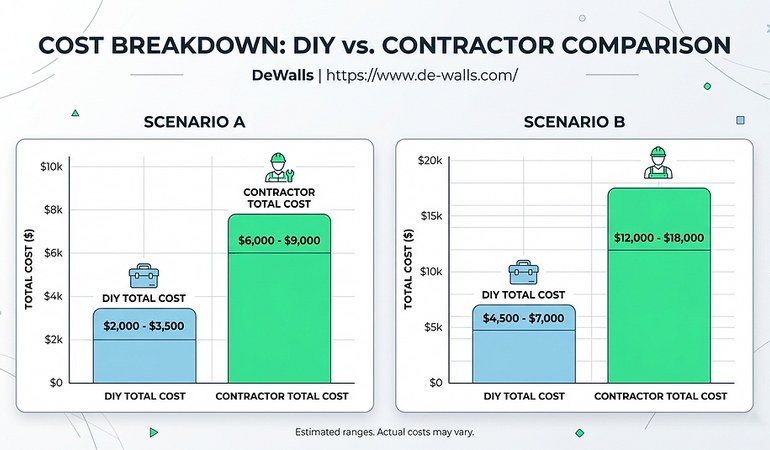
Building a squash court is a significant financial investment whether you do it yourself or hire a professional court contractor. The table below breaks down typical costs for the major components and compares a DIY approach (materials only, assuming your own labor) with professional installation.

These are broad approximate ranges in US dollars only, and actual prices vary widely by location, material quality, and site conditions.

ComponentDIY (materials only)Professionally installed
Wall system (front and side walls)About $5,000-$10,000 for cement blocks, plaster, or basic panels; a high-end panel system kit $15,000 or moreAbout $15,000-$30,000 including labor for plaster or panels; high-end panel systems fully installed reaching around $40,000
Flooring (wood plus subfloor)About $4,000-$7,000 for maple or beech boards, pads, and fastenersAbout $8,000-$15,000 for material and install; specialist installers may charge around $12-$20 per sq ft
Back wall and doorAbout $3,000-$6,000 for a glass wall (panels, door, hardware), or $1,000-$2,000 for a solid wall with a basic doorAbout $6,000-$10,000 for a glass wall by a specialist; a solid wall is cheaper and often included in the wall cost
Lighting and electricalAbout $500-$1,200 for LED fixtures, wiring, and switches, assuming existing service nearbyAbout $1,500-$3,000 for electrician labor and fixtures, more if new circuits are needed from a distant panel
HVAC and ventilationAbout $300-$800 for a wall fan or duct materials, or near zero if using existing HVACAbout $1,000-$5,000 for a pro to add ducts and returns; a simple exhaust fan is inexpensive, central AC or a mini-split raises the cost
Painting and linesAbout $200-$500 for court line tape or paint, wall paint, and a tin panelAbout $500-$1,000 to hire a painter, though this is often done DIY even in contractor builds
Ancillary (permits, design)Perhaps $500 for plans and $500 for permits if required, with your own time not billedAbout $1,000-$3,000 for drawings, engineering, and permits, which a contractor might include

Total estimates. A full DIY material cost commonly lands somewhere from about $15,000 at the bare minimum to $40,000 or more. A turnkey, professionally built court commonly runs from about $50,000 to $100,000 or more, with high-end custom courts reaching around $120,000. Treat all of these as rough ranges.

Notes on costs. These figures assume you already have an empty room or structure of the correct size. If you need to build an addition or external building to house the court, that construction (foundation, roof, and so on) is additional. A pre-engineered steel building or wood-framed structure to fit a squash court could add roughly $20,000-$50,000, separate from the court installation itself.

The court installation alone (walls, floor, and so on) for a single court is often quoted in the $40,000-$60,000 range by professional suppliers for basic setups. One home court builder reported a breakdown of about $35,000 total, roughly $18,000 for wall materials, $8,500 for the glass back wall, and $8,500 for the flooring. Turnkey packages from specialty companies such as ASB and CourtTech may run higher but come with warranties and faster installation. All such figures are approximate and should be confirmed with current quotes.

DIY considerations. Going DIY can save on labor, but be realistic about your skills and time. The most expensive items, prefab wall kits and glass, do not drop much in price with DIY, so the savings mainly come from doing the labor-intensive parts (building walls, laying floor) yourself.

With construction experience you might keep the project on the lower end of the budget. Mistakes can be costly, though; a poorly plastered wall that needs redoing, or a buckled floor from moisture, can erase the savings. A hybrid approach is common: you act as the general contractor, hiring subcontractors for critical steps such as plastering and flooring while doing simpler tasks like painting lines and installing lights yourself.

When hiring, look for contractors experienced in sports floors or court construction. They will understand the tight tolerances and finishes required. Some squash court manufacturers will sell materials or kits to DIY builders; you might buy a panel system and install it with local labor following the manual. This middle ground ensures you have the right materials without paying full service costs.

Construction Process and Timeline

Image coming soon

Building a squash court at home typically proceeds through the following phases.

  1. Planning and design (one to two months). Measure your available space to confirm it can fit the internal court dimensions plus wall thickness. Because the court is a precise box, create scale drawings or hire an architect or engineer to double-check the plans. Decide on your construction method (plaster or panels, glass or solid back wall) and get quotes for key materials. Check with local authorities about building permits; converting a garage or basement, or building an addition, likely needs a permit for structural alterations and electrical work. This phase also includes reinforcing any structure. If your basement has a support column in the middle, you will need a structural solution such as a steel beam to remove it and clear the 21 by 32 ft open span; engage an engineer if necessary. Also plan for ceiling height; if you are short of 18.5 ft, consider raising a roof or lowering a floor if feasible. Early planning helps avoid expensive changes later. Use this time to order long-lead items, since some squash flooring or glass wall systems take a few weeks to manufacture and deliver.
  2. Site preparation (one to three weeks). Once permits and materials are lined up, prepare the space. This can involve demolition: removing old finishes, taking out non-structural walls, and clearing the floor down to the concrete slab. Make sure the subfloor slab is level; you may need to grind high spots or use a self-leveling compound in low areas, since the wood floor needs a flat base, usually within 3-4 mm across the whole court. If running new electrical or HVAC, rough in the conduit and ductwork now, before the walls and floor go in. For example, have an electrician run wiring for the lights and any outlets while the walls are open. Likewise, frame out and install any ducting or an exhaust fan box; you can hide ducts in the ceiling or along a high corner, keeping in mind the WSF guidance that vents in the court should sit below the tin line on the front wall or above court height. If you opted for a panel system with a metal frame, anchor that frame to the slab and ceiling in this phase. For plaster courts, you might put up metal or wooden stud framing as backing, unless plaster will go directly onto block.

Wall construction (two to four weeks). Building the playing walls is often the most time-consuming part.

  • Plaster walls: With masonry, after the block walls are up and cured, a scratch coat and then a finish coat of squash plaster are applied. The plastering itself may take only a few days, but plaster needs proper curing time; courts are often left to dry for one to two weeks before sanding and finishing to ensure all moisture is out, which helps prevent future cracks. Keep the area ventilated to aid curing but avoid rapid drying, which can cause cracks. The final coat is steel-troweled very smooth. Flatness is critical, so check with long straightedges. After curing, the walls can be lightly sanded and then painted if the plaster is not already white throughout.
  • Panel walls: With a panel system, the metal frame (floor tracks, vertical posts, and top tracks) goes in first, aligned and square. Then the panels are mounted, often starting with the front wall. Each panel might be full height or modular; follow the manufacturer's sequence to avoid misalignment. High-density panels can be heavy (100 kg or more each), so mechanical lifts or extra hands are needed. Once the panels are up, joints are sealed or treated per the system; some have shiplap edges, others get a skim coat over the seams. Panel systems are often faster, with a crew installing all walls in a week or less, though DIY may take longer as you carefully adjust frames and seams.
  • Glass back wall: A glass back wall is usually installed after the other walls but before the floor, to allow access for drilling anchors in the slab. The glass frame or shoes are anchored into the slab with epoxy or bolts, then the panels are lifted in and secured. Precise alignment is needed so the door fits correctly. This part is often handled by a specialist subcontractor even in a DIY build, given the weight and risk, and can be done in a day or two with the right equipment.

After all walls are finished, mark the wall lines accurately at regulation heights. These can be painted or taped on later, but now is a good time to pencil them in and snap chalk lines as guides.

Floor installation (about one week). With the walls done, or at least the plaster cured enough, install the wood floor. For a sprung system, place the rubber pads or sleeper grid per the layout, install the plywood subfloor if it is part of the system, and finally lay the hardwood surface. Leave the required expansion gap at the perimeter, usually about 3/4 inch, covered by a small trim or the wall itself.

The floor boards are typically laid lengthwise along the court's length, so they run parallel to the short line, which is traditional. After installation, the floor may be screen-sanded for uniform texture. Then add the floor markings: typically a 2-inch-wide red line for the half-court line and service boxes, painted with polyurethane paint or applied as vinyl tape. Many installers coat the lines with a thin layer of finish or use adhesive tape known to hold up under foot traffic.

Finishing touches (a few days). Now add the small but important details.

  • Mount the tin on the front wall if you are using a metal tin. Use screws and wall plugs suited to your wall surface, or an adhesive if the manufacturer recommends it. Its top should sit exactly 48 cm from the floor.
  • Install the door hardware and make sure the door self-closes properly. Check that when closed, the door is flush with no gap around it that a ball could squeeze through.
  • Install ventilation grilles, light switch plates, and any protective covers for lights. All should be flush and ideally painted white or clear.
  • Thoroughly clean the court: sweep and vacuum the floor, wipe down the walls to remove dust or pencil marks, and clean the glass with a non-streak cleaner.

It is also wise to let the wood floor acclimate and the plaster fully dry for a while before intense play. Some installers recommend waiting a week or so after completion before heavy use, to let all materials stabilize.

Timeline estimate. For a professional crew, once the space is ready, a single squash court installation can be relatively quick, often around four to six weeks from start to finish. Panelized courts can sometimes be finished in under a month on-site.

DIY or self-managed builds usually take longer, perhaps two to three months of intermittent work depending on your pace and whether you contract out some tasks. Always add buffer time for unforeseen issues, such as plaster taking longer to cure in damp weather or a delayed materials shipment. Factor in permit inspections if applicable; you may have to pause at certain stages for the inspector to sign off on framing, electrical, and the final inspection. With good planning, expect roughly 8 to 12 weeks of construction activity spread over a few months.

Challenges and Tips
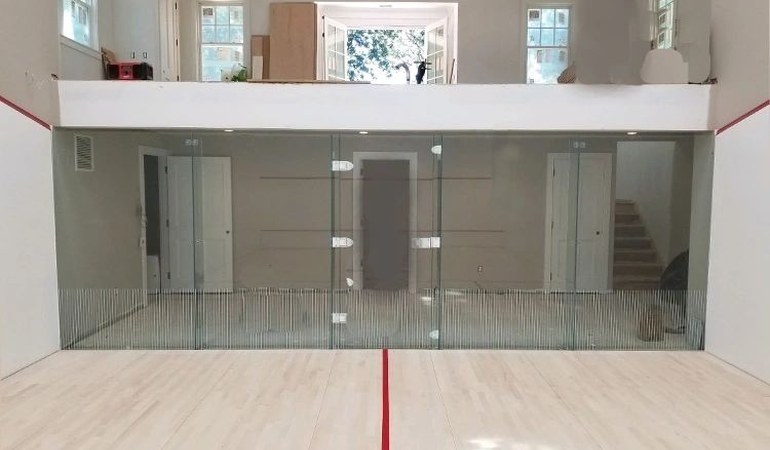
Image coming soon

Building a squash court comes with some unique challenges. Here are common issues and tips to address them.

Space constraints. Achieving the full regulation size and height is challenging in a home setting. If your available area is slightly smaller, you might be tempted to scale things down, but even small deviations can change play quality dramatically. Stick to the standard dimensions for a genuine experience.

If you must compromise, for example a ceiling of only 16 feet, understand the court will not be tournament-standard (any ball hitting the ceiling is out) but can still be a fun practice court. In planning, account for wall thickness, since the room's outer dimensions will be bigger. Also ensure clear space around the court for construction and future maintenance, at least a couple of feet outside the court on all sides, especially where you have lights or an HVAC unit to service.

Structural considerations. A squash court's walls and floor endure repetitive impact. If building inside an existing structure, reinforce the walls and floor structure. When attaching panels or plaster to wood studs, those studs may need extra bracing or doubled-up members to prevent vibration.

If your court is on an upper floor, rare but possible when converting a loft, check the floor joists for their ability to carry the load of play and a heavy floor system; you may need to add beams or posts, and consider the glass wall weight. Many home courts are built in basements or garages on concrete slabs, which is ideal for stability. For new builds, a concrete slab foundation with a vapor barrier is the best base. Make sure the slab is flat and level to within a few millimeters.

Soundproofing. Squash is loud; the bang of the ball on the walls can echo and carry through a house. If your court shares walls with living spaces, invest in soundproofing.

  • Use insulation in any wall cavities and consider double-layer drywall or resilient channel on the outside of the court walls to dampen sound transmission.
  • For plaster courts, the heavy masonry already blocks much of the sound, but you can add an air gap and insulation between the masonry and any exterior framing.
  • For panel courts, some systems have sound-deadening built in, such as sand-filled panels. Fill or insulate any gap behind the panels to prevent drum-like resonance.
  • The door is a sound leak point; if using glass, get one with a tight seal, and if wood, add an acoustic door sweep or gasket.
  • The ceiling or roof should also be insulated or sound-damped if there are bedrooms above. Carpet or soft flooring in adjacent rooms can absorb reflected noise.
  • Dedicated sound-deadening panels outside the court can help if noise is still an issue. In extreme cases, building the court as a room within a room, isolated on rubber mounts, is the ultimate solution, though it is complex and usually reserved for commercial installations.

Ventilation and heat. A closed court can become very hot without ventilation. If your court is in a basement, consider a dedicated dehumidifier or a connection to AC to remove moisture, especially in summer. Airflow design matters; one simple method is a small vent near the floor on one side and one near the ceiling on the opposite side, so cooler air enters low and warmer air exits high.

A ceiling fan outside the court door that exchanges air can also help; some home courts simply leave the door open between games to flush in fresh air. Leaving the door open during play is not ideal for containing the ball, though, so built-in ventilation is better. If using an HVAC system, make sure the vents do not create a draft that could affect the ball's trajectory; diffusers help spread out the airflow.

Floor maintenance and environment. Wood squash floors can be sensitive to humidity. Keep the court climate-controlled year-round if possible. Large swings, such as very dry winters and humid summers, can cause the boards to shrink or expand, leading to gaps or buckling. A constant moderate humidity, perhaps 40-50%, is ideal.

Enforce a clean-shoes rule, since dirt or grit on the floor acts like sandpaper. Over time you may need to re-sand or reseal the floor, every 5-10 years in home use, to maintain the surface. Plan that into maintenance costs.

Wall maintenance. With plaster, nicks and ball marks will appear over the years, so keep some plaster mix for patch repairs. Many players periodically repaint plaster walls to keep them bright and improve ball visibility, since scuff marks from the ball darken the wall. Use a breathable matte paint recommended for squash courts, or simply keep the natural white plaster. Panels are easier to maintain, usually just cleaning; if a panel is damaged, which is unlikely in normal use, you replace that section.

Expert help. Bring in professionals for critical stages. Common points to get help include structural changes such as removing a beam, plastering (an art in itself to do perfectly), flooring (a pro can install a sports floor faster and tune the bounce by selecting the right pad firmness), and glass installation for safety. You can still save money by project-managing and doing the simpler labor yourself.

Making the Space Multipurpose

Image coming soon

One advantage of a home squash court is that it can double as a general recreation or fitness space when you are not playing squash. With some planning, your court can serve several purposes.

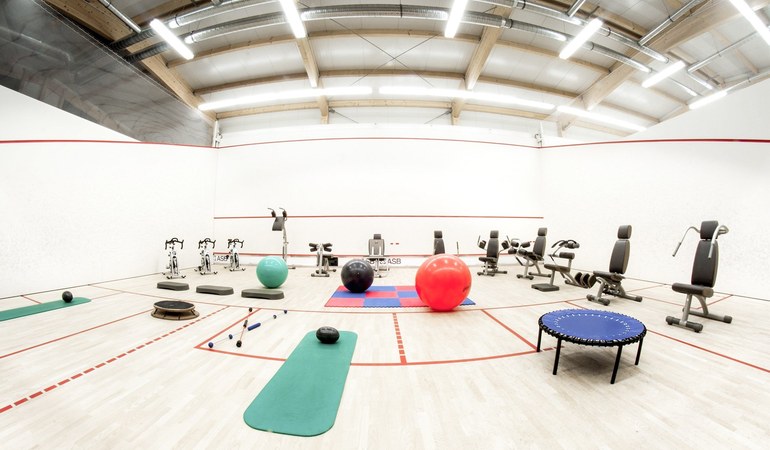
  • Home gym or fitness studio: When not used for squash, the open 32 by 21 ft hardwood floor is well suited to workouts, dance, yoga, or a home gym setup. You can bring in portable equipment such as a stationary bike or free weights, then move it aside to play. To protect the floor from heavy equipment, use rubber mats or plywood sheets under weights or machines. Some owners lay down a large roll-out mat to convert the court into a gym floor temporarily. The high ceilings also suit activities like jumping rope or plyometrics.
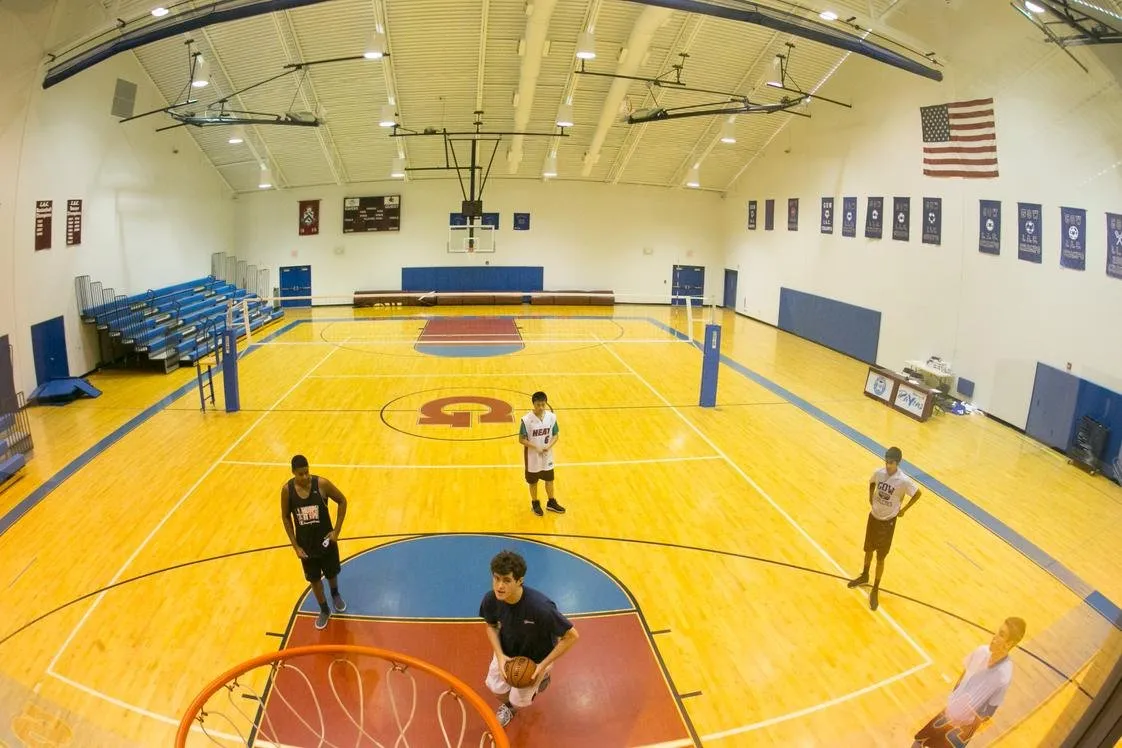
  • Half-court games: The squash court is smaller than a basketball half-court, but you could mount a basketball hoop on the front wall to shoot casually. Keep it high and folded away during squash, perhaps a removable rim or one that folds up flush. A basketball will bounce differently on a sprung wood floor, but it is still useful for practice. The court can also be used for games like wallyball (volleyball inside a racquet court) by hanging a net, or even racquetball or handball, simply ignoring the squash-specific lines.
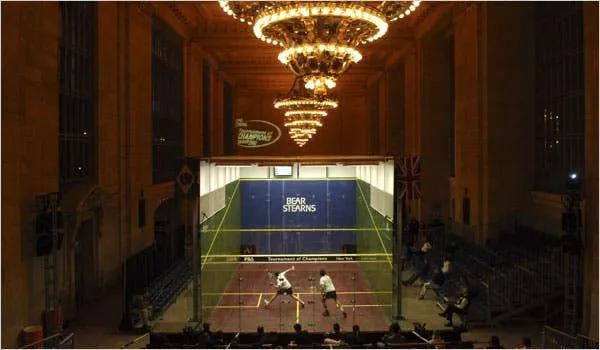
  • Entertainment or events: With some creativity, a squash court can become a small event space. You could mount a projector outside the court and project movies onto the large white front wall, turning it into a home theater viewed from inside the court or through the glass wall. A few movable chairs or beanbags inside make a casual hangout spot; the acoustics are live due to the hard surfaces, but that is workable for casual use. For a party, the court can serve as a dance floor or table tennis area. If you plan such uses often, consider installing flush floor sockets or wall hooks to tie down equipment or decorative lighting.
  • Equipment storage: Build in some storage for non-squash gear. A slim closet or rack just outside the court can hold gym gear or other sports equipment. If space inside allows, a rolling cabinet against the back wall, moved out when playing, could hold yoga mats, balls, and similar items. Some owners leave a small recess in the back wall above the door to stash spare racquets or maintenance tools.
  • Movable or foldable walls: In higher-end designs, there are systems with movable side walls, as used in some clubs to convert two courts into one larger space. At home, one idea is a section of side wall that opens, like a large double-door or sliding panel, into an adjacent room, connecting your court with a lounge or bar area for a more open space. This feature needs structural support and locking mechanisms so it remains solid for squash. It is complex but achievable with the budget and a creative architect.

In general, making the space multipurpose means protecting the key elements, the walls and floor, when the court is used for something else, and keeping the court clear at game time. Avoid permanently mounting anything on the playing walls that could interfere or get damaged; a TV on the playing wall would not survive the first squash ball. Use the outside of the court for things like speakers or a TV if you want a media setup.

Trusted Suppliers for Squash Materials
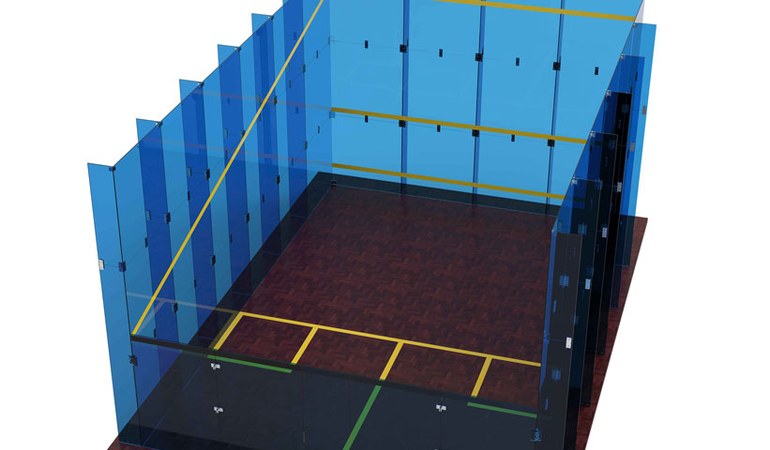
Image coming soon

Given the specialized nature of squash court components, it is wise to source materials from trusted manufacturers experienced in the sport. Below are recommendations for the key components, all with products used in professional courts.

Wall systems and panels

  • ASB Squash Courts (Germany) is a pioneer in squash court construction. It offers complete court kits, including patented glass walls and high-density panel systems. ASB is a WSF-approved court supplier known for consistent rebound quality.
  • CourtTech (Germany and USA) is another WSF-accredited company. It provides full squash court packages and has a presence in the US. Its panel systems use a steel frame with sand-filled panels and come with long warranties. It can supply kits for home courts and often guides your local contractor on installation.
  • Fiberesin (USA) makes a well-regarded, WSF-certified court panel system. It manufactures durable laminate panels for squash and racquetball and has dealers in various countries. For a panel court, Fiberesin panels provide a professional-grade wall surface and can be ordered to size.
  • For plaster, look for Armourcoat Squash Plaster (UK) or similar WSF-approved products that are widely used. These can often be bought through specialty building suppliers. Armourcoat has installers worldwide, or you can buy the mix and have a local plasterer apply it with guidance to achieve the correct finish.

Flooring

  • Junckers (Denmark) is a top brand for sports floors; its SylvaSquash solid hardwood boards are made specifically for squash and are approved by the WSF and national squash associations. Junckers supplies complete systems (wood plus subfloor sleepers) and its floors are used in many tournaments.
  • Other reputable sports flooring companies include HARO (Germany) and Connor Sports (USA). They may not have squash-specific product lines, but they produce high-quality gymnasium floors that can be adapted for squash, provided you use an unsealed finish. If going through a local sports floor installer, ask whether they have done squash courts and can provide the necessary friction and bounce characteristics.
  • You can also ask court builders like ASB or CourtTech, which often supply wood flooring as part of their package; some have proprietary engineered wood solutions for more elasticity.

Glass walls and doors

  • Ellis Pearson / Trent Glass (UK) and McWil (USA) are known providers of squash court glass walls. Glass is fairly standard across suppliers, but it is crucial to get certified tempered glass with proper mounting systems. Many court contractors source from a few specialized glass manufacturers that understand the requirements, such as handling players running into the glass. If you buy a glass back wall kit, make sure it is WSF certified for safety; it will typically include the door, all mounting hardware, and sometimes the floor frame for the door.
  • Court construction firms such as ASB and CourtTech also sell glass walls separately. ASB, for example, has a popular four-panel glass wall system and can likely supply one for a home install. Make sure whoever installs it follows the leveling and alignment instructions precisely.

Miscellaneous accessories

For accessories such as the tin, line tape, and paint, consider the following.

  • The tin: This can be obtained from squash court equipment suppliers. ASB makes tin plates, or a local metal shop can fabricate one; a common spec is about 48 cm high in sheet metal, powder-coated in a bright color such as red or green. It should have foam backing or a mounting that gives a resonant sound.
  • Line marking tape and paint: Companies like 3M make high-quality floor tapes suitable for courts. There are also specialty floor paints, often polyurethane-based, that bond well with wood; check gym floor paint products. For wall lines on plaster, self-adhesive tape may be better than paint, since paint can bleed on plaster. Some court suppliers sell line tape in the correct 50 mm width with good adhesion.
  • Lighting: There are no dedicated squash court lights as such, but use commercial LED fixtures from reputable brands such as Lithonia or Philips that have glare control. Some clubs now use LED panel lights flush in the ceiling for a clean look. Aim for a decent color rendering index (CRI 80 or higher) so the ball is clearly visible, and keep the color temperature consistent across fixtures; a daylight white of around 5000 K is popular for sports.

Before purchasing, consult these manufacturers. Many offer free advice or even design assistance if you are buying their materials. Fiberesin or Junckers, for example, can provide installation manuals and refer you to an installer or technical rep to guide your project. Given the cost of materials, using proven, certified products for walls and floors helps ensure your home court performs like one at a squash club.

Building a squash court is a substantial endeavor, but by following WSF specifications and learning from experienced court builders you can achieve a high-quality result. Manufacturer websites such as ASB, CourtTech, Fiberesin, and Junckers have technical brochures and case studies.

Adapt the plan to your home's conditions and consult professionals when in doubt. With careful planning, the result is a professional-standard squash court in your home, ready for solo practice or competitive games and versatile enough for other uses.