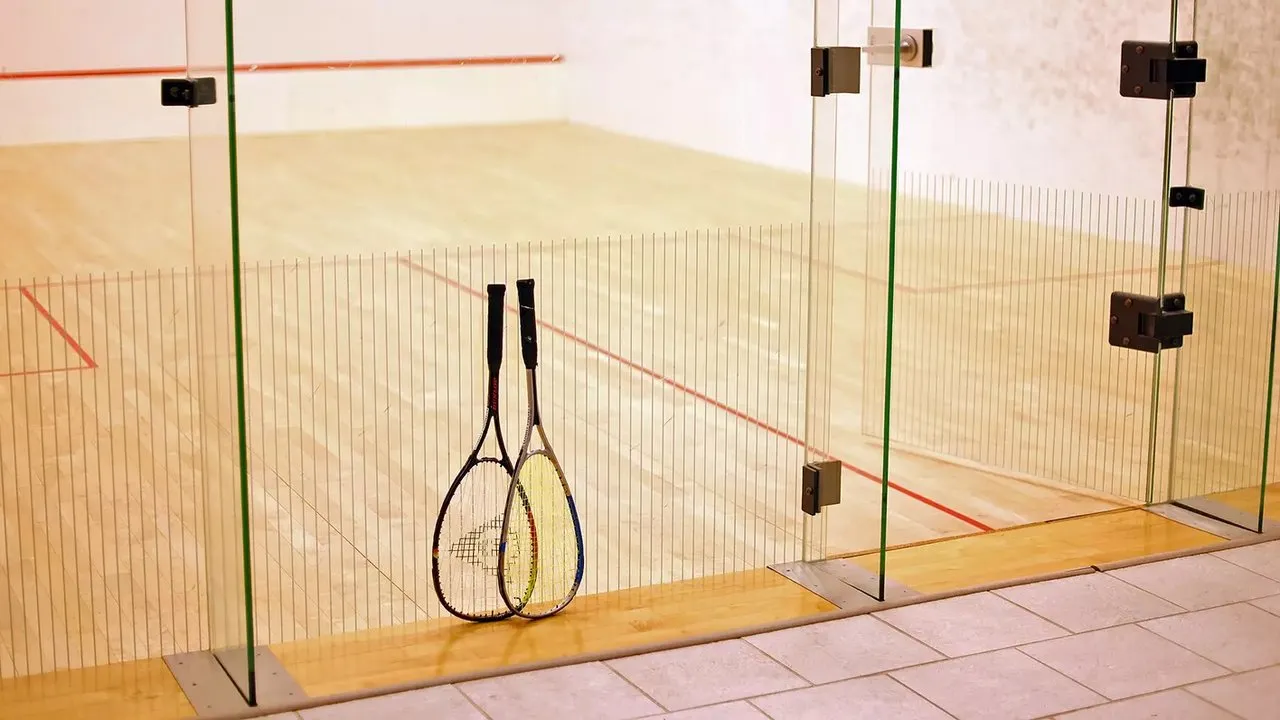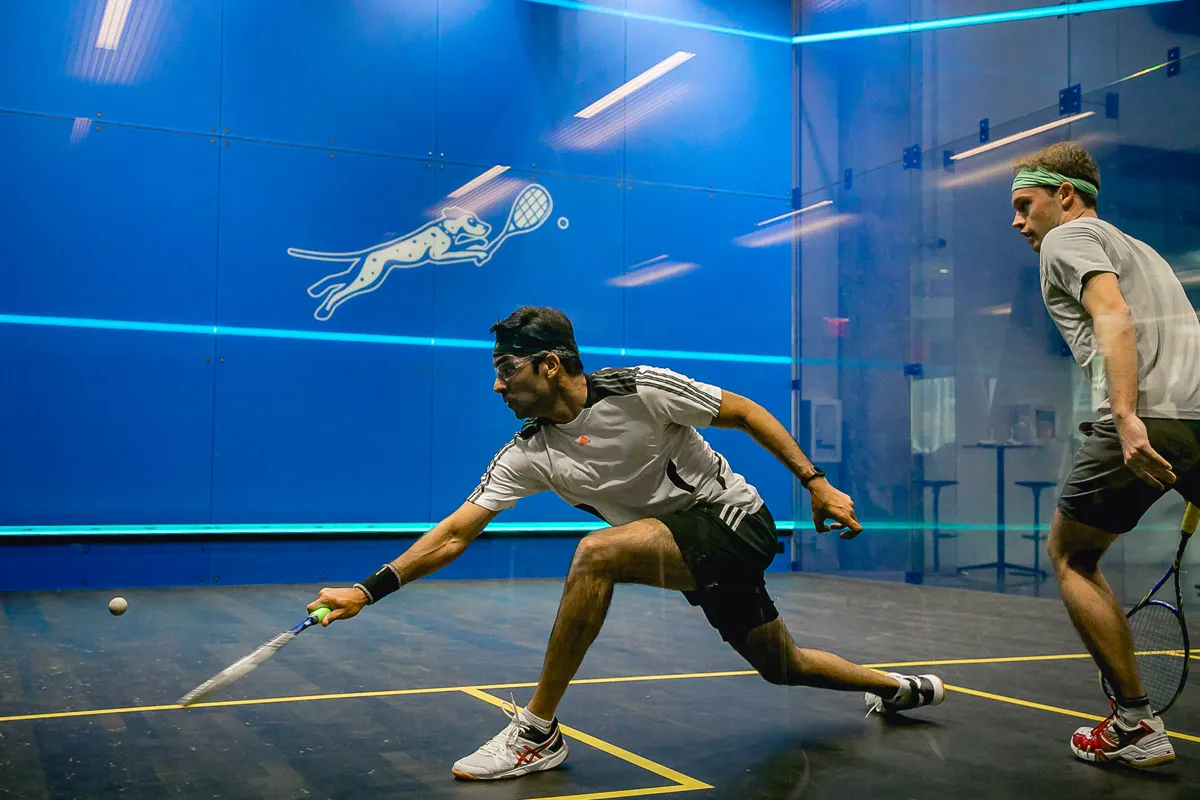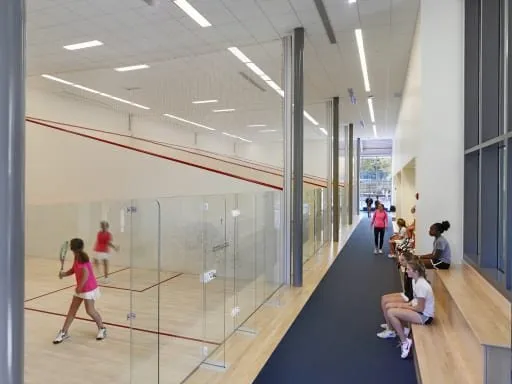

Squash grew from a niche pastime in 19th-century England into a global competitive sport with professional tours and international championships. This overview traces its origins, the milestones that shaped it, and the rise of recreational and competitive play around the world, from the first tournaments and rule changes to advances in equipment and court design.
It also profiles a few of the players and coaches who defined the game across different eras and regions.
Origins and Early Development (19th Century)
Squash began in England in the early 19th century as an offshoot of rackets, a game played in London prisons. Around 1830, students at Harrow School found that a punctured ball, which "squashed" on impact with the wall, made for a more varied and demanding game.
They played it in narrow alleys and improvised spaces, shortening their rackets to suit the cramped conditions. The name comes from the soft rubber ball, which, unlike the hard rackets ball, could be squashed against a wall.
As the game caught on, Harrow built the first four squash courts in 1864, and play spread to other British schools and clubs through the mid-1800s. Early courts varied widely in size and were often obstructed by pipes and ledges. Despite the lack of standard dimensions, squash grew steadily as an informal pastime.
By the late 19th century it had begun to travel: the first squash court in North America was built at St. Paul's School in New Hampshire in 1884, introduced by alumni who had played the game in England. At this stage squash was still largely recreational, with rules and court sizes that differed from place to place.
Growth and Formalization (1900 to 1930s)

The early 20th century brought efforts to formalize squash and organize competition. In 1904 the United States Squash Racquets Association (USSRA) was founded in Philadelphia, the world's first national squash governing body.
By 1912 it had published a set of rules drawing on rackets, tennis, and the handball-like game of fives. This helped standardize play in the United States, where both the international "softball" game and a faster "hardball" variant developed. Squash even had a place aboard the RMS Titanic, launched in 1912, which carried a first-class squash court, an early sign of the sport's social standing.
In Britain, squash grew popular among the wealthy and in private clubs. Court sizes still varied, but momentum for standardization built. The Royal Automobile Club in London hosted rule-setting meetings in 1923, and in 1928 the Squash Rackets Association (SRA) was formed in Great Britain to govern the sport.
The SRA set court specifications and a common code of play for Britain and, increasingly, the wider British Empire. Equipment of the era was simple: wooden rackets, usually ash with gut strings, and natural rubber balls.
Establishment of Early Tournaments
Organized competition took shape in the 1920s and 1930s. The first women's championship, a forerunner of the women's British Open, was held in England in 1921, and British players such as the Cave sisters, Cecily Fenwick, and Susan Noel dominated the early events.
For men, the British Open, effectively the world championship of its day, began in 1930 using a challenge format in which a champion defended the title against challengers. The first champion, Charles Read, was soon beaten by Don Butcher, who took the 1931 title.
By the late 1930s the British Open had moved to a knockout format and become squash's premier annual event. Among the early stars was Egypt's F. D. Amr Bey, whose British Open titles in the 1930s marked the start of international success beyond Britain.
Post-War Expansion and Global Spread (1940s to 1960s)
After the Second World War, squash expanded significantly. The British Open remained the focal point of the competitive game, and players from beyond Britain rose to the top. In the 1940s the Egyptian Mahmoud Karim dominated the British Open, continuing the strong Egyptian presence that Amr Bey had begun.
The sport also took root across the Commonwealth, with courts built in India, Pakistan, Australia, South Africa, and Canada, often by British military officers and expatriates, and national associations formed to match the earlier work of the United States and Britain.
In the 1950s and 1960s Pakistan became a powerhouse that would shape squash for decades. Hashim Khan and his brother Azam Khan won the British Open repeatedly through the 1950s. Hashim took his first British Open in 1951 and, with family members and protegees, kept the title in Pakistani hands for most of the 1950s and early 1960s.
Their success shifted supremacy from British and Egyptian players to the Asian subcontinent and widened the game's appeal. In the late 1960s the British player Jonah Barrington challenged that dominance, winning six British Open titles and reviving interest in squash in Europe. Barrington's emphasis on fitness and professional training also helped modernize the sport.
The 1960s brought the first steps toward global administration. In January 1967 the International Squash Rackets Federation (ISRF) was founded, with charter members from seven nations: Australia, Great Britain, Egypt, India, New Zealand, Pakistan, and South Africa.
Renamed the World Squash Federation (WSF) in 1992, it became the sport's worldwide steward. The first Men's World Team Championship was held in 1967, with the women's edition following in 1979. By the end of the 1960s squash was played at a high level on every inhabited continent.
The Professional Era (1970s to 1980s)
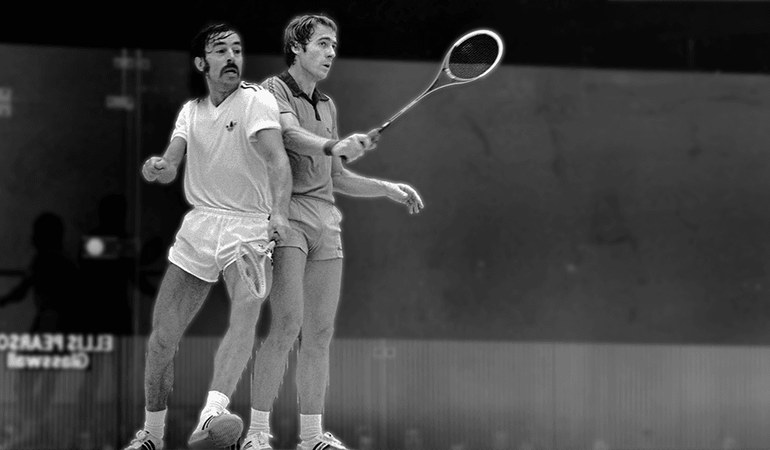
From the 1970s, squash entered a true professional era as open championships and pro circuits let the best players compete full time for prize money. The World Open, the individual world championship, was first held in 1976, shifting the de facto world title away from the British Open.
Australia's Geoff Hunt won that first Men's World Open and went on to take several more while contending with Barrington and the Pakistani greats. The women's World Open began in 1979. Australia's Heather McKay, who had dominated the women's game since the early 1960s, won the inaugural women's World Open and then retired undefeated in 1981, having gone 19 years without a single competitive loss.
As the professional game grew, organizations formed to run the tours: the men's Professional Squash Association (PSA) and the women's tour (originally WISPA, later merged into the PSA). By the 1980s a calendar of international events, from the Tournament of Champions in New York to the Hong Kong Open and various national opens, fed into global rankings, and top players travelled the world to compete.
Rule and equipment changes made the game faster and easier to watch. Traditional English scoring, in which only the server scored up to 9 points, gradually gave way to point-a-rally scoring (PARS), where every rally yields a point. The men's tour experimented with PARS to 15, and many major events adopted it during the 1980s, foreshadowing the later switch to PARS 11.
The men's professional tin, the board on the front wall the ball must clear, was lowered from 19 inches to 17 inches to reward attacking play. Court technology advanced too: a glass back wall was first installed in the late 1960s to improve spectator views, and by the late 1970s showcase events used portable all-glass courts that let fans and cameras see the action from every angle and could be built in dramatic settings, most famously beside the Pyramids at Giza in the 1990s.
The defining figure of the 1980s was Pakistan's Jahangir Khan. He turned professional in 1979 and went on an unbeaten run of 555 matches from 1981 to 1986, winning the British Open 10 times and the World Open 6 times. His relentless fitness and tactical command raised the sport's profile and set new training standards.
With rivals such as Geoff Hunt and, later, Jansher Khan, the decade became a high point for the game. Jansher emerged at the end of the 1980s and into the 1990s, winning a record 8 World Open titles. The continuity of Pakistan's champions kept squash in the international spotlight.
Equipment changed sharply in the late 1970s and 1980s. After decades of wood, makers introduced lighter, stronger materials, and by the mid-1980s graphite composite racquets had largely replaced wooden ones at the elite level, letting players hit harder and react faster.
The last English factory making wooden rackets closed in the 1980s. The two-yellow-dot ball was introduced in 2000 and became the official competition ball in 2001, offering the consistent low bounce suited to high-level play.
Modern Era and Global Recognition (1990s to Present)

By the 1990s squash was fully international, with professional tournaments in every region and champions from a growing list of countries. In the women's game, New Zealand's Susan Devoy won four World Open titles around the turn of the 1990s, and Australia's Michelle Martin and Sarah Fitz-Gerald dominated that decade, with three and five World Opens respectively.
The torch then passed to Malaysia's Nicol David, who reached number one in the 2000s and became the most accomplished woman of the modern era with a record 8 World Open titles. Her success brought huge popularity to squash in Malaysia and across Asia and showed that world-class talent could come from outside the traditional heartlands.
On the men's side, the late 1990s and 2000s saw power shift to Egypt. After Jansher Khan's era, a wave of Egyptian stars rose, helped by strong junior programmes and the visibility of the Cairo events by the Pyramids.
Amr Shabana became Egypt's first male World Open champion, winning four titles in the mid-2000s, and was soon joined by Ramy Ashour, Karim Darwish, and others, alongside France's Gregory Gaultier. By the 2010s Egypt held multiple world number ones across both tours, including Mohamed El Shorbagy, Ali Farag, Nour El Sherbini, and Raneem El Welily.
Champions now came from every continent: France's Thierry Lincou reached number one in 2004, England's Nick Matthew won three World Opens in the 2010s, and Colombia's Miguel Angel Rodriguez won the British Open in 2018, the first South American to do so.
Several rule changes unified the sport in the 2000s. In 2004 the World Squash Federation adopted point-a-rally scoring to 11 for international competition, replacing the older hand-in, hand-out system to 9. The change, already used on the men's tour, made matches easier to follow, and by 2009 essentially all competitive squash used PARS 11.
Portable glass courts became standard for finals, often with one-way spectator glass, and by the 2010s major events used video review for lets and strokes.
Squash also pursued wider recognition. It has been part of the Pan American Games since 1995 and the Commonwealth Games and Asian Games since 1998, which helped spread the game and gave nations such as India and Malaysia a high-profile stage.
The long-standing goal was the Olympics. Squash was a finalist for the 2012 and 2016 Games but lost out, and missed Tokyo 2020. The breakthrough came in October 2023, when the International Olympic Committee approved squash for the 2028 Summer Olympics in Los Angeles, a historic step after decades of campaigning and the sport's largest stage yet.
Notable Figures in Squash History
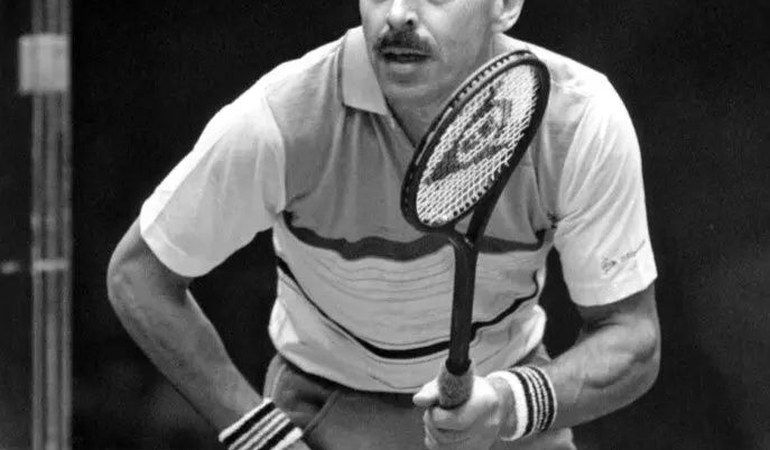
Certain players and coaches have had an outsized influence on the sport. The profiles below highlight a few from different eras and regions.
F. D. Amr Bey (Egypt)
Amr Bey was an Egyptian diplomat who became squash's first international star. He dominated the British Open in the 1930s, winning it six consecutive times from 1933 to 1938 and breaking the British monopoly.
His quick, crafty style and fitness set a new benchmark and showed that excellence in squash was not limited to Britain, an important step in globalizing the game. He is often credited with inspiring the next generation of Egyptian players.
Hashim Khan (Pakistan)
Hashim Khan rose from humble beginnings to transform squash in the 1950s. He won his first British Open in 1951 and took the title seven times in all. A wily competitor in his thirties, he combined deft touch, smart shot selection, and exceptional fitness.
He and the wider Khan family, including Azam, Mo, and Roshan Khan, ruled the British Open for nearly two decades and made Pakistan the centre of world squash. Hashim later moved to the United States to coach, helping popularize the game in North America and emphasizing disciplined training and a competitive spirit that influenced champions for generations.
Heather McKay (Australia)
Heather McKay is one of the most dominant athletes in any sport. She was unbeaten in competitive squash from 1962 to 1981, winning 16 consecutive British Open titles from 1962 to 1977 and two World Opens, including the first women's World Open in 1979.
A powerful and nimble player, she brought new attention to women's squash with aggressive volleying and precise placement. After retiring she also became a world champion in racquetball, underlining her all-round racquet skill. Within squash she set the standard for professionalism in the women's game.
Jahangir Khan (Pakistan)
Often called the greatest squash player of all time, Jahangir Khan reached a level of dominance rarely seen in any sport. The son of former British Open champion Roshan Khan and coached by his brother Torsam and cousin Rehmat, he won the World Open in 1981 at just 17, the youngest world champion at the time.
He then went unbeaten for 555 matches over five years, winning 10 British Open and 6 World Open titles. Famous for hill running and relentless conditioning as well as tactical skill, he was nearly invincible.
He later served as President of the World Squash Federation and as a global ambassador, raising the sport's profile worldwide and supporting its push for the Olympics.
Nicol David (Malaysia)
Nicol David, from Penang, became the face of modern women's squash. Through the 2000s she held the world number one ranking for a record 108 consecutive months, won 8 World Open titles and 5 British Opens, and was often unbeaten for whole seasons.
Her game was built on speed, retrieval, and mental strength. Her success sparked a squash boom in Malaysia and showed that an Asian woman could reach the very top, inspiring juniors across the region. Known for her sportsmanship, she also became a global ambassador and a prominent voice in the sport's Olympic bids.
Pioneering Coaches and Innovators
Coaches and innovators have shaped the game too. Rehmat Khan coached Jahangir Khan through his unbeaten streak with training methods that pushed the limits of squash fitness. Jonah Barrington, after his playing career, became an influential coach and author whose fitness and tactics manuals shaped training worldwide.
In the modern era, Egypt's coaching system has produced a steady stream of champions by encouraging creative play from a young age. On the technical side, the developers of the two-yellow-dot ball and the builders who perfected the all-glass court expanded what was possible in the sport, on court and for spectators.
Timeline of Key Squash Milestones
| Year | Milestone |
|---|---|
| c.1830 | Squash develops at Harrow School in England, where students adapt rackets using a squashable rubber ball. |
| 1864 | The first dedicated squash courts are built at Harrow School. |
| 1884 | The game reaches North America when St. Paul's School in New Hampshire builds the first squash court in the United States. |
| 1904 | The United States Squash Racquets Association (USSRA) is founded in Philadelphia, the world's first national governing body. |
| 1912 | The USSRA publishes one of the first standardized rule books, and a squash court is installed on the RMS Titanic. |
| 1921 | The first women's squash championship is held in England. |
| 1928 | The Squash Rackets Association is established in Britain to govern the sport and standardize courts and rules. |
| 1930 | The men's British Open is held for the first time and becomes squash's premier tournament; F. D. Amr Bey dominates the 1930s editions. |
| 1950s | Pakistan's Hashim Khan and family begin a long run of major titles, opening an era of Asian dominance. |
| 1967 | The International Squash Rackets Federation is founded (renamed the World Squash Federation in 1992); the first Men's World Team Championship is held. |
| Late 1960s | The first glass-walled courts appear, improving spectator viewing and paving the way for all-glass show courts. |
| 1976 | The men's World Open is first held; Australia's Geoff Hunt wins the inaugural title. The women's World Open follows in 1979. |
| 1980s | Graphite racquets replace wooden ones as standard equipment, and Jahangir Khan dominates the decade. |
| 1995 | Squash is included in the Pan American Games for the first time. |
| 1998 | Squash debuts at the Commonwealth Games and the Asian Games. |
| 2004 | International scoring changes to point-a-rally to 11 points (PARS 11) for major competition. |
| 2000s | Egypt enters a period of dominance, producing many world champions across both tours. |
| 2023 | The IOC approves squash for the 2028 Olympics in Los Angeles, a historic milestone after a decades-long campaign. |