
Squash is usually played indoors, but a small number of striking outdoor courts have appeared around the world. The venues below show how the sport adapts to fresh air, public spaces, and even the open sea.
Burlington, Vermont, USA (Leddy Park)
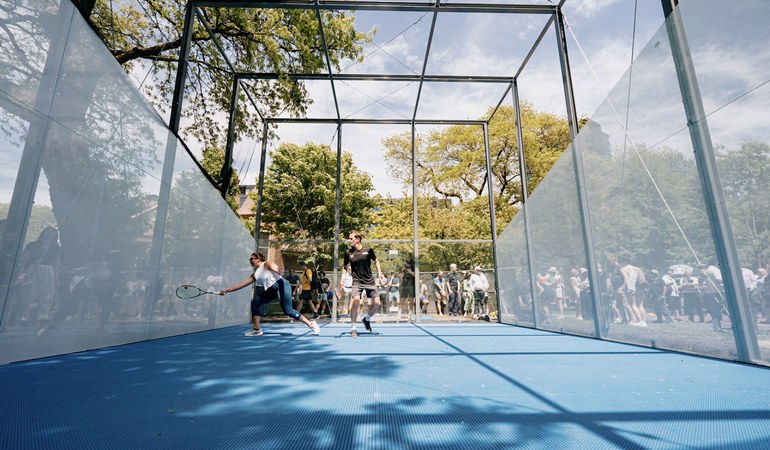
Location: Leddy Park, Burlington, Vermont, on the Lake Champlain waterfront.
Court: A permanent roofless court with four concrete walls and a textured concrete floor. The front wall stands about 16 feet high, the side walls slope down to 7 feet, and the back wall is only 4 feet high with catch-netting above it. The walls are 10 inches thick.
Accessibility: Fully public. Built on city park land, it is maintained by the city and free for anyone to play.
Amenities: A basic open-air setup. A single light was installed on site, though players have noted it is dim for night play. There is no roof, locker room or seating, so players often sweep leaves or snow before play. A perimeter net keeps balls from being lost.
Weatherproofing: The court was designed for the New England climate. The front wall faces north to avoid sun glare, and the floor is slightly sloped to drain rainwater into two front-corner holes.
The heavy concrete walls are painted with a graffiti-resistant polyurethane coating that lets graffiti be removed with solvent. Players report the ball stays lively even in freezing temperatures, so the court can be used later into the season than a tennis court.
Suitability: The court plays much like an indoor court, with comparable bounce and traction. Because it is roofless, wind and rain can interrupt play, but summer evenings and mild days are fine.
The hard concrete construction makes it low-maintenance and vandal-resistant. It suits casual and club-level play rather than sanctioned tournaments.
History: The court was built in 1999 by squash enthusiast and former professional Steven Polli at a total cost of about $60,000. Polli contributed roughly $42,000 in free labour through his construction company and raised about $18,000 in materials through donations from local players, charities and manufacturers.
It was the first permanent outdoor squash court of its kind, intended to let players enjoy summer weather. It has become a local landmark and a working example of outdoor squash.
Manhattan, New York City, USA (Hamilton Fish Park)
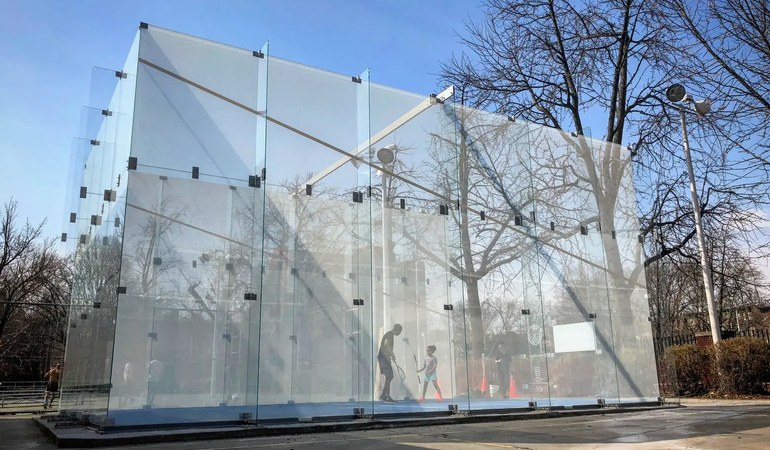
Location: Hamilton Fish Park, Lower East Side, Manhattan, New York City.
Court: An all-glass show court with a tempered-glass front wall and a specially engineered outdoor floor (sprung wooden panels over drainage grids). It had painted boundary lines and a mesh net atop the walls to contain balls. It was installed on one of the park's existing handball courts.
Accessibility: Open to the public, free of charge, on a first-come basis as an NYC Parks facility.
Amenities: Spectator seating surrounded the court. There was no roof or enclosure, so play was fully open-air, with no dedicated night lighting for squash.
Weatherproofing: The glass panels and floor were built to handle rain, with floor drainage and concrete pier anchoring, but with no roof, play was weather-dependent.
Suitability: It was built to professional show-court specifications. In January 2019 top women professionals, including Amanda Sobhy and Sarah-Jane Perry, visited and played here. It served mainly as a novelty and community court rather than a regular tournament site.
History: It opened on April 17, 2018 as New York City's first outdoor public squash court, a project by the nonprofit Public Squash with NYC Parks, created to raise the sport's visibility in the city.
It suffered vandalism that shattered a glass section in 2019 and saw limited use afterward. The court was demolished in 2023. It remains a notable example of an effort to promote urban outdoor squash.
West Kowloon, Hong Kong (Harbourfront Show Court)
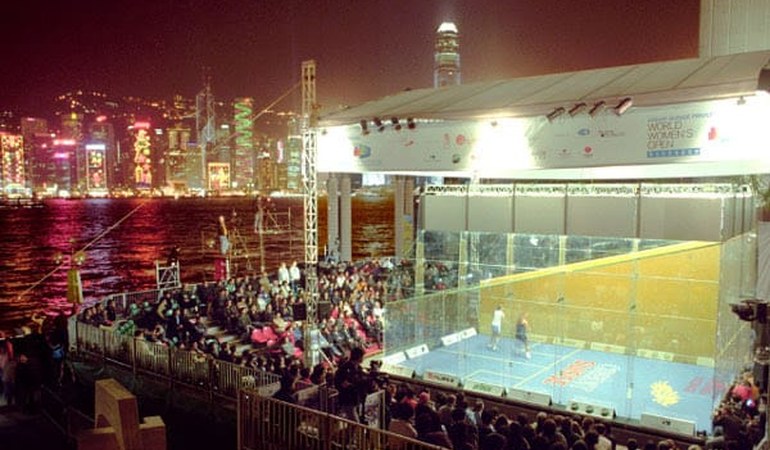
Location: The Cultural Plaza outside the Xiqu Centre, West Kowloon Cultural District, Hong Kong.
Court: A temporary glass show court assembled outdoors, with four transparent framed walls and a full glass floor, built to professional tournament dimensions.
Accessibility: An event-only installation. Spectators could attend during the tournament, but it was not open for casual play.
Amenities: Grandstand seating was erected for the event, along with venue lighting for night matches. There were no permanent amenities, as it was a short-term setup.
Weatherproofing: There was no roof or side cover, so it was entirely open-air. Organizers placed it by the harbour and scheduled it in late November to avoid the typhoon and rain season, but heavy weather could still disrupt matches.
Suitability: It was fully professional grade, used for the semi-finals and finals of the Hong Kong Squash Open in late November and early December 2023. The glass court let players compete with the city skyline behind them, with wind and ambient light adding to the challenge.
Events: It hosted the semi-finals and finals of the 2023 TTI Milwaukee Hong Kong Squash Open. American Amanda Sobhy beat world number one Nour El Sherbini there in the women's semi-final.
Moving the finals outdoors was the first time the event's closing rounds were played in the open air, intended to broaden public interest.
Tel Aviv, Israel (TPoint Outdoor Squash Club)
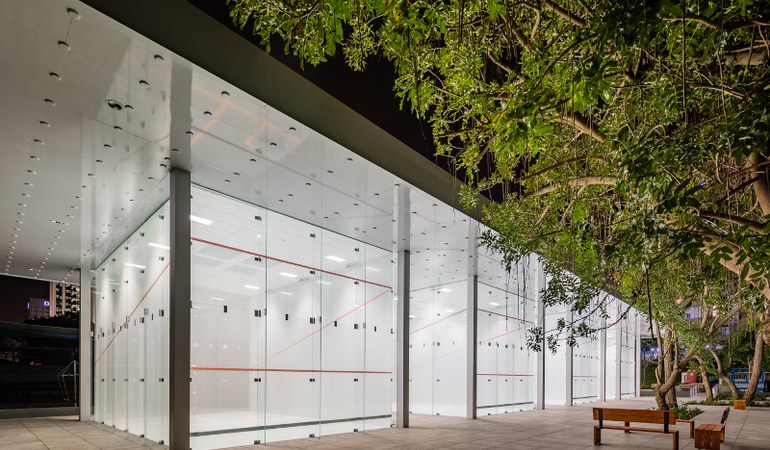
Location: A public park in Tel Aviv, Israel, part of the TPoint sports project.
Court: Four purpose-built outdoor courts. Each is a fully transparent tempered-glass court on a steel frame, with a sprung floor for shock absorption, similar to an indoor court.
Accessibility: A semi-public club model. The courts are open-air but sit in a park, and local players book through an app, with no membership barrier.
Amenities: The courts include app-controlled features such as programmable lighting, electronic scoring and booking. There are benches and open space around them.
Weatherproofing: The glass panels are anchored by steel posts and built for outdoor use. The manufacturer describes the courts as low-maintenance and vandal-resistant. They have no roof, so they function as open-air courts and are used year-round outside of heavy rain.
Suitability: The courts are built to high international standards and are designed for year-round play. The glass-walled, sprung-floor design is comparable to top indoor courts. The club has drawn many players since opening.
History: TPoint launched in 2021 as one of the first smart outdoor squash complexes of its kind, a roughly 1.5 million euro project backed by local entrepreneurs in partnership with the court manufacturer ASB.
The aim was to move squash out of hidden indoor venues and into visible city spaces. The Israeli Squash Federation has described it as a pioneering, world-class facility.
Cruise Ship AIDA Diva (At Sea)
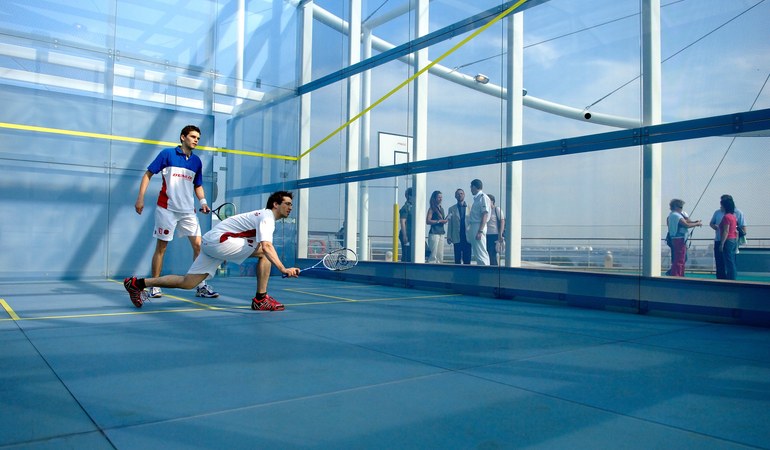
Location: Aboard the AIDA Diva cruise ship, on its open sports deck (deck 14), cruising international waters.
Court: An all-glass court installed open-air on deck. The walls and floor are tempered safety glass on a marine-grade metal frame, with the glass floor mounted on a sprung aluminium base using rubber mounts so it can handle the ship's movement.
Accessibility: Private, available only to ship passengers as one of the onboard leisure activities.
Amenities: An open-deck setting with views of the surrounding sports facilities and the ocean. Deck lighting allows day and night play.
Weatherproofing: The court was engineered for sea conditions, with the glass and floor fixed on elastic mounts to absorb shock as the ship rolls. There is no roof, so play is subject to sun, wind, rain and sea spray, though warm cruise routes limit cold weather.
Suitability: A novelty for casual play rather than professional competition. The glass construction and flooring meet court specifications, but wind can affect play. It is mainly a unique attraction that lets passengers play under the open sky.
History: The AIDA Diva court debuted in 2007 as the first all-glass squash court installed at sea. ASB engineered it specifically for cruise conditions, including the rubber-sprung glass floor. The floating court has drawn media attention as a court under the constant influence of sea movement and the elements.
Chicago, Illinois, USA (Project Beacon, Union Park)
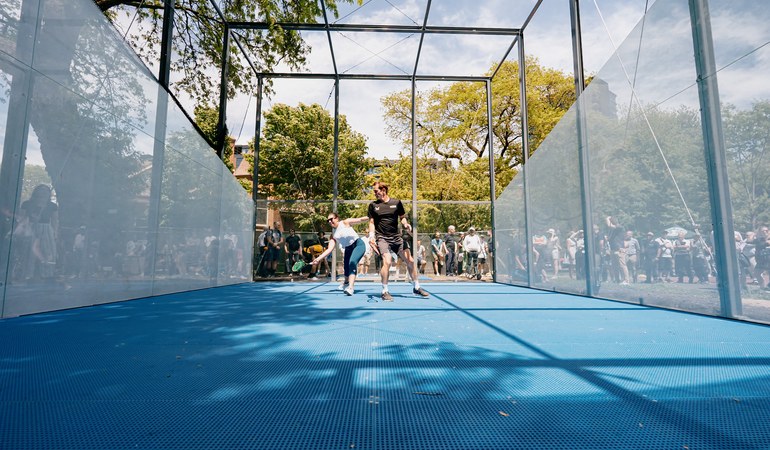
Location: Union Park, in the Fulton Market area west of the Loop, Chicago, Illinois.
Court: An open-air public court with a steel frame, tempered-glass walls and a perforated sprung wooden floor. The panels rest on concrete piers with adjustable feet.
Accessibility: Public and free, designed as a community space as part of an initiative to grow access to squash.
Amenities: The outer court walls double as canvases for rotating art, with work from Chicago-based artist Tony Fitzpatrick alongside pieces by community and student artists. Being in a park, it has nearby viewing space. It is a standalone court with no roof or enclosure.
Weatherproofing: It is engineered for Chicago weather, with tempered glass to resist wind and rain and floor panels that drain water. With no roof, winter play is limited, as with any outdoor court.
Suitability: The court is built to professional specifications and can host events and clinics, and it is intended for all levels of play from casual public use upward.
History: Announced in 2024 and opened on May 16, 2025, Project Beacon is the only outdoor squash court in a public park in the United States and the first publicly accessible outdoor court in the country in a decade.
It was designed and built by the Amsterdam company Access Courts, led by the PSA Foundation with US Squash and the Chicago Park District, in the build-up to squash's debut at the 2028 Olympic Games in Los Angeles. Its rotating exterior art ties the court to the local arts community.
San Salvador, El Salvador (Squash Para Todos Complex)
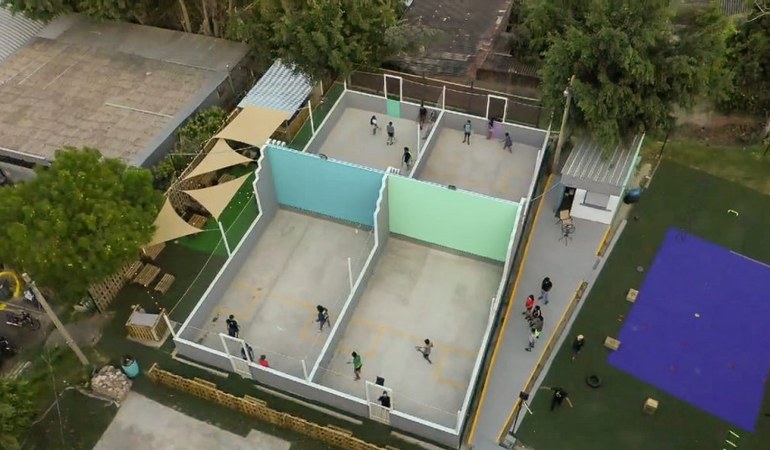
Location: The San Salvador area of El Salvador, run by the Squash Para Todos nonprofit.
Court: A set of outdoor community courts with glass back walls and wooden sprung floors built to international standards, in an open-air setting with simple fencing.
Accessibility: Community-oriented, used for programs aimed at underserved youth. Play is free or low-cost as part of the Squash Para Todos social program.
Amenities: The complex includes seating and space for youth and education programs, set within a larger sports facility.
Weatherproofing: The courts are built for a tropical climate, with glass walls and wooden floors like indoor courts but exposed to sun and rain, and drainage panels in the floor. Players must adapt to sun and wind outdoors.
Suitability: The courts are aimed at beginners and youth rather than professionals. The organizers describe them as high-quality glass-and-wood courts, but the goal is outreach rather than competition, supporting coaching and year-round play outside of heavy rain.
History: Squash Para Todos began building this outdoor community complex in 2020, partnering with Glasswing International, to make squash visible and accessible to children and to use sport to address social challenges. It is one of Latin America's first dedicated outdoor squash hubs, combining sport with education.
Outdoor courts at a glance
| Court | Location | Standout feature |
|---|---|---|
| Leddy Park | Burlington, Vermont, USA | Permanent concrete court, first of its kind (1999) |
| Hamilton Fish Park | Manhattan, New York City, USA | NYC's first outdoor public squash court (now demolished) |
| Harbourfront Show Court | West Kowloon, Hong Kong | Temporary glass court for the 2023 Hong Kong Squash Open |
| TPoint Outdoor Squash Club | Tel Aviv, Israel | Four smart, app-controlled glass courts |
| AIDA Diva | At sea (cruise ship) | First all-glass court installed at sea (2007) |
| Project Beacon, Union Park | Chicago, Illinois, USA | Only US public-park outdoor court, with rotating art walls |
| Squash Para Todos Complex | San Salvador, El Salvador | Community youth courts, a Latin American first |