
Introduction
Squash players often embody the scholar-athlete, aiming for excellence on court and in the classroom. Squash and education frequently go hand in hand, and many top players attend university or finish school while competing at a high level. Below is how players actually manage both, the programs built to combine squash with study, and where it gets hard, with examples from several countries.
School-Aged Squash Athletes and Academic Life
Training demands. Junior players often train several hours a day around school. Aryaveer Dewan, a 15-year-old from India, sets aside about four hours daily: he wakes at 6 AM, attends school in the morning, then trains from the afternoon until 8 PM. Top juniors also travel often to tournaments, missing class they must make up on the road.
Supportive schools. Anahat Singh, a leading Indian junior, credits her school: "My school is extremely supportive. I miss so much of school throughout the year, but if I need to talk to teachers online or on the phone, they're always there for me." She studies remotely when travelling, especially while preparing for her Class 12 board exams, and Aryaveer's teachers accommodate his schedule too. Flexibility like virtual catch-up, deadline extensions, and adjusted attendance is often essential.
Sacrifices. Anahat has spoken about missing "typical teenage experiences" such as friends, school trips, and parties: "I don't get to go out with my friends so much, I miss out on a lot of that," though she feels squash makes up for it.
Early time management. Many school-age players build strong time-management skills. U.S. junior Eedha Mehta struggled at first in high school and her mental health suffered, but with support from coaches, teammates, and parents she found her footing, doing homework with teammates at the academy. By the end of high school, many players have balanced school and squash for the better part of a decade.
University Student-Athletes and Collegiate Squash
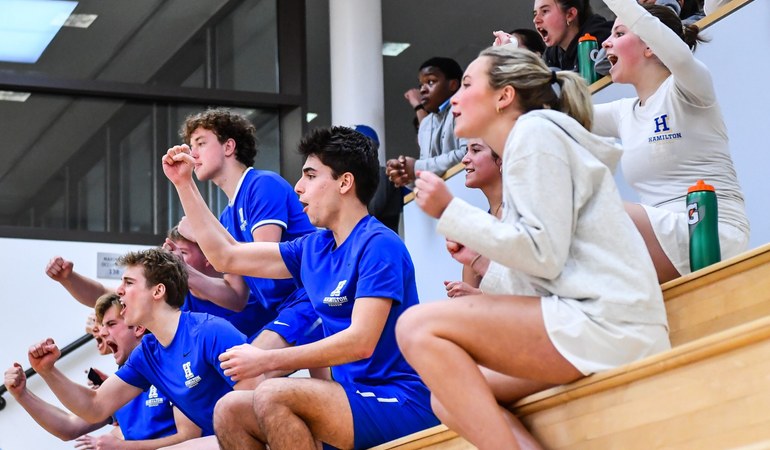
Collegiate opportunities. In the United States, squash is played at dozens of universities, especially in the Ivy League, under the College Squash Association (CSA), which governs intercollegiate squash in the U.S. and Canada. It is not an NCAA championship sport; it runs as a varsity or club sport with rosters of top recruits worldwide. Lina Tammam, a junior national player from Egypt, chose education over turning pro at 15 and enrolled at the University of Virginia, finding "the perfect balance of squash and academics."
Training versus workload. Teams train intensively while students carry full course loads. A Dartmouth College player practises about two hours on court six days a week, plus weight training. At Columbia University, where India's Ramit Tandon played before turning pro, players had five squash sessions, two gym workouts, and two track conditioning sessions a week; Tandon recalls practice 7:30 to 10:00 AM, gym 11:30 to 12:30, classes from 2 PM until as late as 7 PM, then homework and exam prep at night.
Academic performance and support. Many college players still do well through time management, with universities providing advisors, tutors, and flexible exam scheduling when teams travel. A Scholar-Athlete Award recognizes college juniors or seniors who earn at least a 3.5 GPA while competing, and at the high school level more than 200 U.S. juniors were honored as scholar-athletes in 2024 for a GPA of 3.5 or higher. Squash has long been tied to selective institutions like Harvard, Yale, and Princeton, and most players treat the sport as a complement to education, since pro squash lacks the financial security of basketball or football.
Global university pathways. In the UK, universities such as Birmingham, Nottingham, and Bristol have strong squash, with students competing through BUCS (British Universities and Colleges Sport). In Egypt, some top players attend the American University in Cairo before the pro tour. Ali Farag attended Harvard from 2010 to 2014, losing only twice in three years and going undefeated in his senior season; after a degree in Mechanical Engineering he turned full-time pro and rose to world No. 1 and multiple World Championships. Amanda Sobhy graduated Harvard in 2015 with a 62-0 college record and a world top-10 ranking, and England's Gina Kennedy finished at Harvard (class of 2020) before a 2022 Commonwealth Games gold and a world top-five ranking.
Notable scholar-athlete achievements.
| Player | Degree | Key squash achievements |
|---|---|---|
| Ali Farag (Egypt) | B.Sc. Mechanical Engineering, Harvard University (2014) | Four-time World Champion and former World No. 1, with 238 weeks at No. 1 |
| Amanda Sobhy (USA) | B.A. Anthropology, Harvard University (2015) | Undefeated 62-0 in college and the first U.S.-born player to reach the world top five |
| Saurav Ghosal (India) | B.A. Economics and Management, University of Leeds (2008) | First Indian man to reach the world top 10 (world No. 10) and an Asian Games team gold medalist |
| Gina Kennedy (England) | B.A. Psychology, Harvard University (2020) | 2022 Commonwealth Games gold medalist who reached world No. 5 |
Even players who reach the professional summit often hold university degrees, reflecting squash's roots in educational institutions.
Programs Integrating Squash and Education

Structured programs deliberately combine squash with academics, often for students from underserved communities.
Squash and Education Alliance (SEA). SEA grew out of mid-1990s urban after-school programs such as SquashBusters in Boston and StreetSquash in New York, which offered free coaching, tutoring, and mentoring to inner-city students. Today SEA has 28 member organizations (21 in the U.S. and 7 abroad) serving more than 2,000 students with squash practice, academic enrichment, college prep, and life-skills workshops. About 90% of students who stay through high school graduate and go on to post-secondary education; more than 2,000 participants have completed secondary school and more than 230 alumni have competed on varsity college squash teams, with Yale a common destination. SquashBusters started with 28 middle schoolers in 1996.
Global urban squash expansion. The model has spread to affiliated programs including:
- Canada: Urban Squash Toronto
- Colombia: Squash Urbano Cartagena
- South Africa: Egoli Squash in Johannesburg
- Israel: SquashBond
- India: Khelshala
In 2023 the Nicol David Organisation (NDO) in Malaysia, founded by eight-time world champion Nicol David, joined as SEA's seventh international partner; it serves 140 children in Kuala Lumpur with squash coaching plus English tutoring, robotics, life-skills workshops, and support for the students' mothers.
Specialized squash schools and academies. India's Corvuss American Academy bills itself as the country's first residential school for student-athletes, with an American college-prep curriculum and professional coaching. In the UK, boarding schools such as Millfield and Eton support top juniors with tailored academic plans and on-campus coaching, and in Malaysia national juniors often attend the Bukit Jalil Sports School, where the academic calendar adjusts around training and competition. Saurav Ghosal trained at the ICL Squash Academy in Chennai until about 18 while completing a degree in Economics and Management from the University of Leeds in 2008.
Challenges Faced by Squash Student-Athletes
Time management and fatigue. A high-performing player might train two to four hours daily and travel for competitions, cutting into study and rest. Ramit Tandon has said balancing squash and studies in college was a huge challenge, and that learning to budget his time was the most important skill he gained at university. Physical exhaustion makes schoolwork harder, so athletes must manage sleep and recovery carefully.
Academic pressure. Athletes meet the same standards as their peers, which creates pressure when tournaments clash with deadlines. Missing classes for travel means self-teaching material or arranging make-up work, and if grades slip, athletes sometimes cut training hours or skip part of a season to focus on study.
Mental health and stress. The dual demands can cause burnout. Eedha Mehta has spoken about periods when the stress caused mental health struggles, including anxiety and a sense of isolation. Some college teams now offer mental health resources, and programs like SEA include mental wellness and mentorship.
Injuries. Being sidelined frees time for school but can hurt morale and routines; a serious injury in Eedha's junior year hurt her ranking and added stress during college recruitment.
Social and personal sacrifices. Student-athletes often have a limited social life, and many find their friend group is made up of teammates with similar schedules.
Strategies for success.
- Rigorous scheduling and prioritization. Map each week around classes, training, study, and rest using planners and time-blocking, and cut optional leisure during busy periods.
- Seeking support and communication. Share competition schedules with professors early and arrange alternate exam times; coaches often monitor academics and some teams require a minimum GPA. Saurav Ghosal credits his family's complete support for keeping him grounded.
- Maintaining perspective and self-care. Prioritize sleep, nutrition, and mental breaks, since burnout is a real risk. Lina Tammam keeps a creative outlet at UVA, playing guitar and singing, to recharge.
- Peer networks and role models. Study groups with teammates and mentorship (such as older SEA alumni advising high schoolers) help, and role models like Farag, Sobhy, and Ghosal show that a degree and the top of squash are both possible.
Conclusion
Squash student-athletes worldwide walk a demanding dual path, and their experiences show sport and study can strengthen one another, teaching time management, resilience, and goal-setting early. The global network of squash-and-education programs reinforces this, opening doors for under-resourced young people. As Ramit Tandon reflected on his college years, "however hard it is, it's also a lot of fun. You're always competing against time, which, once you enter the real world, you realize is life in general."