
Introduction
Choosing the right squash racket matters for a new player. Your racket influences your power, control, and overall comfort on the court, and an ill-suited racket can hinder your performance or even increase the risk of injury.
A well-matched racket can enhance your strengths and help compensate for areas you are still developing. This guide is for beginners, whether teens or adults, and explains the key racket features and how they affect your game.
It covers weight, balance, head shape, grip size, and string tension, with practical tips on what to look for when buying your first squash racket.
Weight
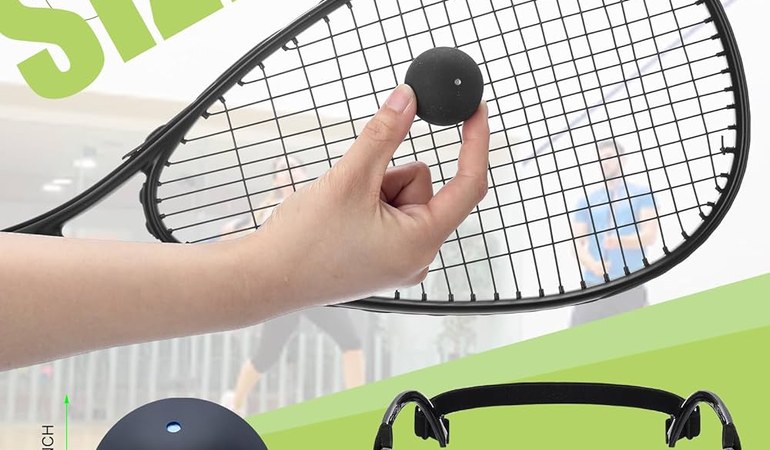
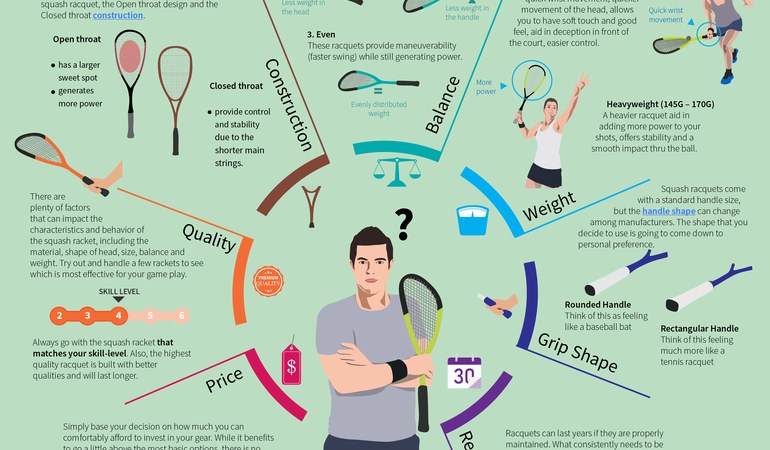
Weight affects a racket's swing speed, power, and how quickly you can react. Squash rackets vary widely in weight, from about 110 grams (very light) to 170 grams and up (very heavy). Heavier rackets generally produce more power, while lighter rackets are easier to maneuver and control.
Each weight range has its pros and cons:
- Lightweight (about 110-125g): Light rackets are easy to swing quickly. They improve maneuverability and put less strain on your arm, which helps with fast reaction shots and volleying. The trade-off is lower inherent power, so you will need a faster swing to hit hard, and very light frames can be harder for a beginner to control on off-center hits. Ultra-light models also tend to cost more because of the advanced materials involved.
- Midweight (about 130-140g): A midweight racket offers a balance between power and control. It is heavy enough to help you hit with decent power, yet light enough to maneuver reasonably easily. This versatility makes midweight rackets a popular choice for beginners and intermediate players alike.
- Heavyweight (about 145g and up): Heavier rackets generally hit harder with less effort because the extra mass carries the ball deeper. They also feel solid and stable at contact. The downside is that a heavy racket can be tiring to swing over time and slower to maneuver for quick shots. Extremely heavy rackets, above roughly 160g, are not usually recommended for beginners, as they can strain your wrist and shoulder and slow down your swing speed.
Beginner tip: Aim for the middle of the road. Many coaches suggest new players start with a medium-weight racket in roughly the 120-150 gram range. This avoids the extremes until you develop enough technique to appreciate a very light or very heavy frame.
A super-light racket might feel great in the hand but can be unforgiving if your contact is not clean, while an overly heavy one can cause fatigue or injury as you are learning. A racket around 130-140g is a safe, beginner-friendly choice that provides a comfortable mix of power and maneuverability.
Balance (Head-Heavy vs Head-Light)
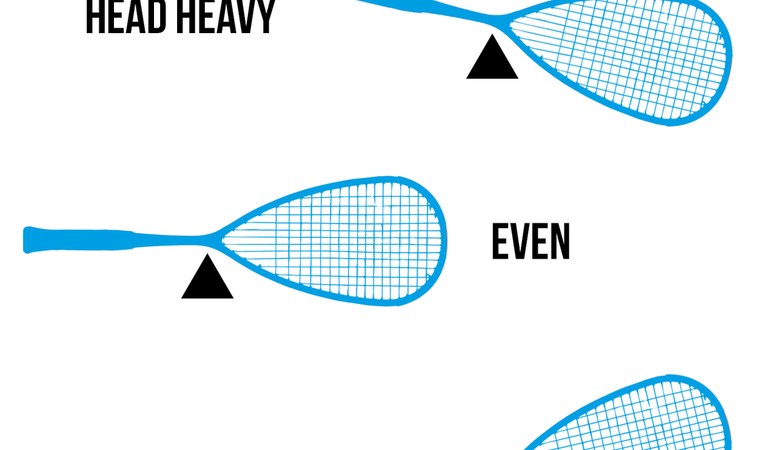
Balance refers to how the weight is distributed in the racket: toward the head, toward the handle, or evenly throughout. This affects how the racket swings and feels. There are three general categories of balance.
| Balance | Weight distribution | Strengths | Trade-offs |
|---|---|---|---|
| Head-heavy | More weight in the head | Extra momentum and power; helps you hit deep with less swing effort | Less maneuverable on quick volleys; can be taxing on the arm if technique or strength is not yet solid |
| Head-light | More weight in the handle | Very maneuverable; faster wrist action for quick reactions, volleys, and touch shots | Slightly reduced power; less forgiving of off-center hits, since a light head can twist more on impact |
| Even balance | Weight spread evenly | Neutral feel; a blend of power and control with stability and depth | Does not strongly favor either power or control, so no single standout trait |
Head-heavy: More weight is concentrated in the head of the racket. This gives your shots extra momentum and power, since the heavy head carries through the ball. A head-heavy racket helps you hit deep with less swing effort, which is useful for players who need a power boost. It can feel less maneuverable on quick volleys, though, and may be taxing on the arm if your technique or strength is not yet solid. Head-heavy rackets pack a punch but require you to control that weight.
Head-light: More weight is in the handle relative to the head. Head-light rackets feel very maneuverable and allow faster wrist action, making it easier to react quickly and to volley or play delicate touch shots. Many players find head-light rackets give them a sense of control and quick handling.
The downside is slightly reduced power, since with less mass in the head you may have to swing a bit harder to generate the same pace. Also, if you do not hit the sweet spot, a light head can cause the racket to twist more on impact, leading to a weaker shot. In other words, head-light frames are a little less forgiving of off-center hits.
Even balance: The weight is distributed evenly between the head and handle, giving a neutral feel. An even-balanced racket offers a blend of power and control, with some head weight for stability and depth but also enough maneuverability for control shots. This balance is often ideal for beginners who have not yet developed a specific playing style or preference. It lets you experiment with all aspects of your game without the racket favoring power at the expense of control, or the reverse.
Beginner tip: When in doubt, go for an even or moderate balance to start. Extreme balances can accentuate certain strengths but also magnify weaknesses. A very head-heavy racket might help you hit harder but feel clumsy on defense, whereas an ultra head-light racket might be very quick but require you to supply more power.
As a beginner, you will benefit from a more neutral feel. An even-balanced racket, or one only slightly head-heavy or head-light, will be easier to control and less likely to cause wrist strain than one with a very pronounced balance. Once you have played for a while, you can decide whether you prefer the added power of head-heavy or the quick handling of head-light, but a balanced approach is safest at first.
Head Shape and Throat Design
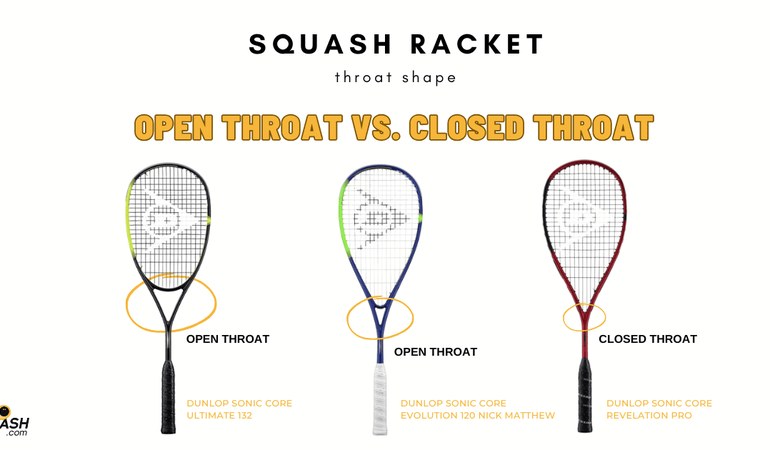
Squash rackets come in two main head shapes, also called throat designs: traditional closed-throat and teardrop open-throat. The difference lies in whether there is a bridge across the throat of the racket. This choice affects the racket's sweet spot, power, and control.
Teardrop (open-throat): In a teardrop racket, the throat area is open with no cross-bar, allowing the main strings to run longer. This creates a larger stringbed with a bigger sweet spot, which means the racket is more forgiving on off-center hits and can generate power more easily.
Beginners who struggle to hit with depth often appreciate teardrop rackets, because the ball comes off the strings with extra liveliness. The increased trampoline effect translates to hitting the ball deeper with less effort. The trade-off is that the feel can be a bit less precise, so you gain power at the expense of some fine control. Teardrop designs work well if you need a power boost and a margin for error as you learn.
Traditional (closed-throat): A traditional squash racket has a bridge in the throat, creating a triangular opening and a slightly smaller head shape. This shortens the main strings and usually gives a stiffer, more controlled feel. The sweet spot is smaller, so you will not get as much free power on off-center hits, but the payoff is greater accuracy when you strike the ball well.
Many control-oriented players like this design because it provides stability, since the frame does not flex as much, allowing more precise shot placement. For a beginner, a closed-throat racket can feel very accurate if you have good hand-eye coordination, but it is unforgiving if you miss the sweet spot, resulting in weaker hits.
How to choose? Think about what you need more as a new player: extra power or extra control. There is a general trade-off, with teardrop giving more power and traditional giving more control. If you struggle to generate enough power to get the ball to the back of the court, a teardrop racket can help by providing a livelier response. If you are naturally strong or fast and find that your shots are wild or hard to direct, you might benefit from the tighter control of a classic head shape.
There is no strict rule, and even professional tour players are split between the two designs. Use the power-versus-control guideline to decide what sounds right for you. What matters most is how the racket feels in your hand. A racket that gives you confidence, whether because it is more forgiving or more precise, is the one that will help you play your best as a beginner.
Grip Size and Comfort
A racket's grip size, the thickness of the handle, might not seem as important as weight or balance, but it matters a lot for comfort and control. If the grip is too large for your hand, you will have trouble holding the racket securely. If it is too small, you will over-squeeze the handle and the racket may twist on contact. Either extreme can lead to mishits, discomfort, or even injury, since improper grip size has been linked to tennis elbow in other racket sports.
Squash rackets are generally not made in different grip sizes. Players start with the same handle size and then build it up to suit their hand, so many adult beginners will be fine with the stock grip. Teens or players with smaller hands might find some grips a bit thick, while players with very large hands could find them too thin.
How do you know if a grip fits? A common test is to grip the racket as you normally would and check the gap between your fingertips and the base of your thumb, the fleshy part of your palm:
- Ideally your fingers will just barely touch that part of your hand, or leave a small gap of about a finger's width, when wrapped around the handle.
- If there is a big gap, the grip might be too large.
- If your fingers are digging into your palm, the grip is likely too small.
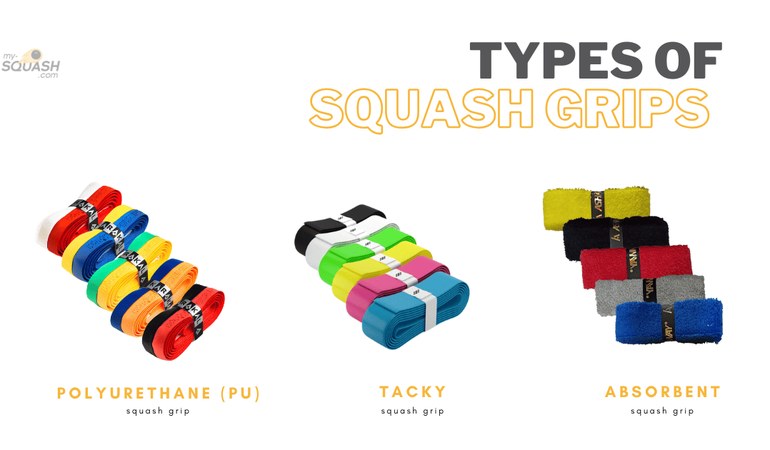
The good news is that grip size is easy to adjust. If a handle feels too small, you can build it up by adding an overgrip or a replacement grip to increase the thickness. Many players do this routinely, since rackets are often sold with relatively thin factory grips, and manufacturers tend to err on the small side knowing players can add layers.
Adding an overgrip not only customizes the size but also gives a fresh, tacky surface to hold, which improves your hold on the racket. If the grip feels too big, it is a bit trickier to fix; you can try a thinner replacement grip or remove any extra overgrips.
In practice, too-small is more common than too-big, and a lot of new rackets feel slightly thin in the handle, especially to adult men, until you build them up. So do not be afraid to re-grip your racket. It is a cheap fix and can make a real difference in comfort. A properly sized grip lets you hold the racket firmly without having to choke it, which relaxes your wrist and arm, improves your touch, and keeps the racket from twisting on ball impact.
String Tension
String tension refers to how tightly the racket's strings are strung, usually measured in pounds or kilograms. This significantly affects how the ball comes off your strings, though beginners often overlook it. The key principle is that lower tension gives more power and a softer feel, while higher tension gives more control and a crisper feel.
When strings are looser, they act like a trampoline, pocketing the ball more and returning more energy to it, which results in easier power and a larger sweet spot. The cost is that the ball's direction is a bit harder to control precisely, because the strings give more. Tighter strings deform less on impact, so you do not get as much rebound energy and thus slightly less power, but the trade-off is more accuracy, with the ball going where you aim and less springiness.
A racket strung at a low tension might feel bouncy and send the ball deep with little effort, whereas a high-tension stringbed feels firm and direct, allowing sharp shots but requiring a full swing for depth. In squash, typical string tensions sit in a mid-range of roughly 20-30 lbs.
Most rackets come pre-strung around 25-27 lbs, a comfortable middle ground for power and control, and it is usually best for beginners to stick with that moderate tension. If you get your racket restrung, you could ask for around 26 lbs as a starting point, which is close to the most common tension among players.
Should beginners worry about tension? Not too much. Some coaches compare obsessing over string tension at an early stage to a learner driver worrying about tire pressure, getting into the details before they really matter. The factory or mid-range tension will serve you well until your skill improves and you develop specific preferences.
The difference of one or two pounds of tension is subtle, and as a new player you will gain more from practicing your swing than from fine-tuning string settings. Use the general rule, looser for more power and tighter for more control, as a basic understanding, but do not stress about optimizing string tension right away. As long as your strings are in a reasonable range, not too floppy or unbearably stiff, you will be able to learn and play effectively. Later, if you start breaking strings or want specific performance tweaks, you can experiment with different tensions.
Tips for Buying Your First Racket
As you shop for your first squash racket, keep these practical tips in mind:
- Try before you buy if possible: Squash racket preferences are personal, and what feels great to someone else might not suit you. If you can, try out a couple of different rackets before deciding. Many squash clubs and sporting goods stores have demo rackets or rental programs. Feeling the differences in weight and balance in your own hand is the best way to discover what you like.
- Do not go too cheap on materials: Avoid the very cheap, old-style aluminum rackets often sold at discount stores. These tend to be heavy and twin-shaft in design, with two separate metal beams in the throat, which makes them durable but not performance-friendly. An all-aluminum racket can weigh 180g or more and will feel clunky. Instead, look for an entry-level graphite composite racket. Graphite, often mixed with other fibers, lets the racket be lighter while still strong, which greatly improves playability. Invest in the best racket you can reasonably afford, since it will make the game more enjoyable. A quick test: if a racket has two metal shafts in the throat, it is almost certainly aluminum, and you do not want that.
- Budget for a beginner racket: You do not need to spend a fortune on your first racket. There are plenty of good beginner-friendly models in the range of roughly $50 to $100 that offer durability and decent performance. More expensive rackets typically just shave off weight or add specialized features that a beginner will not miss. Start with a moderately priced racket and see how much you enjoy the game; you can always upgrade later. Established brands such as Dunlop, Tecnifibre, Head, Karakal, Prince, and Black Knight all make entry-level frames worth considering.
- Comfort over specs: Pay attention to how the racket feels when you swing it. The right choice should feel comfortable when you mimic a swing, not too heavy to control and not so light that you struggle to generate any power. For a smaller or younger player, such as a teen moving up from junior rackets, erring toward the lighter end can help with maneuverability. A stronger adult beginner might handle a slightly heavier frame for more power. In either case, you should be able to swing the racket freely without strain. A comfortable weight and grip let you focus on technique rather than fighting the equipment.
- Plan to adjust and upgrade: Your first racket does not have to be perfect in every aspect, because you can make minor tweaks. You can change the grip easily if the original is not to your liking, or restring the racket with better strings down the line. Keep in mind that as you improve and play more, your preferences may change; it is normal for players to switch to a different weight or balance as their style develops. Think of your beginner racket as a starter that helps you learn the game. After 6 to 12 months of playing, you will have a much better idea of what features you want in your next racket. So do not overthink it: pick a quality racket that fits you right now, and enjoy the game.
Conclusion
Finding the perfect squash racket as a beginner is about balance, both in the racket's properties and in the trade-offs you make. A racket that is medium in weight, with an even balance and a comfortable grip, gives you a solid all-around starting point. From there, you can refine your choice as you gain experience.
The most important thing is that your racket feels good to swing and gives you confidence on the court. As you practice and play more, you will discover what you value most, whether more power, a lighter feel, or something else, and you can move toward a racket that accentuates those strengths.
Even the best racket will not magically make you a pro; improvement comes from developing your skills. Choose a decent racket, take good care of it, and focus on learning the sport.
The simple plan: start with something in the middle, neither too heavy nor too light, do not obsess over every spec at first, and try as many rackets as you can over time to inform your future choice. With a suitable beginner racket in hand, you will be set to enjoy squash and progress in your game.