
A squash racquet's balance (how its weight is distributed along the frame) strongly affects how it plays. The swing weight (its rotational inertia about the handle) determines how heavy it feels when swung.
The three common profiles:
- Head-heavy (more mass toward the head): powerful, stable shots with less effort.
- Head-light (more mass near the handle): faster swing and more maneuverable.
- Even-balanced: a compromise between power and control.
Balance interacts with swing speed and moment of inertia: adding weight far from the handle raises swing weight sharply and slows the swing, while mass near the grip has less effect. A lab study by Cross and Bower found that swing speed falls as rotational inertia rises, so a heavier-headed racquet is harder to accelerate but can impart more momentum to the ball.
Swing Weight and Swing Dynamics
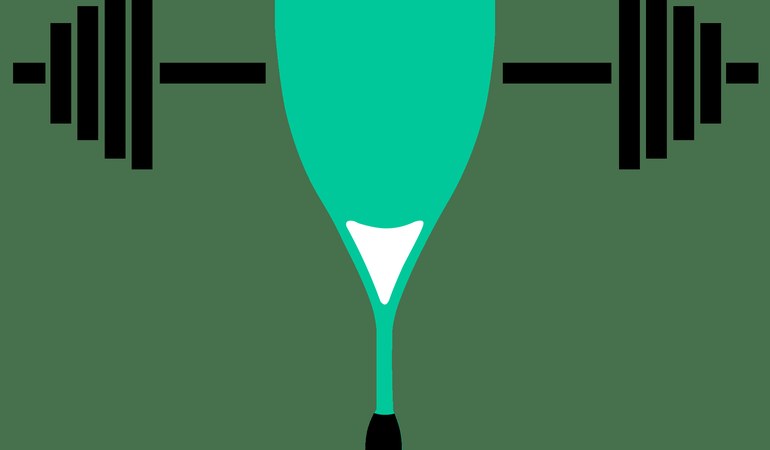
Swing weight (the second moment of mass) measures the racquet's resistance to rotation about an axis near the handle, essentially its moment of inertia, found by summing each mass element times the square of its distance from the pivot. Higher swing weight feels heavier and needs more effort to accelerate, but resists being knocked off course by the ball, giving more stability and power on impact. Low swing weight is easy to whip around for fast swings and reflex volleys, but gives up some power and stability.
High swing weight (head-heavy bias)
More mass in the head gives large rotational inertia: harder to accelerate, but once moving it delivers more energy to the ball, so even a slow swing can send the ball fast. The trade-off is more muscular effort to swing quickly and harder changes of direction.
Low swing weight (head-light bias)
More mass near the handle lowers swing weight: the racquet swings faster and is highly maneuverable, helping quick reaction shots and tight volley control. The player must generate more of the power themselves, since the ball stays in contact slightly longer and can push the racquet back.
This is the classic power-versus-control trade-off: a heavy head gives power and stability, a light head gives speed and control. Players often experiment to find the swing weight that matches their style.
Head-Heavy, Head-Light, and Even Balance
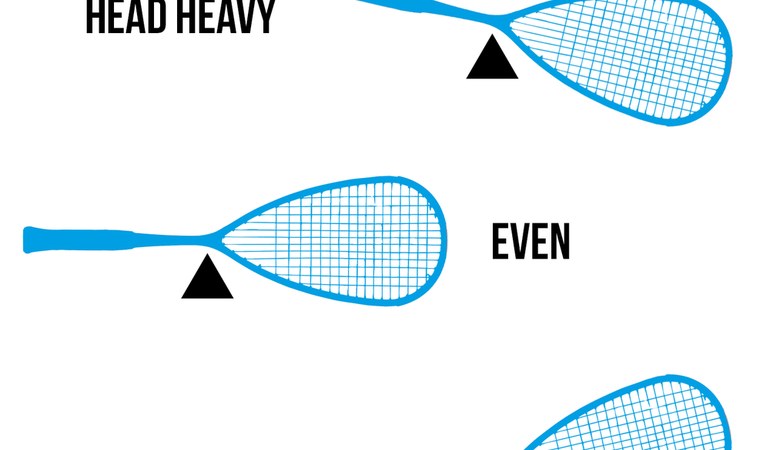
Rackets are labeled head-heavy, head-light, or even-balanced by the balance point measured from the handle:
| Balance type | Balance point from butt end | Playing character |
|---|---|---|
| Head-heavy | Above about 38 cm | More power and stability |
| Even | Around 37 cm | Compromise between power and maneuverability |
| Head-light | Below about 36 cm | More speed and maneuverability |
Head-heavy rackets carry most weight toward the top. The added inertia drives through the ball, sending shots deep with less effort and giving drives and deep kicks a solid punch. The downside is a slower swing and less nimble net play and volley reflexes. They suit a patient, length-based game or players with fluid full swings, and let less powerful players generate pace, useful for those who cannot generate much power on their own.
Head-light rackets carry more weight toward the handle, allowing quick racket-head speed and rapid direction changes. They suit aggressive volleyers, trick-shot specialists, and players who rely on anticipation and placement. The trade-off is that they do not drive through the ball as naturally, so good technique and wrist strength are needed to generate the same power.
Even-balanced rackets sit in the middle, balancing stability and maneuverability, so a player can volley and change pace easily while still getting respectable power on full swings. They suit all-court players who switch tactics mid-rally, or those upgrading from a beginner frame to a more versatile blade.
Key takeaway: head-heavy gives power and stability, head-light gives speed and maneuverability, even-balanced is a compromise. Match the racquet's balance to your swing style and typical shots.
Player Levels: Recreational vs. Professional
Recreational and beginner players often lack the technique or strength to generate power from the swing alone, so they benefit from heavier, head-heavy frames. Racquets above about 150 g provide extra power suitable for beginners (at the expense of some control), and head-heavy frames help players who struggle to hit hard, and young players until they build strength.
Advanced and professional players generate their own power through technique and body speed, so they trade some raw power for finesse, favoring lighter, head-light racquets for swing speed and touch. Lightweight frames around 110 to 130 g suit offensive play, enabling faster reactions, attacking volleys, and precise placement. As ability increases, many players gravitate toward the middle, around 120 to 130 g and even-balanced, or toward ultra-light frames for full control over placement.
At the elite level, consistency is critical: top pros often carry multiple identical rackets whose swing weights have been machine-matched by technicians, strung and balanced to a precise specification, down to grams.
Materials and Construction
Frame material strongly influences balance, weight, and stiffness. Older or cheap rackets used aluminum or steel: denser than modern composites, so frames were built thicker and were heavier, often 160 to 200 g or more, durable but inherently head-heavy unless counterweighted, and usually aimed at beginners. Most competitive players moved off aluminum by the 1980s.
Today's racquets use carbon fiber and graphite composites, with high strength-to-weight ratios: a full graphite frame can be 110 to 130 g unstrung while staying stiff. Composites let engineers tailor shaft versus head stiffness and place fibers and small metal inserts to fine-tune balance. Titanium reinforcement adds strength with minimal weight, and dense materials such as tungsten or zirconia are embedded in specific spots to shift balance without adding bulk, a little tungsten in the handle creates a head-light feel, while mass in the head increases swing weight.
Brands use proprietary composites: HEAD has used graphene to concentrate weight in the middle, Yonex developed M40X carbon fiber for extra stiffness, and Dunlop's high-end models add basalt fiber layers in the shaft for shock damping.
Materials group roughly as follows:
- Aluminum and metal frames: cheap, robust, and heavy (often above 160 g), usually head-heavy by default, and can risk arm strain for novices.
- Graphite and carbon fiber: the backbone of modern rackets, very light and stiff with precise balance. The Tecnifibre Carboflex line, for example, offers a removable bumper weight so a 125 g racket can be shifted even lighter in the head.
- Titanium and alloys: usually an additive, appearing as thin strips or mesh within a graphite matrix; lighter than aluminum and aiming to balance power and control, and able to stiffen the head or damp vibration without adding bulk.
- Other fibers: Kevlar (aramid) is sometimes wrapped around the shaft for durability; basalt or glass fibers are cheaper than carbon and can smooth out flex. These change feel more than balance.
Modern materials achieve far lower swing weights than old wooden or aluminum frames, keeping even head-heavy models reasonably quick and enabling ultra-light head-light frames. String choice also matters: heavier or thicker-gauge strings add weight to the head and shift balance upward, while a thicker grip adds weight at the handle and shifts balance head-light. In competitive play, pros often rebalance a new frame, adding lead tape or swapping bumpers, to get the exact balance they want.
Racquet Design for Different Styles and Skill Levels
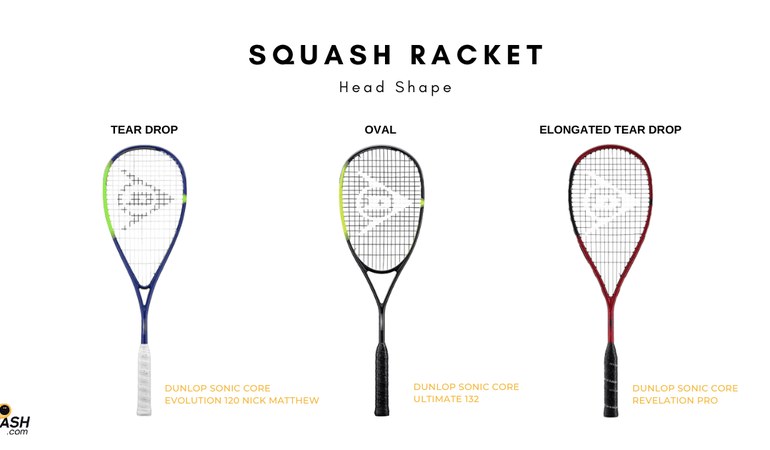
Brands tailor models to playing styles, with both head-light power models and head-heavy control models in a single lineup. Dunlop's Hyperfibre series includes the Revelation 125 (head-light, 125 g) and the Revelation Pro (head-heavy, 128 g); in a controlled test the two had nearly identical frame weight but swing weights of 175 and 195 respectively, purely due to balance. Tecnifibre's Carboflex range includes the 125S (lighter and more evenly balanced, with a detachable bumper to make it more head-light) and the 125X (slightly head-heavy for extra push). HEAD's Speed series are very light, maneuverable frames for hard hitters, while the Radical series are stiffer with balanced heft for control.
Beginners' lines emphasize forgiveness and power, sometimes with larger head sizes or reinforced frames, while advanced lines shave grams and bias the balance; some offer tungsten-insert slots so a player can tweak head or handle mass.
Coaching and expert advice echoes these trends:
- Aggressive players and rapid volleyers should go head-light for quick racquet preparation.
- Serious players should own two racquets of the same balance and specs so they can switch without changing feel.
- A slower-swing player is usually better off head-heavy for free power.
- Nominal frame weight does not tell the whole story: swing weight, which depends on balance, is what really dictates the playing feel.
Elite pros have rackets strung and measured on swing-weight machines, then adjusted by adding tape to the handle or head so that all of them feel identical.
Conclusions
A squash racquet's balance, head-heavy, head-light, or even, is a fundamental design choice that affects swing dynamics, power, and control. A head-heavy frame raises moment of inertia and swing weight for powerful, stable drives; a head-light frame lowers swing weight for a quick, agile racquet; even-balanced frames seek the middle. A heavy head is harder to maneuver but easier on the muscles for raw power, while a light head swings easily but relies on the player to generate pace.
Modern composites in carbon, graphite, and titanium allow very light overall weight and finely adjusted balance, where older metal frames were heavier and more lopsided. It is not just total weight that matters but where that weight sits, so understanding swing weight and moment of inertia lets players choose well and tweak their rackets with lead tape or removable weights. Volleyers and speed players favor light, head-light racquets, while baseliners and those needing power may prefer head-heavy models. The best racquet balance is the one that syncs with your swing and delivers comfort, confidence, and consistent results.